Shibazaki-Yorozuya Reiko, Yamada Akira, Sasaki Ryo, Watanabe Yorikatsu
From Division of Orthodontics, Incorporated Medical Institution, Yorozuya Dental Office, Tokyo, Japan.
Division of Pediatric Plastic Surgery, Northwestern University Feinberg School of Medicine, Ann & Robert H. Lurie Children's Hospital of Chicago, Chicago.
Plast Reconstr Surg Glob Open. 2024 May 28;12(5):e5810. doi: 10.1097/GOX.0000000000005810. eCollection 2024 May.
Various classifications of hemifacial microsomia (HFM) have been described previously. Although some of these classifications are used widely, others use external outlines of reference organs, even in three-dimensional (3D) images. The purpose of this study was to investigate the 3D characteristics of the mandibular condyle in HFM and to update the Pruzansky and Kaban classification as a 3D classification.
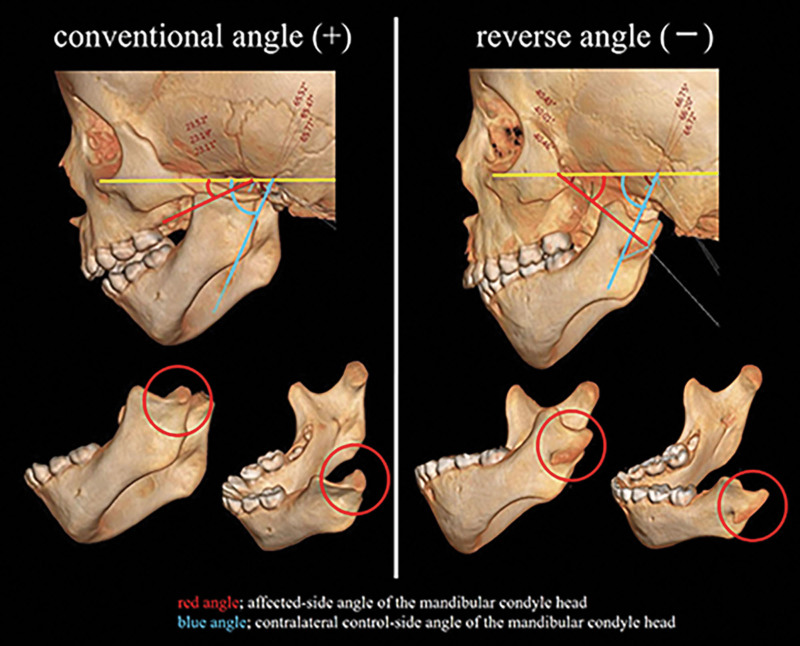
Fifty-three patients with HFM were classified according to the Pruzansky and Kaban classification (type I, IIA, IIB, and III) using computed tomographic scan images. 3D images of the mandible were isolated, and the 3D characteristics were observed; furthermore, the angle of inclination of the mandibular condyle was measured in 3D.
Subtypes of retroflexed mandibular condyle in 3D were observed in the Pruzansky and Kaban classification type IIA and IIB, termed as type IIAβ (33.3% in type IIA) and type IIBβ (100% in type IIB). Although some differences were observed in the inclination of the mandibular condyle between the control and the affected sides in type I and IIAα, multiple differences were observed in type IIAβ and IIBβ.
To the best of our knowledge, this is the first report that identified the retroflexed mandibular condyle as subtypes type IIAβ and IIBβ. Notably, this could not be identified in the two-dimensional images (lateral cephalogram) yet. We proposed to update the Pruzansky and Kaban classification as a 3D classification with a new 3D subtype. The angle of the retroflexed mandibular condyle may predict mandibular growth in HFM.
先前已描述了半侧颜面短小畸形(HFM)的各种分类。尽管其中一些分类被广泛使用,但其他分类甚至在三维(3D)图像中也使用参考器官的外部轮廓。本研究的目的是研究HFM中下颌髁突的3D特征,并更新普鲁赞斯基和卡班分类作为一种3D分类。
使用计算机断层扫描图像,根据普鲁赞斯基和卡班分类(I型、IIA、IIB和III型)对53例HFM患者进行分类。分离下颌骨的3D图像,观察其3D特征;此外,在3D中测量下颌髁突的倾斜角度。
在普鲁赞斯基和卡班分类IIA和IIB型中观察到3D中后屈下颌髁突的亚型,分别称为IIAβ型(IIA型中占33.3%)和IIBβ型(IIB型中占100%)。虽然在I型和IIAα型中,患侧和对照侧下颌髁突的倾斜度存在一些差异,但在IIAβ型和IIBβ型中观察到多个差异。
据我们所知,这是第一份将后屈下颌髁突确定为IIAβ型和IIBβ型亚型的报告。值得注意 的是,这在二维图像(侧位头影测量片)中尚未得到确认。我们建议将普鲁赞斯基和卡班分类更新为具有新3D亚型的3D分类。后屈下颌髁突的角度可能预测HFM中的下颌生长。