Immunopathology Group, Mater Research Institute-The University of Queensland, Translational Research Institute, Brisbane, Australia.
Faculty of Medicine, The University of Queensland, Brisbane, QLD, Australia.
Nat Commun. 2024 May 29;15(1):4528. doi: 10.1038/s41467-024-48317-x.
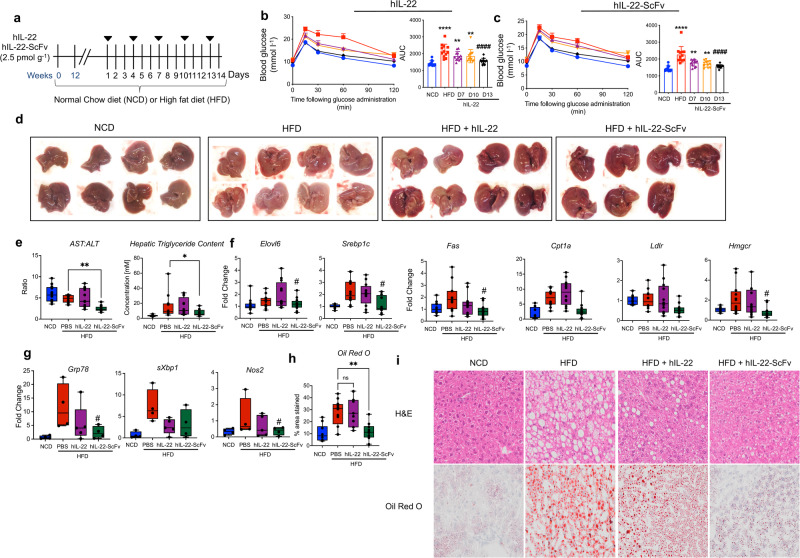
Metabolic dysfunction-associated steatohepatitis (MASH) is the most prevalent cause of liver disease worldwide, with a single approved therapeutic. Previous research has shown that interleukin-22 (IL-22) can suppress β-cell stress, reduce local islet inflammation, restore appropriate insulin production, reverse hyperglycemia, and ameliorate insulin resistance in preclinical models of diabetes. In clinical trials long-acting forms of IL-22 have led to increased proliferation in the skin and intestine, where the IL-22RA1 receptor is highly expressed. To maximise beneficial effects whilst reducing the risk of epithelial proliferation and cancer, we designed short-acting IL-22-bispecific biologic drugs that successfully targeted the liver and pancreas. Here we show 10-fold lower doses of these bispecific biologics exceed the beneficial effects of native IL-22 in multiple preclinical models of MASH, without off-target effects. Treatment restores glycemic control, markedly reduces hepatic steatosis, inflammation, and fibrogenesis. These short-acting IL-22-bispecific targeted biologics are a promising new therapeutic approach for MASH.
代谢相关脂肪性肝炎(MASH)是全球最常见的肝脏疾病病因,仅有一种已获批的治疗药物。既往研究表明白细胞介素-22(IL-22)可抑制β细胞应激,减少局部胰岛炎症,恢复适当的胰岛素产生,逆转糖尿病临床前模型中的高血糖,并改善胰岛素抵抗。在临床试验中,长效形式的 IL-22 可导致皮肤和肠道中 IL-22RA1 受体高度表达的细胞增殖增加。为了在降低上皮细胞增殖和癌症风险的同时最大化有益效果,我们设计了短半衰期的 IL-22 双特异性生物药物,这些药物可成功靶向肝脏和胰腺。在这里,我们证明这些双特异性生物药物的 10 倍低剂量在多种 MASH 的临床前模型中超过了天然 IL-22 的有益效果,没有脱靶效应。治疗可恢复血糖控制,显著减少肝脂肪变性、炎症和纤维化。这些短半衰期的 IL-22 双特异性靶向生物药物为 MASH 提供了一种有前途的新治疗方法。