Qingdao Key Laboratory of Genetic Improvement and Breeding in Horticultural Plants, Engineering Laboratory of Genetic Improvement of Horticultural Crops of Shandong Province, College of Horticulture, Qingdao Agricultural University, Qingdao, 266109, China.
Haidu College, Qingdao Agricultural University, Laiyang, 265200, China.
BMC Plant Biol. 2024 May 29;24(1):470. doi: 10.1186/s12870-024-05187-1.
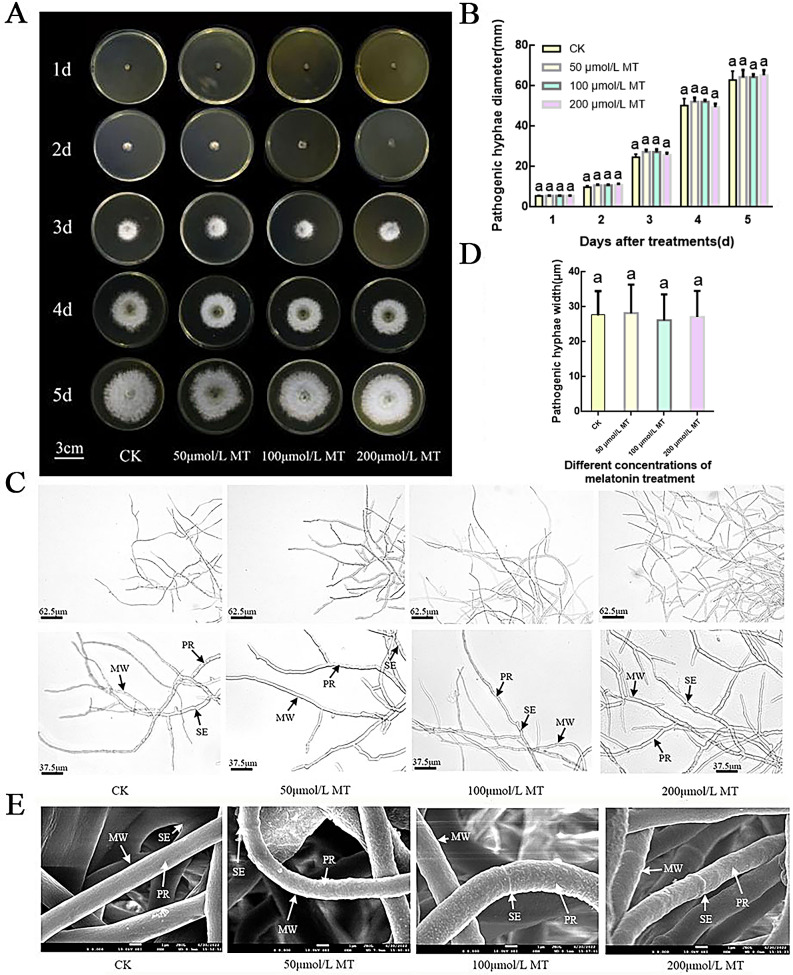
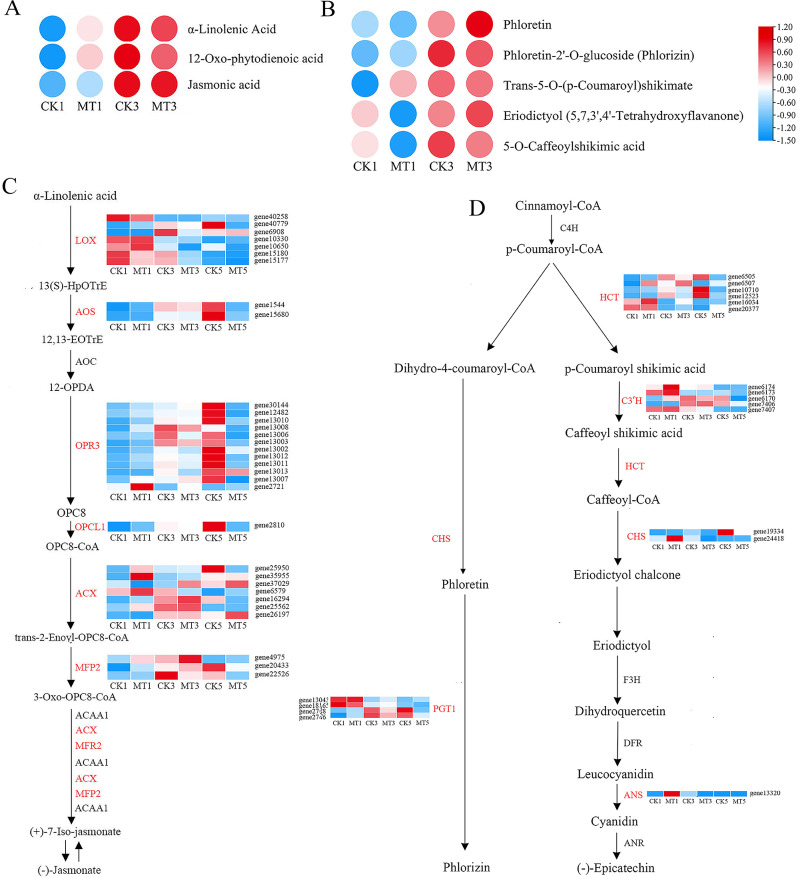
Ring rot, caused by Botryosphaeria dothidea, is an important fungal disease of pear fruit during postharvest storage. Melatonin, as a plant growth regulator, plays an important role in enhancing the stress resistance of pear fruits. It enhances the resistance of pear fruits to ring rot by enhancing their antioxidant capacity. However, the underlying mechanism remains unclear. In this study, we examined the effect of melatonin on the growth of B. dothidea. Results showed that melatonin did not limit the growth of B. dothidea during in vitro culture. However, metabolomics and transcriptomics analyses of 'Whangkeumbae' pear (Pyrus pyrifolia) revealed that melatonin increased the activity of antioxidant enzymes, including peroxidase (POD), superoxide dismutase (SOD), and polyphenol oxidase (PPO), in the fruit and activated the phenylpropanoid metabolic pathway to improve fruit resistance. Furthermore, melatonin treatment significantly increased the contents of jasmonic acid and phlorizin in pear fruit, both of which could improve disease resistance. Jasmonic acid regulates melatonin synthesis and can also promote phlorizin synthesis, ultimately improving the resistance of pear fruit to ring rot. In summary, the interaction between melatonin and jasmonic acid and phlorizin enhances the antioxidant defense response and phenylpropanoid metabolism pathway of pear fruit, thereby enhancing the resistance of pear fruit to ring rot disease. Our results provide new insights into the application of melatonin in the resistance to pear fruit ring rot.
轮纹病由 Botryosphaeria dothidea 引起,是梨果实采后贮藏期的一种重要真菌病害。褪黑素作为一种植物生长调节剂,在增强梨果实的抗逆性方面发挥着重要作用。它通过增强梨果实的抗氧化能力来增强其对轮纹病的抗性。然而,其潜在机制尚不清楚。在本研究中,我们研究了褪黑素对 B. dothidea 生长的影响。结果表明,褪黑素在体外培养过程中并没有限制 B. dothidea 的生长。然而,对‘黄金梨’(Pyrus pyrifolia)的代谢组学和转录组学分析表明,褪黑素提高了果实中抗氧化酶(包括过氧化物酶(POD)、超氧化物歧化酶(SOD)和多酚氧化酶(PPO))的活性,并激活了苯丙烷代谢途径,从而提高了果实的抗性。此外,褪黑素处理显著增加了梨果实中茉莉酸和根皮苷的含量,这两者都可以提高抗病性。茉莉酸调节褪黑素的合成,也可以促进根皮苷的合成,最终提高梨果实对轮纹病的抗性。综上所述,褪黑素与茉莉酸和根皮苷的相互作用增强了梨果实的抗氧化防御反应和苯丙烷代谢途径,从而增强了梨果实对轮纹病的抗性。我们的研究结果为褪黑素在梨果实抗轮纹病中的应用提供了新的思路。