• 文献检索
  • 文档翻译
  • 深度研究
  • 学术资讯
  • Suppr Zotero 插件Zotero 插件
  • 邀请有礼
  • 套餐&价格
  • 历史记录
应用&插件
Suppr Zotero 插件Zotero 插件浏览器插件Mac 客户端Windows 客户端微信小程序
定价
高级版会员购买积分包购买API积分包
服务
文献检索文档翻译深度研究API 文档MCP 服务
关于我们
关于 Suppr公司介绍联系我们用户协议隐私条款
关注我们

Suppr 超能文献

核心技术专利:CN118964589B侵权必究
粤ICP备2023148730 号-1Suppr @ 2026

文献检索

告别复杂PubMed语法,用中文像聊天一样搜索,搜遍4000万医学文献。AI智能推荐,让科研检索更轻松。

立即免费搜索

文件翻译

保留排版,准确专业,支持PDF/Word/PPT等文件格式,支持 12+语言互译。

免费翻译文档

深度研究

AI帮你快速写综述,25分钟生成高质量综述,智能提取关键信息,辅助科研写作。

立即免费体验

嗜酸性粒细胞增多症及嗜酸性粒细胞疾病的诊断与分类挑战:综述

The challenge of diagnosing and classifying eosinophilia and eosinophil disorders: A review.

作者信息

Szymczyk Agnieszka, Jaworski Jakub, Podhorecka Monika

机构信息

Department of Hematology, National Medical Institute of the Ministry of Interior and Administration, Warsaw, Poland.

Doctoral School, Medical University of Lublin, Poland.

出版信息

Cent Eur J Immunol. 2024;49(1):60-69. doi: 10.5114/ceji.2024.136512. Epub 2024 Apr 19.

DOI:10.5114/ceji.2024.136512
PMID:38812609
原文链接:https://pmc.ncbi.nlm.nih.gov/articles/PMC11130981/
Abstract

Eosinophilia is a feature of multiple conditions, both hematologic and non-hematologic, and may be associated with organ damage. The pathogenesis of eosinophilia can follow two distinct pathways. Primary eosinophilia is caused by a cell-intrinsic mechanism originating from clonal expansion of eosinophils through acquisition of a somatic mutation, such as FIP1L1-PDGFRA. In recent years, great progress has been made in the field of pathogenesis and molecularly targeted therapy of neoplastic eosinophilia. The diagnostic procedure should include, among other things, morphologic analysis of blood and bone marrow samples, cytogenetics and fluorescence in situ-hybridization tests to detect evidence of an acute or chronic myeloid or lymphoid disorder. Secondary eosinophilia follows a cell-extrinsic mechanism as a response to exogenous cytokines. In most clinical cases, peripheral blood eosinophilia is reactive and typically associated with non-hematological disorders such as infections, allergic conditions, connective tissue disorders, vasculitis, malignancy, or endocrinopathies. Nonetheless, the cause of most cases of hypereosinophilic syndrome remains unknown. In this article, we present a short review focused on differential diagnosis of eosinophilia and eosinophilic disorders. The diagnosis of eosinophilia is a challenge for physicians; thus this review may be useful in clinical practice.

摘要

嗜酸性粒细胞增多是多种血液系统和非血液系统疾病的一个特征,且可能与器官损害有关。嗜酸性粒细胞增多的发病机制可遵循两种不同途径。原发性嗜酸性粒细胞增多由一种细胞内在机制引起,该机制源于嗜酸性粒细胞通过获得体细胞突变(如FIP1L1-PDGFRA)进行克隆性扩增。近年来,肿瘤性嗜酸性粒细胞增多的发病机制和分子靶向治疗领域取得了重大进展。诊断程序应包括,除其他外,对血液和骨髓样本进行形态学分析、细胞遗传学和荧光原位杂交检测,以检测急性或慢性髓系或淋巴系疾病的证据。继发性嗜酸性粒细胞增多遵循细胞外在机制,作为对外源细胞因子的反应。在大多数临床病例中,外周血嗜酸性粒细胞增多是反应性的,通常与非血液系统疾病相关,如感染、过敏性疾病、结缔组织疾病、血管炎、恶性肿瘤或内分泌疾病。尽管如此,大多数高嗜酸性粒细胞综合征病例的病因仍不明。在本文中,我们简要综述了聚焦于嗜酸性粒细胞增多和嗜酸性粒细胞疾病的鉴别诊断。嗜酸性粒细胞增多的诊断对医生来说是一项挑战;因此,本综述在临床实践中可能有用。
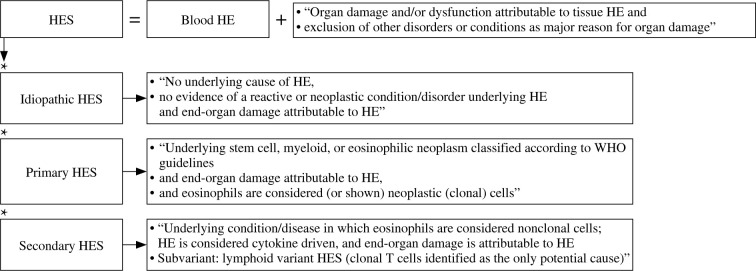
https://cdn.ncbi.nlm.nih.gov/pmc/blobs/34ee/11130981/698a728329c8/CEJI-49-52692-g003.jpg
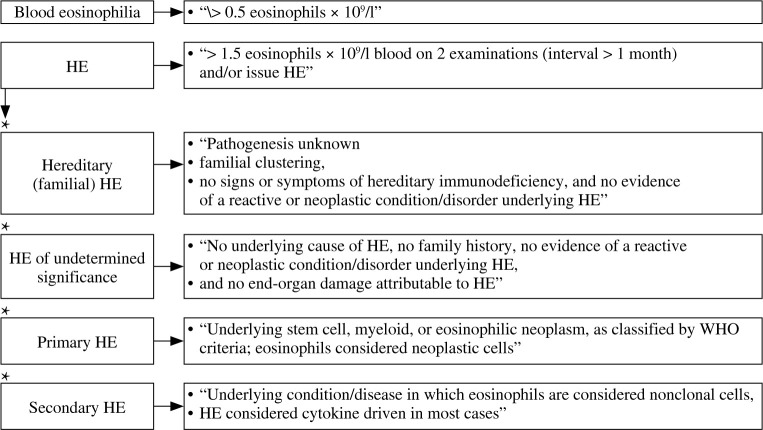
https://cdn.ncbi.nlm.nih.gov/pmc/blobs/34ee/11130981/b9f507b99c1d/CEJI-49-52692-g001.jpg
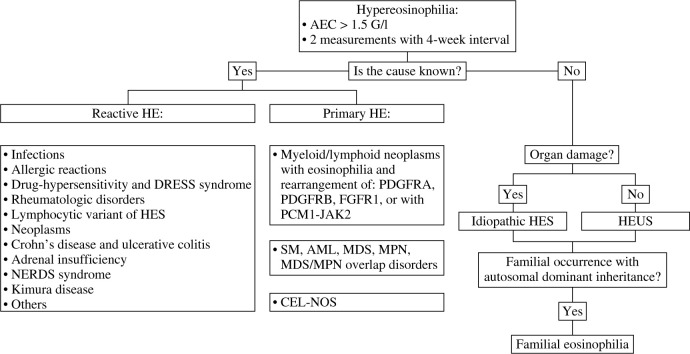
https://cdn.ncbi.nlm.nih.gov/pmc/blobs/34ee/11130981/99b7887b4a61/CEJI-49-52692-g002.jpg
https://cdn.ncbi.nlm.nih.gov/pmc/blobs/34ee/11130981/698a728329c8/CEJI-49-52692-g003.jpg
https://cdn.ncbi.nlm.nih.gov/pmc/blobs/34ee/11130981/b9f507b99c1d/CEJI-49-52692-g001.jpg
https://cdn.ncbi.nlm.nih.gov/pmc/blobs/34ee/11130981/99b7887b4a61/CEJI-49-52692-g002.jpg
https://cdn.ncbi.nlm.nih.gov/pmc/blobs/34ee/11130981/698a728329c8/CEJI-49-52692-g003.jpg

相似文献

1
The challenge of diagnosing and classifying eosinophilia and eosinophil disorders: A review.嗜酸性粒细胞增多症及嗜酸性粒细胞疾病的诊断与分类挑战:综述
Cent Eur J Immunol. 2024;49(1):60-69. doi: 10.5114/ceji.2024.136512. Epub 2024 Apr 19.
2
World Health Organization-defined eosinophilic disorders: 2019 update on diagnosis, risk stratification, and management.世界卫生组织定义的嗜酸性粒细胞疾病:2019 年诊断、风险分层和管理更新。
Am J Hematol. 2019 Oct;94(10):1149-1167. doi: 10.1002/ajh.25617.
3
World Health Organization-defined eosinophilic disorders: 2015 update on diagnosis, risk stratification, and management.世界卫生组织定义的嗜酸性粒细胞疾病:2015 年诊断、风险分层和管理更新。
Am J Hematol. 2015 Nov;90(11):1077-89. doi: 10.1002/ajh.24196.
4
World Health Organization-defined eosinophilic disorders: 2014 update on diagnosis, risk stratification, and management.世界卫生组织定义的嗜酸性粒细胞疾病:2014 年诊断、风险分层和管理更新。
Am J Hematol. 2014 Mar;89(3):325-37. doi: 10.1002/ajh.23664.
5
Pathogenesis, classification, and therapy of eosinophilia and eosinophil disorders.嗜酸性粒细胞增多症及嗜酸性粒细胞相关疾病的发病机制、分类与治疗
Blood Rev. 2009 Jul;23(4):157-65. doi: 10.1016/j.blre.2009.01.001. Epub 2009 Feb 25.
6
World Health Organization-defined eosinophilic disorders: 2017 update on diagnosis, risk stratification, and management.世界卫生组织定义的嗜酸性粒细胞疾病:2017 年诊断、风险分层和管理更新。
Am J Hematol. 2017 Nov;92(11):1243-1259. doi: 10.1002/ajh.24880.
7
World Health Organization-defined eosinophilic disorders: 2011 update on diagnosis, risk stratification, and management.世界卫生组织定义的嗜酸性粒细胞疾病:2011 年诊断、风险分层和管理更新。
Am J Hematol. 2011 Aug;86(8):677-88. doi: 10.1002/ajh.22062.
8
World Health Organization-defined eosinophilic disorders: 2022 update on diagnosis, risk stratification, and management.世界卫生组织定义的嗜酸性粒细胞疾病:诊断、风险分层和管理的 2022 年更新。
Am J Hematol. 2022 Jan 1;97(1):129-148. doi: 10.1002/ajh.26352. Epub 2021 Oct 8.
9
World Health Organization and International Consensus Classification of eosinophilic disorders: 2024 update on diagnosis, risk stratification, and management.世界卫生组织和国际嗜酸性粒细胞疾病共识分类:2024 年关于诊断、风险分层和管理的更新。
Am J Hematol. 2024 May;99(5):946-968. doi: 10.1002/ajh.27287. Epub 2024 Mar 29.
10
World Health Organization-defined eosinophilic disorders: 2012 update on diagnosis, risk stratification, and management.世界卫生组织定义的嗜酸性粒细胞疾病:诊断、危险分层和管理的 2012 年更新。
Am J Hematol. 2012 Sep;87(9):903-14. doi: 10.1002/ajh.23293.

引用本文的文献

1
Tracking Public Interest in Rare Diseases and Eosinophilic Disorders in Germany: Web Search Analysis.追踪德国公众对罕见病和嗜酸性粒细胞疾病的关注:网络搜索分析
JMIR Infodemiology. 2025 May 26;5:e69040. doi: 10.2196/69040.
2
Differential diagnosis of eosinophilic oesophagitis variants and biomarker identification: current progress.嗜酸性食管炎变体的鉴别诊断和生物标志物识别:当前进展
Cent Eur J Immunol. 2024;49(4):438-441. doi: 10.5114/ceji.2024.143996. Epub 2024 Nov 13.
3
A Challenging Case of Idiopathic Hypereosinophilic Syndrome: An Itching in the Brain.

本文引用的文献

1
Impact of MPO-ANCA-mediated oxidative imbalance on renal vasculitis.中性粒细胞明胶酶相关载脂蛋白-抗中性粒细胞胞浆抗体介导的氧化失衡对肾血管炎的影响。
Am J Physiol Renal Physiol. 2018 Dec 1;315(6):F1769-F1776. doi: 10.1152/ajprenal.00111.2018. Epub 2018 Sep 12.
2
Consultation for Elevated Blood Eosinophils: Clinical Presentations, High Value Diagnostic Tests, and Treatment Options.咨询血嗜酸性粒细胞升高:临床表现、高价值诊断检测和治疗选择。
J Allergy Clin Immunol Pract. 2018 Sep-Oct;6(5):1446-1453. doi: 10.1016/j.jaip.2018.04.030.
3
A Retrospective Analysis on the Cystic Echinococcosis Cases Occured in Northeastern Punjab Province, Pakistan.
特发性嗜酸性粒细胞增多综合征的一个具有挑战性的病例:脑部瘙痒
Cureus. 2024 Aug 20;16(8):e67278. doi: 10.7759/cureus.67278. eCollection 2024 Aug.
巴基斯坦旁遮普省东北部地区发生的囊型棘球蚴病病例回顾性分析
Korean J Parasitol. 2018 Aug;56(4):385-390. doi: 10.3347/kjp.2018.56.4.385. Epub 2018 Aug 31.
4
Drug reaction with eosinophilia and systemic symptoms (DRESS) and multiple organ dysfunction syndrome (MODS): one more reason for a new effective treatment against leishmaniasis.药物反应伴嗜酸性粒细胞增多和全身症状(DRESS)和多器官功能障碍综合征(MODS):治疗利什曼病的又一新有效方法。
Int J Dermatol. 2018 Nov;57(11):1304-1313. doi: 10.1111/ijd.14126. Epub 2018 Aug 29.
5
IgG4-related disease: why is it so important?IgG4相关性疾病:为何如此重要?
Cent Eur J Immunol. 2018;43(2):204-208. doi: 10.5114/ceji.2018.77391. Epub 2018 Jun 30.
6
Recent developments in the epidemiology, diagnosis, and treatment of Fasciola infection.肝片吸虫感染的流行病学、诊断和治疗的最新进展。
Curr Opin Infect Dis. 2018 Oct;31(5):409-414. doi: 10.1097/QCO.0000000000000482.
7
Hypereosinophilic syndrome in the differential diagnosis of pulmonary infiltrates with eosinophilia.高嗜酸性粒细胞综合征在伴有嗜酸性粒细胞肺浸润中的鉴别诊断。
Ann Allergy Asthma Immunol. 2018 Aug;121(2):179-185. doi: 10.1016/j.anai.2018.05.014. Epub 2018 May 24.
8
Unravelling the NERDS syndrome.解读NERDS综合征。
BMJ Case Rep. 2018 May 12;2018:bcr-2017-223506. doi: 10.1136/bcr-2017-223506.
9
Eosinophilic Pneumonias.嗜酸粒细胞性肺炎。
J Allergy Clin Immunol Pract. 2018 Sep-Oct;6(5):1455-1461. doi: 10.1016/j.jaip.2018.03.011. Epub 2018 May 4.
10
Eosinophil Development, Disease Involvement, and Therapeutic Suppression.嗜酸性粒细胞的发育、疾病参与和治疗抑制。
Adv Immunol. 2018;138:1-34. doi: 10.1016/bs.ai.2018.03.001. Epub 2018 Apr 22.