Dai Zhen, Qin Fuqiang, Yang Yuxing, Liang Weiming, Wang Xiao
The First Affiliated Hospital of Guangxi University of Science and Technology, Guangxi University of Science and Technology, Liuzhou, Guangxi, China.
Front Oncol. 2024 May 15;14:1303165. doi: 10.3389/fonc.2024.1303165. eCollection 2024.
Robotic radical hysterectomy (RRH) is a newly developed minimally invasive surgery that has been suggested as a substitute for laparoscopic radical hysterectomy (LRH). This meta-analysis aims to assess the clinical efficacy and safety of robot-assisted radical hysterectomy (RRH) for cervical cancer.
A systematic search was conducted in four databases (Medline, Embase, Web of Science, and CENTRAL) for studies comparing the utilization of RRH and LRH in the treatment of cervical cancer. The search included articles published from the inception of the databases up until July 18, 2023. Meta-analyses were conducted to assess several surgical outcomes, including operation time, estimated blood loss, length of hospital stay, pelvic lymph nodes, positive surgical margin, total complications, one-year recurrence rate, one-year mortality, and one-year disease-free survival rate.
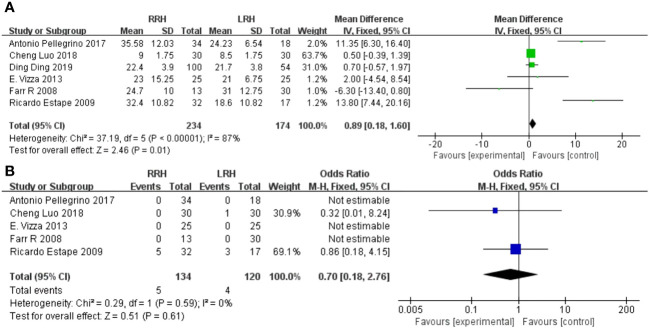
Six studies were included for meta-analysis. In total, 234 patients were in the RRH group and 174 patients were in the LRH group. RRH had significantly longer operative time (MD=14.23,95% CI:5.2723.20, P=0.002),shorter hospital stay (MD= -1.10,95% CI:-1.430.76, P <0.00001),more dissected pelvic lymph nodes(MD=0.89,95%CI:0.181.60, P =0.01) and less blood loss(WMD = -27.78,95%CI:-58.69 ~ -3.14, P=0.08, I 80%) compared with LRH. No significant difference was observed between two groups regarding positive surgical margin (OR = 0.59, 95% CI 0.182.76, P=0.61), over complications (OR = 0.77, 95% CI, 0.46-1.28, P=0.31), one-year recurrence rate (OR = 0.19, 95% CI 0.03-1.15, P=0.13), one-year mortality rate (OR = 0.19, 95% CI 0.03-1.15, P=0.07) and disease-free survival at one year (OR = 1.92, 95% CI 0.32-11.50, P=0.48).
RRH is an increasingly popular surgical method known for its high level of security and efficiency. It has many benefits in comparison to LRH, such as decreased blood loss, a higher quantity of dissected pelvic lymph nodes, and a shorter duration of hospitalization. Further multicenter, randomized controlled trials with extended follow-up durations are necessary to conclusively determine the safety and efficacy of RRH, as no significant differences were observed in terms of positive surgical margin, postoperative complications, 1-year recurrence, 1-year mortality, and 1-year disease-free survival.
PROSPERO, identifier CRD42023446653.
机器人根治性子宫切除术(RRH)是一种新开发的微创手术,被认为可替代腹腔镜根治性子宫切除术(LRH)。本荟萃分析旨在评估机器人辅助根治性子宫切除术(RRH)治疗宫颈癌的临床疗效和安全性。
在四个数据库(Medline、Embase、Web of Science和CENTRAL)中进行系统检索,以查找比较RRH和LRH在宫颈癌治疗中应用的研究。检索范围包括从数据库建立之初到2023年7月18日发表的文章。进行荟萃分析以评估多项手术结果,包括手术时间、估计失血量、住院时间、盆腔淋巴结、手术切缘阳性、总并发症、一年复发率、一年死亡率和一年无病生存率。
纳入六项研究进行荟萃分析。RRH组共有234例患者,LRH组有174例患者。与LRH相比,RRH的手术时间显著更长(MD = 14.23,95%CI:5.2723.20,P = 0.002),住院时间更短(MD = -1.10,95%CI:-1.430.76,P <0.00001),切除的盆腔淋巴结更多(MD = 0.89,95%CI:0.181.60,P = 0.01),失血量更少(WMD = -27.78,95%CI:-58.69 ~ -3.14,P = 0.08,I² = 80%)。两组在手术切缘阳性(OR = 0.59,95%CI 0.182.76,P = 0.61)、总体并发症(OR = 0.77,95%CI,0.46 - 1.28,P = 0.31)、一年复发率(OR = 0.19,95%CI 0.03 - 1.15,P = 0.13)、一年死亡率(OR = 0.19,95%CI 0.03 - 1.15,P = 0.07)和一年无病生存率(OR = 1.92,95%CI 0.32 - 11.50,P = 0.48)方面未观察到显著差异。
RRH是一种越来越受欢迎的手术方法,以其高度的安全性和效率而闻名。与LRH相比,它有许多优点,如减少失血量、切除更多的盆腔淋巴结和缩短住院时间。由于在手术切缘阳性、术后并发症、一年复发、一年死亡率和一年无病生存率方面未观察到显著差异,因此需要进一步进行多中心、随机对照试验,并延长随访时间,以最终确定RRH的安全性和疗效。
PROSPERO,标识符CRD42023446653。