Kobylkov Dmitry, Vallortigara Giorgio
Centre for Mind/Brain Science, CIMeC, University of Trento, Rovereto, Italy.
Front Neurosci. 2024 May 15;18:1404174. doi: 10.3389/fnins.2024.1404174. eCollection 2024.
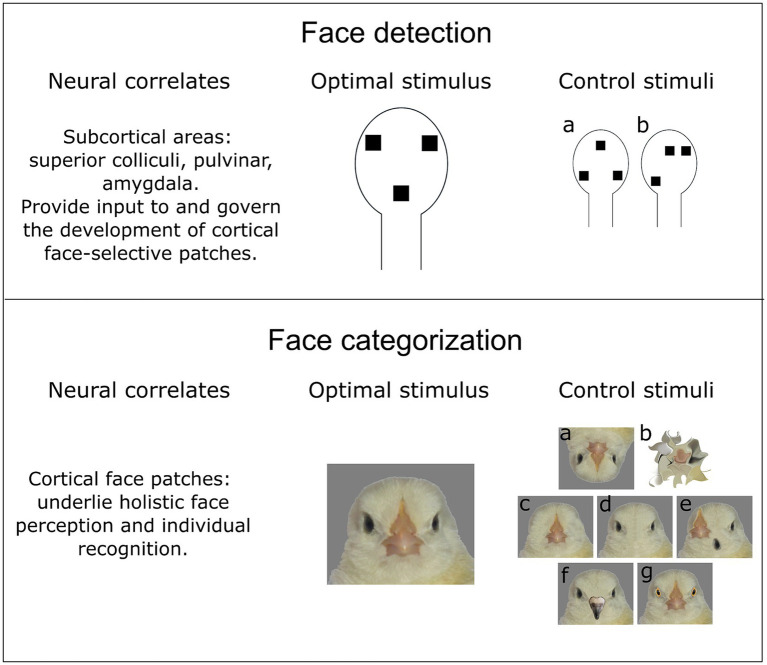
For many animals, faces are a vitally important visual stimulus. Hence, it is not surprising that face perception has become a very popular research topic in neuroscience, with 2000 papers published every year. As a result, significant progress has been made in understanding the intricate mechanisms underlying this phenomenon. However, the ontogeny of face perception, in particular the role of innate predispositions, remains largely unexplored at the neural level. Several influential studies in monkeys have suggested that seeing faces is necessary for the development of the face-selective brain domains. At the same time, behavioural experiments with newborn human babies and newly-hatched domestic chicks demonstrate that a spontaneous preference towards faces emerges early in life without pre-existing experience. Moreover, we were recently able to record face-selective neural responses in the brain of young, face-naïve chicks, thus demonstrating the existence of an innate face detection mechanism. In this review, we discuss these seemingly contradictory results and propose potential experimental approaches to resolve some of the open questions.
对于许多动物来说,面孔是至关重要的视觉刺激。因此,面孔感知已成为神经科学中一个非常热门的研究课题,每年有2000篇相关论文发表,这并不奇怪。结果,在理解这一现象背后的复杂机制方面取得了重大进展。然而,面孔感知的个体发生,特别是先天倾向的作用,在神经层面上仍 largely未被探索。猴子的几项有影响力的研究表明,看到面孔对于面孔选择性脑区的发育是必要的。与此同时,对新生儿和新孵化的家鸡进行的行为实验表明,在没有先前经验的情况下,生命早期就会出现对面孔的自发偏好。此外,我们最近能够在年幼、未接触过面孔的小鸡大脑中记录到面孔选择性神经反应,从而证明了先天面孔检测机制的存在。在这篇综述中,我们讨论了这些看似矛盾的结果,并提出了潜在的实验方法来解决一些悬而未决的问题。