Department of Pediatrics, Pediatric Endocrinology, Hospital Clínico Universitario Valladolid, Ramón y Cajal Avenue, Number 3, 47005, Valladolid, Spain.
Department of Endocrinology and Nutrition, Hospital Clínico Universitario Valladolid, Ramón y Cajal Avenue, Number 3, 47005, Valladolid, Spain.
Endocrine. 2024 Nov;86(2):539-545. doi: 10.1007/s12020-024-03881-6. Epub 2024 May 30.
To analyze the time in tight range (TITR), and its relationship with other glucometric parameters in patients with type 1 diabetes (T1D) treated with advanced hybrid closed-loop (AHCL) systems.
A prospective observational study was conducted on pediatric and adult patients with T1D undergoing treatment with AHCL systems for at least 3 months. Clinical variables and glucometric parameters before and after AHCL initiation were collected.
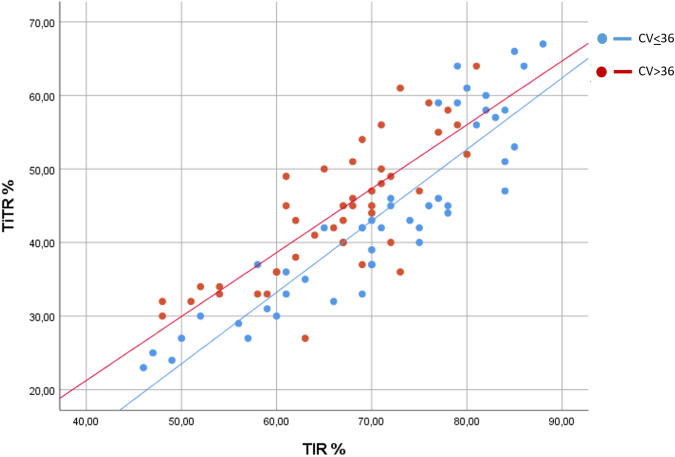
A total of 117 patients were evaluated. Comparison of metabolic control after AHCL initiation showed significant improvements in HbA1c (6.9 ± 0.9 vs. 6.6 ± 0.5%, p < 0.001), time in range (TIR) (68.2 ± 11.5 vs. 82.5 ± 6.9%, p < 0.001), TITR (43.7 ± 10.8 vs. 57.3 ± 9.7%, p < 0.001), glucose management indicator (GMI) (6.9 ± 0.4 vs. 6.6 ± 0.3%, p < 0.001), time below range (TBR) 70-54 mg/dl (4.3 ± 4.5 vs. 2.0 ± 1.4%, p < 0.001), and time above range (TAR) > 180 mg/dl (36.0 ± 7.6 vs. 15.1 ± 6.4%, p < 0.001). Coefficient of variation (CV) also improved (36.3 ± 5.7 vs. 30.6 ± 3.7, p < 0.001), while time between 140-180 mg/dl remained unchanged. In total, 76.3% achieved TITR > 50% (100% pediatric). Correlation analysis between TITR and TIR and GRI showed a strong positive correlation, modified by glycemic variability.
AHCL systems achieve significant improvements in metabolic control (TIR > 70% in 93.9% patients). The increase in TIR was not related to an increase in TIR 140-180 mg/dl. Despite being closely related to TIR, TITR allows for a more adequate discrimination of the achieved control level, especially in a population with good initial metabolic control. The correlation between TIR and TITR is directly influenced by the degree of glycemic variability.
分析 1 型糖尿病(T1D)患者使用先进混合闭环(AHCL)系统时的时间紧范围(TITR)及其与其他血糖参数的关系。
对至少接受 3 个月 AHCL 系统治疗的儿科和成年 T1D 患者进行前瞻性观察性研究。收集 AHCL 启动前后的临床变量和血糖参数。
共评估了 117 名患者。与 AHCL 启动后的代谢控制比较,HbA1c(6.9±0.9 与 6.6±0.5%,p<0.001)、时间在范围内(TIR)(68.2±11.5 与 82.5±6.9%,p<0.001)、TITR(43.7±10.8 与 57.3±9.7%,p<0.001)、血糖管理指标(GMI)(6.9±0.4 与 6.6±0.3%,p<0.001)、TBR 70-54mg/dl(4.3±4.5 与 2.0±1.4%,p<0.001)和 TAR>180mg/dl(36.0±7.6 与 15.1±6.4%,p<0.001)均有显著改善。变异系数(CV)也有所改善(36.3±5.7 与 30.6±3.7,p<0.001),而 140-180mg/dl 之间的时间保持不变。共有 76.3%的患者达到 TITR>50%(100%儿科)。TITR 与 TIR 和 GRI 之间的相关分析显示,在血糖变异性的修饰下,存在强烈的正相关。
AHCL 系统可显著改善代谢控制(93.9%的患者 TIR>70%)。TIR 的增加与 TIR 140-180mg/dl 的增加无关。尽管与 TIR 密切相关,但 TITR 可以更准确地判断所达到的控制水平,特别是在初始代谢控制良好的人群中。TIR 和 TITR 之间的相关性直接受到血糖变异性程度的影响。