Postgraduate Program in Medicine, Universidade Nove de Julho, UNINOVE, São Paulo, Brazil.
Postgraduate Program in Medicine-Biophotonics, Universidade Nove de Julho, UNINOVE, São Paulo, Brazil.
PLoS Negl Trop Dis. 2024 May 30;18(5):e0012227. doi: 10.1371/journal.pntd.0012227. eCollection 2024 May.
Photobiomodulation has exhibited promise in mitigating the local effects induced by Bothrops snakebite envenoming; however, the mechanisms underlying this protection are not yet fully understood. Herein, the effectiveness of photobiomodulation effects on regenerative response of C2C12 myoblast cells following exposure to Bothrops jararacussu venom (BjsuV), as well as the mechanisms involved was investigated.
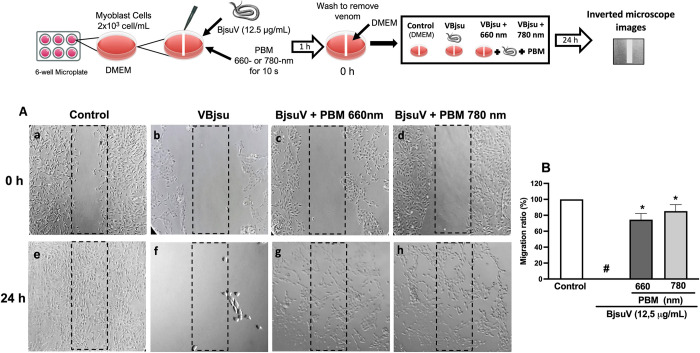
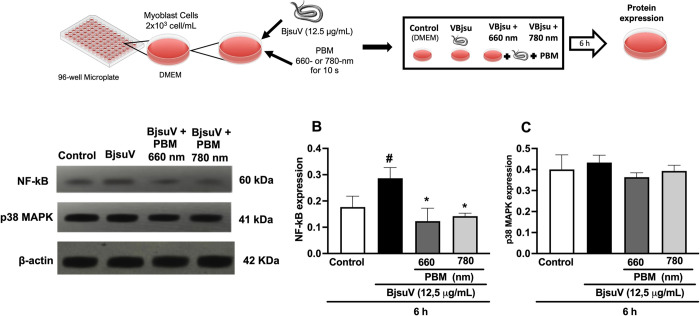
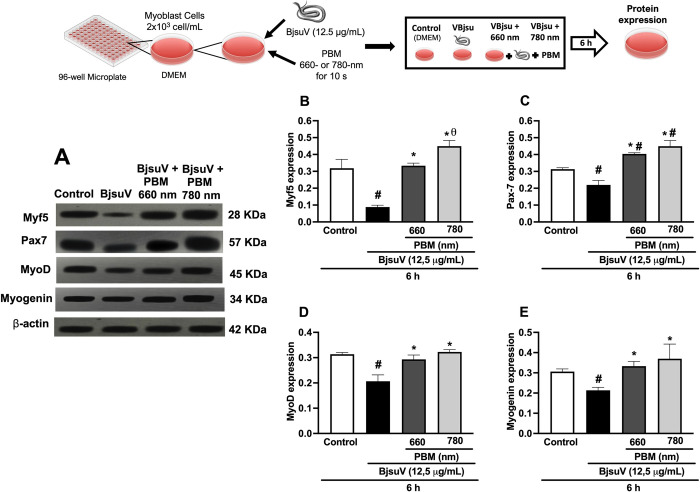
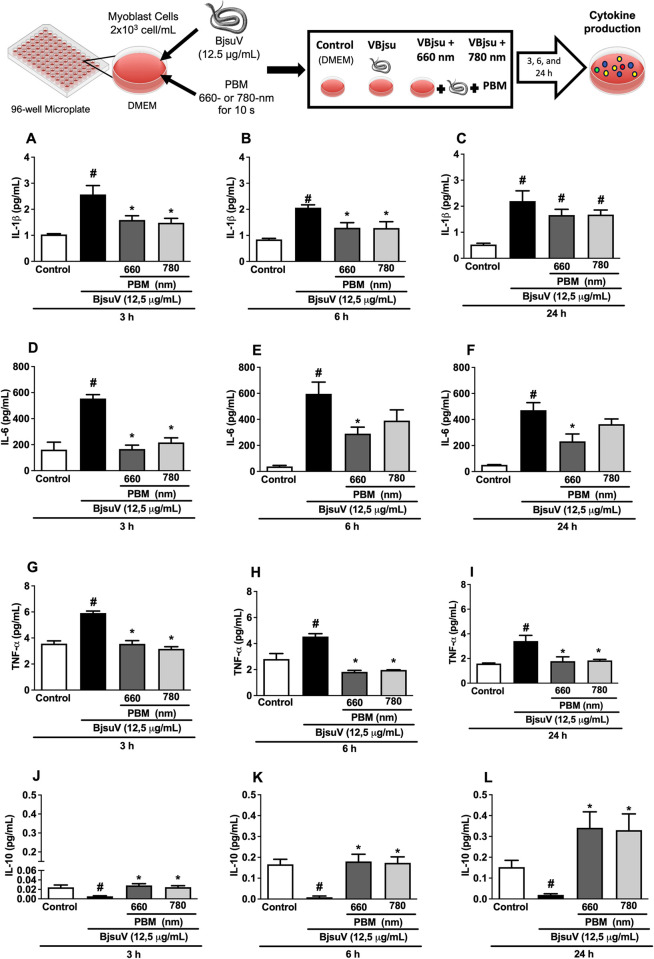
METHODOLOGY/PRINCIPAL FINDINGS: C2C12 myoblast cells were exposed to BjsuV (12.5 μg/mL) and irradiated once for 10 seconds with laser light of 660 nm (14.08 mW; 0.04 cm2; 352 mW/cm2) or 780 nm (17.6 mW; 0.04 cm2; 440 mW/ cm2) to provide energy densities of 3.52 and 4.4 J/cm2, and total energies of 0.1408 and 0.176 J, respectively. Cell migration was assessed through a wound-healing assay. The expression of MAPK p38-α, NF-Кβ, Myf5, Pax-7, MyoD, and myogenin proteins were assessed by western blotting analysis. In addition, interleukin IL1-β, IL-6, TNF-alfa and IL-10 levels were measured in the supernatant by ELISA. The PBM applied to C2C12 cells exposed to BjsuV promoted cell migration, increase the expression of myogenic factors (Pax7, MyF5, MyoD and myogenin), reduced the levels of proinflammatory cytokines, IL1-β, IL-6, TNF-alfa, and increased the levels of anti-inflammatory cytokine IL-10. In addition, PBM downregulates the expression of NF-kB, and had no effect on p38 MAKP.
CONCLUSION/SIGNIFICANCE: These data demonstrated that protection of the muscle cell by PBM seems to be related to the increase of myogenic factors as well as the modulation of inflammatory mediators. PBM therapy may offer a new therapeutic strategy to address the local effects of snakebite envenoming by promoting muscle regeneration and reducing the inflammatory process.
光生物调节已显示出在减轻巴西矛头蝮蛇咬伤引起的局部效应方面有一定效果;然而,这种保护作用的机制尚不完全清楚。在此,研究了光生物调节对 C2C12 成肌细胞在暴露于巴西矛头蝮蛇毒液(BjsuV)后的再生反应的影响及其相关机制。
方法/主要发现:将 C2C12 成肌细胞暴露于 BjsuV(12.5μg/ml)中,并使用 660nm(14.08mW;0.04cm2;352mW/cm2)或 780nm(17.6mW;0.04cm2;440mW/cm2)激光照射 10 秒,提供 3.52 和 4.4J/cm2 的能量密度和 0.1408 和 0.176J 的总能量,以评估细胞迁移。通过划痕愈合试验评估细胞迁移。通过 Western blot 分析评估 MAPK p38-α、NF-Кβ、Myf5、Pax-7、MyoD 和肌生成蛋白的表达。此外,通过 ELISA 测量上清液中白细胞介素 IL1-β、IL-6、TNF-alfa 和 IL-10 的水平。将 PBM 应用于暴露于 BjsuV 的 C2C12 细胞可促进细胞迁移,增加肌生成因子(Pax7、MyF5、MyoD 和肌生成蛋白)的表达,降低促炎细胞因子 IL1-β、IL-6、TNF-alfa 的水平,并增加抗炎细胞因子 IL-10 的水平。此外,PBM 下调 NF-kB 的表达,对 p38 MAPK 没有影响。
结论/意义:这些数据表明,PBM 对肌肉细胞的保护作用似乎与肌生成因子的增加以及炎症介质的调节有关。PBM 治疗可能为通过促进肌肉再生和减少炎症过程来解决蛇咬伤引起的局部效应提供一种新的治疗策略。