Department of Neurology, First Hospital of Shanxi Medical University, Taiyuan, China.
First Clinical Medical College, Shanxi Medical University, Taiyuan, China.
BMC Infect Dis. 2024 May 30;24(1):541. doi: 10.1186/s12879-024-09401-1.
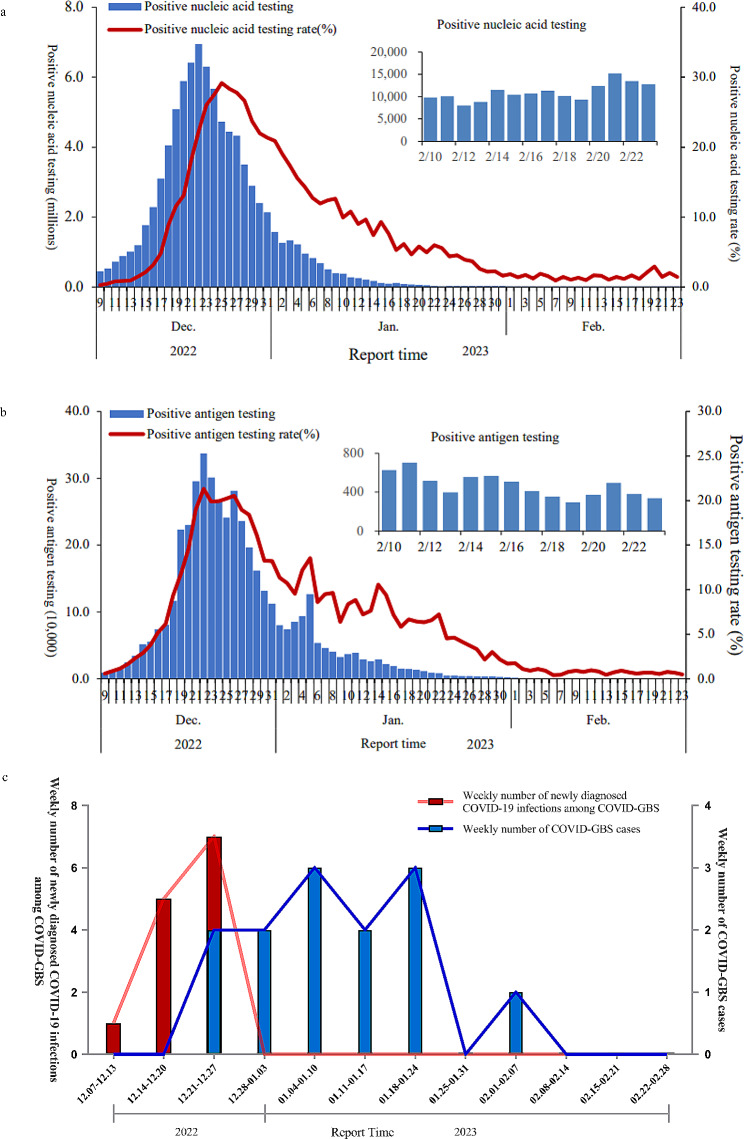
Most studies investigated the relationship between COVID-19 and Guillain-Barré syndrome (GBS) by comparing the incidence of GBS before and during the pandemic of COVID-19. However, the findings were inconsistent, probably owing to varying degrees of the lockdown policy. The quarantine requirements and travel restrictions in China were lifted around December 7, 2022. This study aimed to explore whether the relative frequency of GBS increased during the major outbreak in the absence of COVID-19-mandated social restrictions in China.
GBS patients admitted to the First Hospital, Shanxi Medical University, from December 7, 2022 to February 20, 2023, and from June, 2017 to August, 2019 were included. The relative frequencies of GBS in hospitalized patients during different periods were compared. The patients with and without SARS-CoV-2 infection within six weeks prior to GBS onset formed the COVID-GBS group and non-COVID-GBS group, respectively.
The relative frequency of GBS among hospitalized patients during the major outbreak of COVID-19 (13/14,408) was significantly higher than that before the COVID-19 epidemic (29/160,669, P < 0.001). More COVID-GBS patients (11/13) presented AIDP subtype than non-COVID-GBS cases (10/27, P = 0.003). The mean interval between onset of infective symptoms and GBS was longer in COVID-GBS (21.54 ± 11.56 days) than in non-COVID-GBS (5.76 ± 3.18 days, P < 0.001).
COVID-19 significantly increased the incidence of GBS. Most COVID-GBS patients fell into the category of AIDP, responded well to IVIg, and had a favorable prognosis.
大多数研究通过比较 COVID-19 大流行前后 GBS 的发病率来探讨 COVID-19 与 GBS 之间的关系。然而,研究结果并不一致,可能是由于封锁政策的程度不同。中国的隔离要求和旅行限制于 2022 年 12 月 7 日左右取消。本研究旨在探讨在中国 COVID-19 强制社交限制取消后,主要疫情期间 GBS 的相对频率是否增加。
纳入 2022 年 12 月 7 日至 2023 年 2 月 20 日和 2017 年 6 月至 2019 年 8 月期间在山西医科大学第一医院住院的 GBS 患者。比较不同时期住院患者 GBS 的相对频率。发病前 6 周内有 SARS-CoV-2 感染的患者分别为 COVID-GBS 组和非 COVID-GBS 组。
COVID-19 大流行期间住院患者 GBS 的相对频率(13/14,408)明显高于疫情前(29/160,669,P<0.001)。与非 COVID-GBS 病例(10/27,P=0.003)相比,更多的 COVID-GBS 患者(11/13)表现为 AIDP 亚型。COVID-GBS 患者(21.54±11.56 天)发病前感染症状至 GBS 的平均间隔时间长于非 COVID-GBS 患者(5.76±3.18 天,P<0.001)。
COVID-19 显著增加了 GBS 的发病率。大多数 COVID-GBS 患者归入 AIDP 型,对 IVIg 反应良好,预后良好。