Medical Genetics, Department of Precision Medicine, University of Campania 'Luigi Vanvitelli', Naples, Italy.
Medical Genetics, Department of Precision Medicine, University of Campania 'Luigi Vanvitelli', Naples, Italy; Eye Clinic, Multidisciplinary Department of Medical, Surgical and Dental Sciences, University of Campania 'Luigi Vanvitelli', Naples, Italy.
HGG Adv. 2024 Jul 18;5(3):100314. doi: 10.1016/j.xhgg.2024.100314. Epub 2024 May 29.
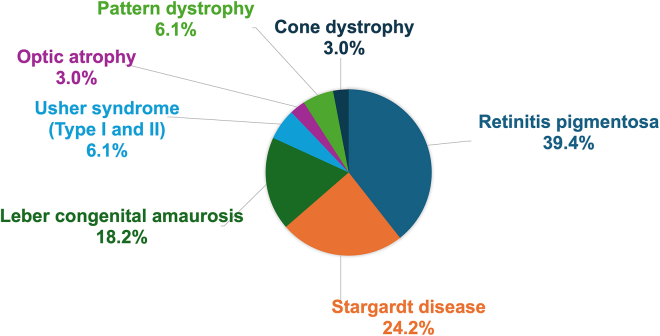
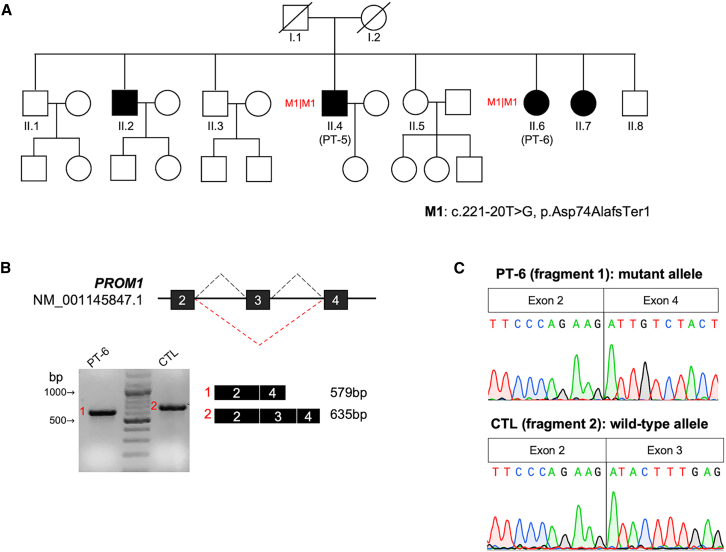
Inherited retinal diseases (IRDs) are a group of rare monogenic diseases with high genetic heterogeneity (pathogenic variants identified in over 280 causative genes). The genetic diagnostic rate for IRDs is around 60%, mainly thanks to the routine application of next-generation sequencing (NGS) approaches such as extensive gene panels or whole exome analyses. Whole-genome sequencing (WGS) has been reported to improve this diagnostic rate by revealing elusive variants, such as structural variants (SVs) and deep intronic variants (DIVs). We performed WGS on 33 unsolved cases with suspected autosomal recessive IRD, aiming to identify causative genetic variants in non-coding regions or to detect SVs that were unexplored in the initial screening. Most of the selected cases (30 of 33, 90.9%) carried monoallelic pathogenic variants in genes associated with their clinical presentation, hence we first analyzed the non-coding regions of these candidate genes. Whenever additional pathogenic variants were not identified with this approach, we extended the search for SVs and DIVs to all IRD-associated genes. Overall, we identified the missing causative variants in 11 patients (11 of 33, 33.3%). These included three DIVs in ABCA4, CEP290 and RPGRIP1; one non-canonical splice site (NCSS) variant in PROM1 and three SVs (large deletions) in EYS, PCDH15 and USH2A. For the previously unreported DIV in CEP290 and for the NCCS variant in PROM1, we confirmed the effect on splicing by reverse transcription (RT)-PCR on patient-derived RNA. This study demonstrates the power and clinical utility of WGS as an all-in-one test to identify disease-causing variants missed by standard NGS diagnostic methodologies.
遗传性视网膜疾病(IRDs)是一组罕见的单基因疾病,具有高度的遗传异质性(已鉴定出超过 280 个致病基因的变异)。IRDs 的基因诊断率约为 60%,主要得益于下一代测序(NGS)方法的常规应用,如广泛的基因panel 或全外显子分析。全基因组测序(WGS)已被报道可通过揭示难以捉摸的变异(如结构变异(SVs)和深内含子变异(DIVs))来提高这一诊断率。我们对 33 例疑似常染色体隐性遗传 IRD 的未解决病例进行了 WGS,旨在鉴定非编码区的致病遗传变异,或检测在初始筛选中未探索的 SVs。大多数选定的病例(33 例中的 30 例,90.9%)携带与其临床表现相关的基因的单等位基因致病性变异,因此我们首先分析了这些候选基因的非编码区。如果通过这种方法没有发现其他致病性变异,我们将对所有与 IRD 相关的基因进行 SVs 和 DIVs 的搜索。总的来说,我们在 11 名患者(33 名中的 11 名,33.3%)中鉴定出了缺失的致病变异。这些变异包括 ABCA4、CEP290 和 RPGRIP1 中的三个 DIV;PROM1 中的一个非典型剪接位点(NCSS)变异和 EYS、PCDH15 和 USH2A 中的三个 SV(大片段缺失)。对于 CEP290 中的先前未报道的 DIV 和 PROM1 中的 NCSS 变异,我们通过对患者来源的 RNA 进行逆转录(RT)-PCR 证实了其对剪接的影响。这项研究证明了 WGS 作为一种一站式检测方法的强大功能和临床应用价值,可识别标准 NGS 诊断方法遗漏的致病变异。