Faculty of Chemistry, Biotechnology and Food Science, Norwegian University of Life Sciences, Ås, Norway.
Division of Host-Microbe Systems & Therapeutics, Department of Pediatrics, UC San Diego School of Medicine, La Jolla, California, USA.
Microbiol Spectr. 2024 Jul 2;12(7):e0054624. doi: 10.1128/spectrum.00546-24. Epub 2024 May 31.
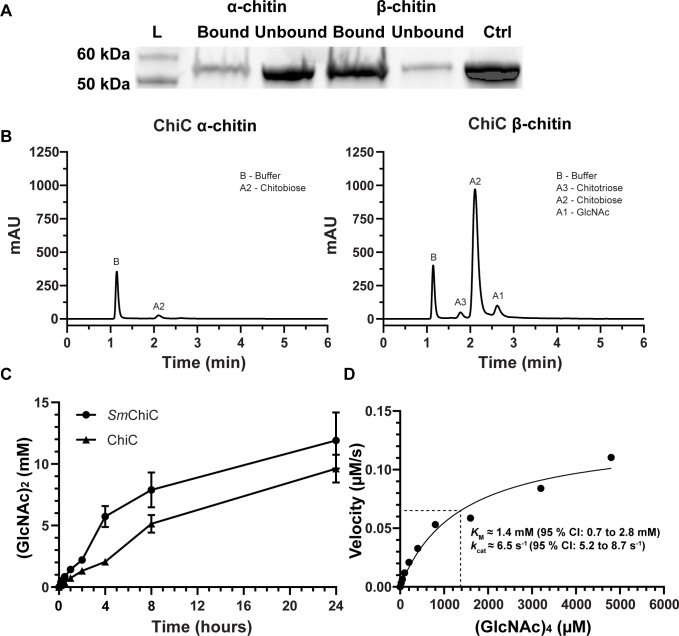
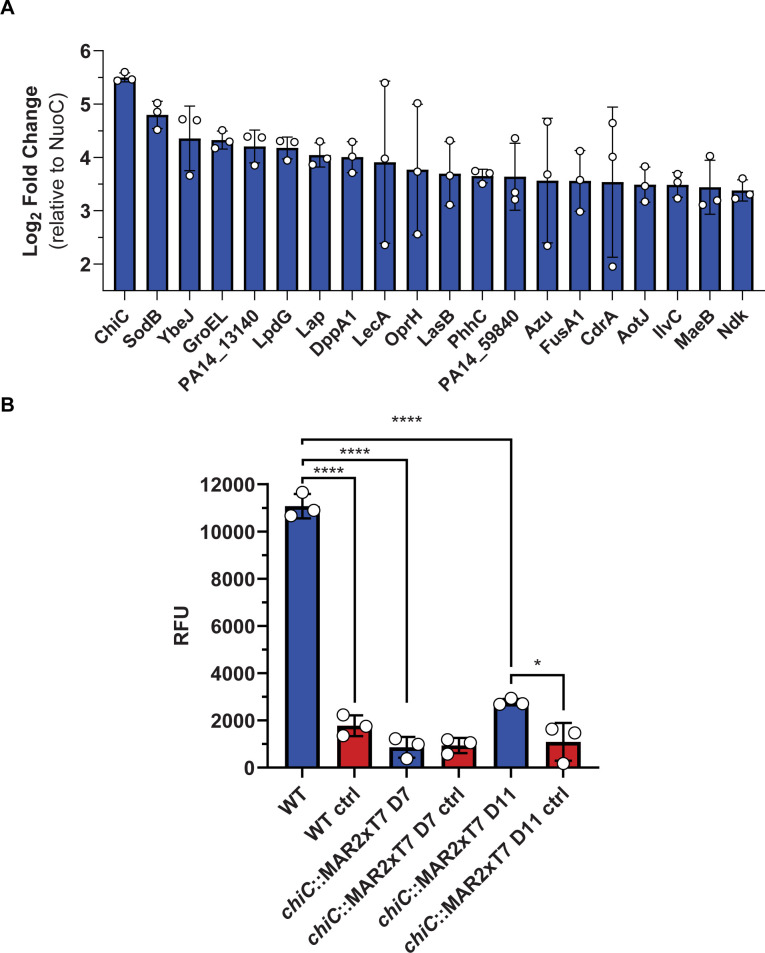
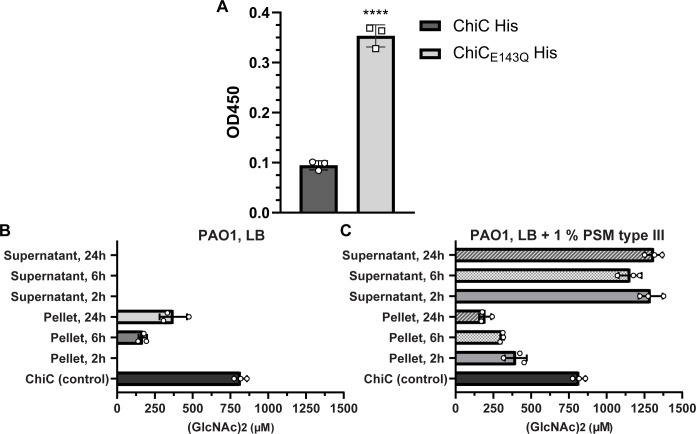
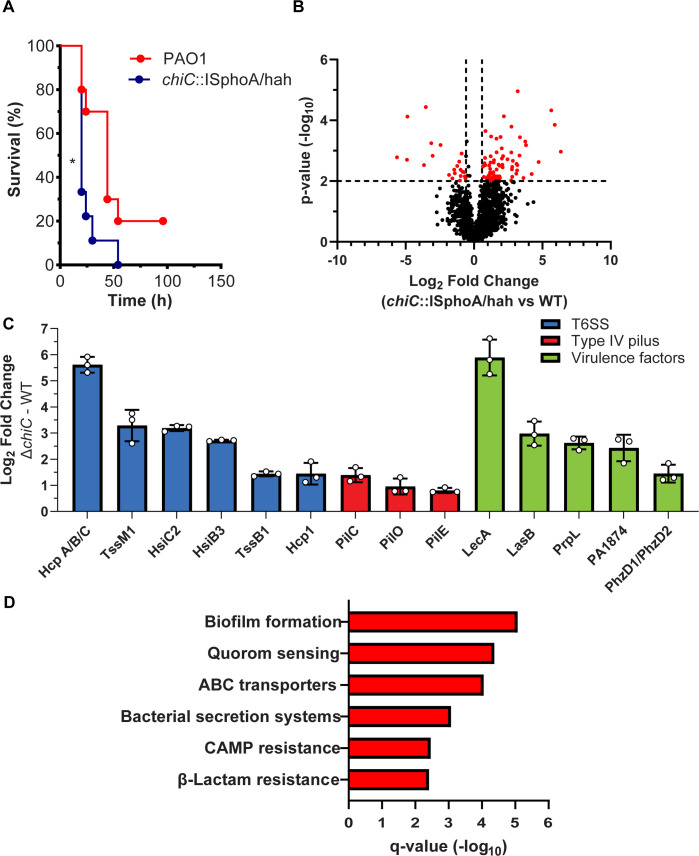
Chitinases are ubiquitous enzymes involved in biomass degradation and chitin turnover in nature. (PA), an opportunistic human pathogen, expresses ChiC, a secreted glycoside hydrolase 18 family chitinase. Despite speculation about ChiC's role in PA disease pathogenesis, there is scant evidence supporting this hypothesis. Since PA cannot catabolize chitin, we investigated the potential function(s) of ChiC in PA pathophysiology. Our findings show that ChiC exhibits activity against both insoluble (α- and β-chitin) and soluble chitooligosaccharides. Enzyme kinetics toward (GlcNAc) revealed a of 6.50 s and a of 1.38 mM, the latter remarkably high for a canonical chitinase. In our label-free proteomics investigation, ChiC was among the most abundant proteins in the Pel biofilm, suggesting a potential contribution to PA biofilm formation. Using an intratracheal challenge model of PA pneumonia, the ::ISphoA/hah transposon insertion mutant paradoxically showed slightly increased virulence compared to the wild-type parent strain. Our results indicate that ChiC is a genuine chitinase that contributes to a PA pathoadaptive pathway.IMPORTANCEIn addition to performing chitin degradation, chitinases from the glycoside hydrolase 18 family have been found to play important roles during pathogenic bacterial infection. is an opportunistic pathogen capable of causing pneumonia in immunocompromised individuals. Despite not being able to grow on chitin, the bacterium produces a chitinase (ChiC) with hitherto unknown function. This study describes an in-depth characterization of ChiC, focusing on its potential contribution to the bacterium's disease-causing ability. We demonstrate that ChiC can degrade both polymeric chitin and chitooligosaccharides, and proteomic analysis of biofilm revealed an abundance of ChiC, hinting at a potential role in biofilm formation. Surprisingly, a mutant strain incapable of ChiC production showed higher virulence than the wild-type strain. While ChiC appears to be a genuine chitinase, further investigation is required to fully elucidate its contribution to virulence, an important task given the evident health risk posed by this bacterium.
几丁质酶是一种普遍存在的酶,参与自然界中生物质的降解和几丁质的转化。(PA)是一种机会性病原体,表达 ChiC,一种分泌的糖苷水解酶 18 家族几丁质酶。尽管人们推测 ChiC 在 PA 疾病发病机制中的作用,但几乎没有证据支持这一假说。由于 PA 不能分解几丁质,我们研究了 ChiC 在 PA 病理生理学中的潜在功能。我们的研究结果表明,ChiC 对不溶性(α-和β-几丁质)和可溶性壳寡糖都具有活性。对(GlcNAc)的酶动力学研究表明,的半衰期为 6.50 秒,的半衰期为 1.38mM,对于典型的几丁质酶来说,后者非常高。在我们的无标记蛋白质组学研究中,ChiC 是 Pel 生物膜中最丰富的蛋白质之一,这表明它可能有助于 PA 生物膜的形成。使用 PA 肺炎的气管内挑战模型,::ISphoA/hah 转座子插入突变体与野生型亲本菌株相比,其毒力反而略有增加。我们的结果表明,ChiC 是一种真正的几丁质酶,有助于 PA 的病理适应途径。
重要性
除了进行几丁质降解外,糖苷水解酶 18 家族的几丁质酶还被发现在致病性细菌感染过程中发挥重要作用。 是一种机会性病原体,能够在免疫功能低下的个体中引起肺炎。尽管不能在几丁质上生长,但细菌产生了一种具有未知功能的几丁质酶(ChiC)。本研究对 ChiC 进行了深入的表征,重点研究了其对细菌致病能力的潜在贡献。我们证明 ChiC 可以降解聚合物几丁质和壳寡糖,并且 Pel 生物膜的蛋白质组学分析显示 ChiC 丰富,暗示其在生物膜形成中可能发挥作用。令人惊讶的是,无法产生 ChiC 的突变菌株比野生型菌株的毒力更高。虽然 ChiC 似乎是一种真正的几丁质酶,但需要进一步研究才能充分阐明其对 毒力的贡献,鉴于这种细菌明显存在健康风险,这是一项重要任务。