Department of Physiotherapy, Trinity College Dublin, Dublin, Ireland.
Trinity St James's Cancer Institute, Dublin, Ireland.
Support Care Cancer. 2024 May 31;32(6):399. doi: 10.1007/s00520-024-08574-4.
Exercise prehabilitation aims to increase preoperative fitness, reduce post-operative complications, and improve health-related quality of life. For prehabilitation to work, access to an effective programme which is acceptable to stakeholders is vital. The aim was to explore acceptability of exercise prehabilitation before cancer surgery among key stakeholders specifically patients, family members and healthcare providers.
A mixed-methods approach (questionnaire and semi-structured interview) underpinned by the Theoretical Framework of Acceptability was utilised. Composite acceptability score, (summation of acceptability constructs and a single-item overall acceptability construct), and median of each construct was calculated. Correlation analysis between the single-item overall acceptability and each construct was completed. Qualitative data was analysed using deductive and inductive thematic analysis.
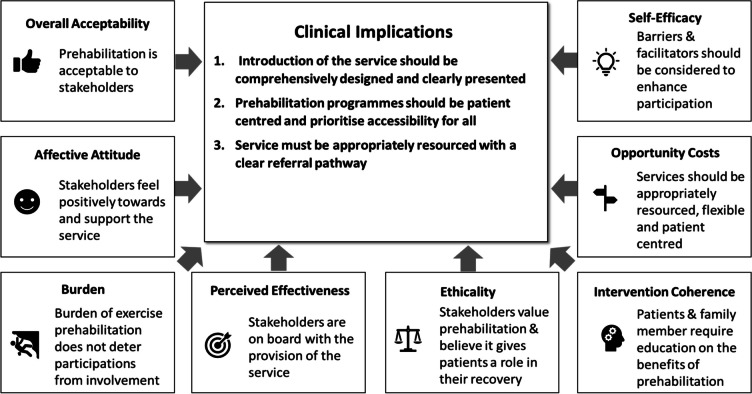
244 participants completed the questionnaire and n=31 completed interviews. Composite acceptability was comparable between groups (p=0.466). Four constructs positively correlated with overall acceptability: affective attitude (r=0.453), self-efficacy (r=0.399), ethicality (r=0.298) and intervention coherence (r=0.281). Qualitative data confirmed positive feelings, citing psychological benefits including a sense of control. Participants felt flexible prehabilitation program would be suitable for everyone, identifying barriers and facilitators to reduce burden.
Exercise prehabilitation is highly acceptable to key stakeholders. Despite some burden, it is a worthwhile and effective intervention. Stakeholders understand its purpose, are confident in patients' ability to participate, and regard it is an important intervention contributing to patients' psychological and physical wellbeing.
•Introduction should be comprehensively designed and clearly presented, providing appropriate information and opportunity for questions. •Programmes should be patient-centred, designed to overcome barriers and address patients' specific needs and goals. •Service must be appropriately resourced with a clear referral-pathway.
运动康复旨在提高术前体能,减少术后并发症,提高与健康相关的生活质量。为了使康复发挥作用,获得一个对利益攸关方具有吸引力的有效方案至关重要。本研究旨在探讨癌症手术前患者、家属和医护人员等主要利益攸关方对运动康复的可接受性。
采用基于可接受性理论框架的混合方法(问卷调查和半结构化访谈)。计算综合可接受性评分(可接受性结构的总和和一个整体可接受性结构的单项评分)和每个结构的中位数。完成单项整体可接受性与每个结构之间的相关性分析。使用演绎和归纳主题分析对定性数据进行分析。
244 名参与者完成了问卷调查,31 名参与者完成了访谈。组间综合可接受性相当(p=0.466)。四个结构与整体可接受性呈正相关:情感态度(r=0.453)、自我效能(r=0.399)、道德(r=0.298)和干预一致性(r=0.281)。定性数据证实了积极的感觉,包括控制感等心理收益。参与者认为灵活的康复计划适合每个人,确定了减少负担的障碍和促进因素。
运动康复对主要利益攸关方具有高度可接受性。尽管存在一些负担,但它是一种有价值且有效的干预措施。利益攸关方了解其目的,对患者参与的能力有信心,并认为这是一项重要的干预措施,有助于患者的心理和身体健康。
方案的引入应全面设计并清晰呈现,提供适当的信息和提问机会。
方案应以患者为中心,旨在克服障碍,满足患者的特定需求和目标。
服务必须有适当的资源,并提供明确的转诊途径。