Te Aka Mātuatua - School of Science, The University of Waikato, Hamilton, New Zealand.
Parasitol Res. 2024 May 31;123(6):228. doi: 10.1007/s00436-024-08241-x.
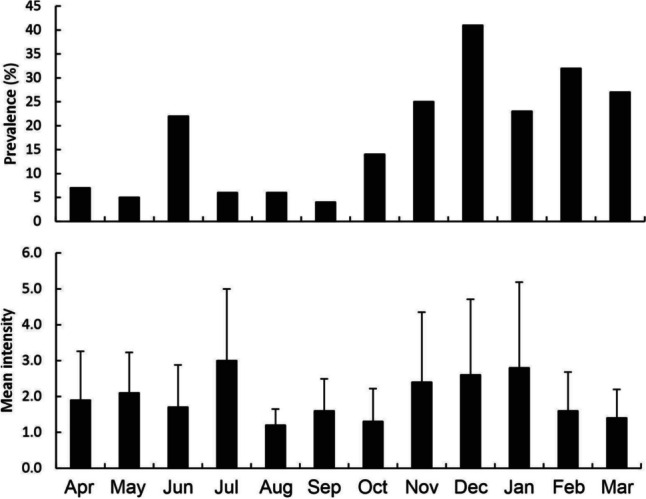
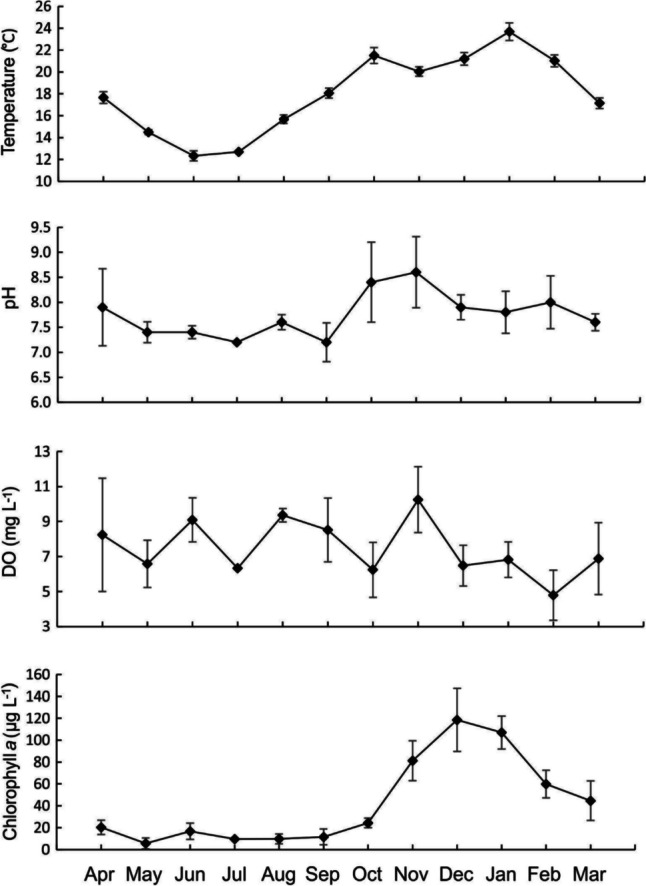
A number of studies have been conducted on monogenean seasonality, though primarily in continental regions with wide annual temperatures ranges. We investigated seasonal changes in the prevalence and intensity of Salsuginus seculus infesting sexually dimorphic western mosquitofish (Gambusia affinis) in New Zealand. This represents the first examination of seasonality for this species globally, and the first seasonal assessment of any monogenean population in New Zealand, a temperate country with a mild oceanic climate. Prevalence and intensity of S. seculus with respect to fish size and sex was also examined. Prevalence of S. seculus changed temporally, peaking in summer, and was strongly positively correlated with algal concentrations. This relationship may be associated with increasing food levels, leading to an increase in fish courting and mating, resulting in high numbers and close physical associations of G. affinis individuals, facilitating transmission of the monogeneans. Thus, biotic factors may be important in determining temporal changes in S. seculus prevalence in New Zealand. Female G. affinis had a significantly higher prevalence and mean intensity of S. seculus than males. Longer fish had a higher mean intensity and prevalence of S. seculus. Female G. affinis likely host disproportionately more monogeneans as they are larger than males. Alternatively, females may have a compromised immune response during reproductive periods. Overall, seasonal change was observed in S. seculus prevalence and intensity under New Zealand's mild climatic conditions, and the larger female G. affinis in this dimorphic species supported a greater prevalence and intensity of infestation than males.
已有多项关于单殖吸虫季节性的研究,但主要集中在大陆地区,这些地区的年温差较大。我们调查了在新西兰,具有性二态性的西部食蚊鱼(Gambusia affinis)感染 Salsuginus seculus 的流行率和强度的季节性变化。这代表了对该物种的全球首次季节性检查,也是对新西兰任何单殖吸虫种群的首次季节性评估,新西兰是一个气候温和的海洋性气候的温带国家。我们还检查了 S. seculus 相对于鱼体大小和性别变化的流行率和强度。S. seculus 的流行率随时间而变化,夏季达到高峰,并与藻类浓度呈强烈正相关。这种关系可能与食物水平的增加有关,从而导致鱼类求偶和交配的增加,导致大量 G. affinis 个体紧密的身体接触,促进了单殖吸虫的传播。因此,生物因素可能在决定新西兰 S. seculus 流行率的时间变化方面很重要。雌性 G. affinis 的 S. seculus 流行率和平均强度显著高于雄性。体型较大的鱼具有更高的平均强度和流行率。雌性 G. affinis 可能宿主的单殖吸虫数量不成比例地更多,因为它们比雄性大。或者,雌性在繁殖期间可能会受到免疫反应的影响。总体而言,在新西兰温和的气候条件下,观察到了 S. seculus 流行率和强度的季节性变化,而这种具有二态性的物种中体型较大的雌性 G. affinis 比雄性更容易感染 S. seculus,感染的流行率和强度更高。