Department of Mathematical Sciences, University of Bath, Bath BA2 7AY, UK
Department of Integrative Biology, University of California, Berkeley, CA, USA.
Proc Biol Sci. 2018 Jun 27;285(1881). doi: 10.1098/rspb.2018.0844.
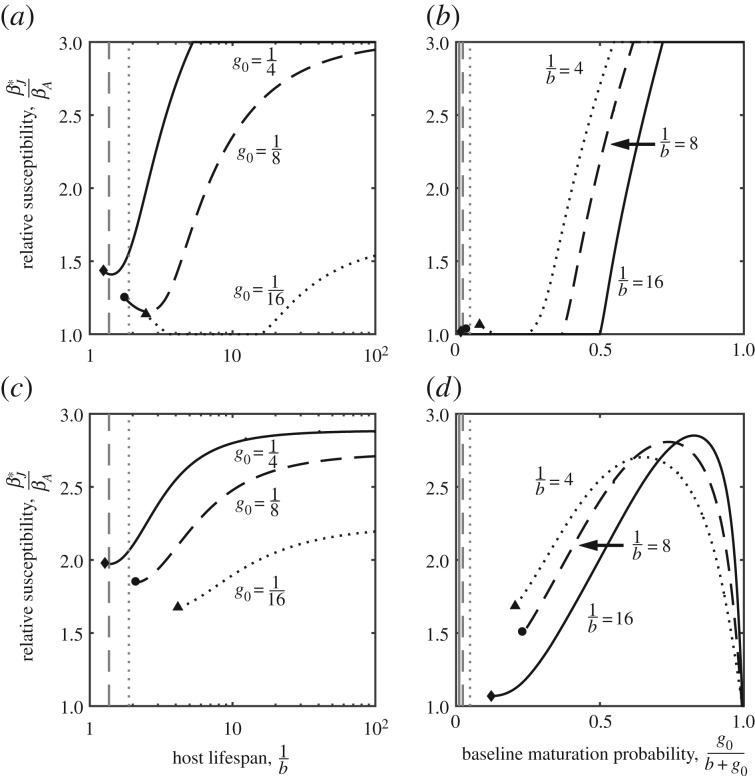
Infection prior to reproduction usually carries greater fitness costs for hosts than infection later in life, suggesting selection should tend to favour juvenile resistance. Yet, juveniles are generally more susceptible than adults across a wide spectrum of host taxa. While physiological constraints and a lack of prior exposure can explain some of this pattern, studies in plants and insects suggest that hosts may trade off juvenile susceptibility against other life-history traits. However, it is unclear precisely how trade-offs shape the evolution of juvenile susceptibility. Here, we theoretically explore the evolution of juvenile susceptibility subject to trade-offs with maturation or reproduction, which could realistically occur due to resource allocation during development (e.g. prioritizing growth over immune defence). We show how host lifespan, the probability of maturation (i.e. of reaching the adult stage) and transmission mode affect the results. Our key finding is that elevated juvenile susceptibility is expected to evolve over a wide range of conditions, but should be lowest when hosts have moderate lifespans and an intermediate probability of reaching the adult stage. Our results elucidate how interactions between trade-offs and the epidemiological-demographic structure of the population can lead to the evolution of elevated juvenile susceptibility.
在繁殖之前感染通常会给宿主带来更大的适应度成本,这表明选择应该倾向于有利于幼体的抵抗力。然而,在广泛的宿主分类群中,幼体通常比成体更容易受到感染。虽然生理限制和缺乏先前暴露可以解释部分这种模式,但植物和昆虫的研究表明,宿主可能会在幼体易感性和其他生活史特征之间进行权衡。然而,尚不清楚权衡如何影响幼体易感性的进化。在这里,我们从理论上探讨了在成熟或繁殖的权衡条件下幼体易感性的进化,这种权衡可能由于发育过程中的资源分配(例如,优先考虑生长而不是免疫防御)而真实发生。我们展示了宿主寿命、成熟的概率(即达到成年阶段的概率)和传播模式如何影响结果。我们的主要发现是,在广泛的条件下,预计会进化出更高的幼体易感性,但当宿主具有中等寿命和中等达到成年阶段的概率时,幼体易感性应该最低。我们的研究结果阐明了权衡与种群的流行病学-人口结构之间的相互作用如何导致幼体易感性的进化。