Joy Joash D, Malacrida Beatrice, Laforêts Florian, Kotantaki Panoraia, Maniati Eleni, Manchanda Ranjit, Annibaldi Alessandro, Hopkins Sarah, Garrobo-Calleja Ianire, Gautrot Julien, Balkwill Frances R
Barts Cancer Institute, Queen Mary University of London, London, United Kingdom.
Wolfson Institute of Population Health, Cancer Research UK, Barts Centre, Queen Mary University of London, London, United Kingdom.
Cancer Res. 2024 Aug 1;84(15):2432-2449. doi: 10.1158/0008-5472.CAN-23-3007.
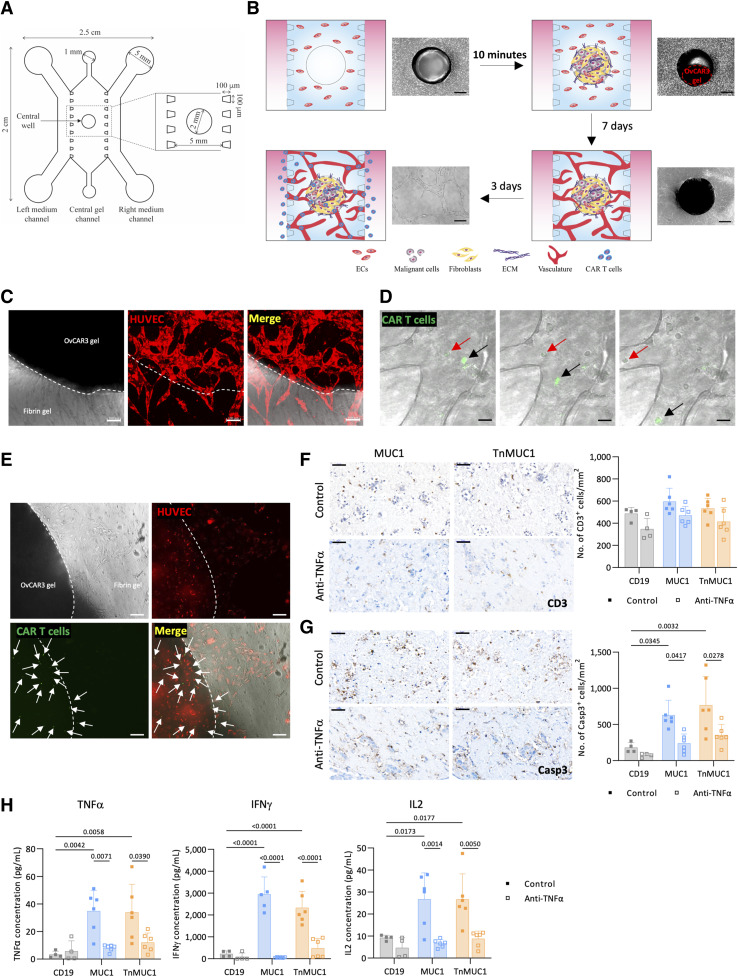
In vitro preclinical testing of chimeric antigen receptor (CAR) T cells is mostly carried out in monolayer cell cultures. However, alternative strategies are needed to take into account the complexity and the effects of the tumor microenvironment. Here, we describe the modulation of CAR T-cell activity by malignant cells and fibroblasts in human three-dimensional (3D) in vitro cell models of increasing complexity. In models combining mucin-1 (MUC1) and TnMUC1 CAR T cells with human high-grade serous ovarian cancer cell spheroids, malignant cell-intrinsic resistance to CAR T-cell killing was due to defective death receptor signaling involving TNFα. Adding primary human fibroblasts to spheroids unexpectedly increased the ability of CAR T cells to kill resistant malignant cells as CCL2 produced by fibroblasts activated CCR2/4+ CAR T cells. However, culturing malignant cells and fibroblasts in collagen gels engendered production of a dense extracellular matrix that impeded CAR T-cell activity in a TGFβ-dependent manner. A vascularized microfluidic device was developed that allowed CAR T cells to flow through the vessels and penetrate the gels in a more physiological way, killing malignant cells in a TNFα-dependent manner. Complex 3D human cell models may provide an efficient way of screening multiple cytotoxic human immune cell constructs while also enabling evaluation of mechanisms of resistance involving cell-cell and cell-matrix interactions, thus accelerating preclinical research on cytotoxic immune cell therapies in solid tumors. Significance: Three-dimensional in vitro models of increasing complexity uncover mechanisms of resistance to CAR T cells in solid tumors, which could help accelerate development of improved CAR T-cell constructs.
嵌合抗原受体(CAR)T细胞的体外临床前测试大多在单层细胞培养中进行。然而,需要采用其他策略来考虑肿瘤微环境的复杂性及其影响。在此,我们描述了在复杂性不断增加的人三维(3D)体外细胞模型中,恶性细胞和成纤维细胞对CAR T细胞活性的调节作用。在将粘蛋白-1(MUC1)和TnMUC1 CAR T细胞与人类高级别浆液性卵巢癌细胞球体相结合的模型中,恶性细胞对CAR T细胞杀伤的内在抗性归因于涉及肿瘤坏死因子α(TNFα)的死亡受体信号传导缺陷。将原代人成纤维细胞添加到球体中意外地增强了CAR T细胞杀伤抗性恶性细胞的能力,因为成纤维细胞产生的趋化因子配体2(CCL2)激活了CCR2/4+ CAR T细胞。然而,在胶原凝胶中培养恶性细胞和成纤维细胞会产生致密的细胞外基质,以转化生长因子β(TGFβ)依赖的方式阻碍CAR T细胞的活性。我们开发了一种血管化微流控装置,使CAR T细胞能够以更符合生理的方式流经血管并穿透凝胶,以TNFα依赖的方式杀伤恶性细胞。复杂的3D人类细胞模型可能提供一种有效的方法来筛选多种细胞毒性人类免疫细胞构建体,同时还能评估涉及细胞间和细胞与基质相互作用的抗性机制,从而加速实体瘤细胞毒性免疫细胞疗法的临床前研究。意义:复杂性不断增加的三维体外模型揭示了实体瘤对CAR T细胞的抗性机制,这有助于加速改进型CAR T细胞构建体的开发。