Department of Internal Medicine, Wake Forest University School of Medicine, Winston-Salem, NC, USA.
VA Center for Health Equity Research and Promotion, VA Pittsburgh Healthcare System, Pittsburgh, PA, USA.
J Gen Intern Med. 2024 Sep;39(12):2249-2260. doi: 10.1007/s11606-024-08818-3. Epub 2024 May 31.
Prior research documented racial and ethnic disparities in health care experiences within the Veterans Health Administration (VA). Little is known about such differences in VA-funded community care programs, through which a growing number of Veterans receive health care. Community care is available to Veterans when care is not available through the VA, nearby, or in a timely manner.
To examine differences in Veterans' experiences with VA-funded community care by race and ethnicity and assess changes in these experiences from 2016 to 2021.
Observational analyses of Veterans' ratings of community care experiences by self-reported race and ethnicity. We used linear and logistic regressions to estimate racial and ethnic differences in community care experiences, sequentially adjusting for demographic, health, insurance, and socioeconomic factors.
Respondents to the 2016-2021 VA Survey of Healthcare Experiences of Patients-Community Care Survey.
Care ratings in nine domains.
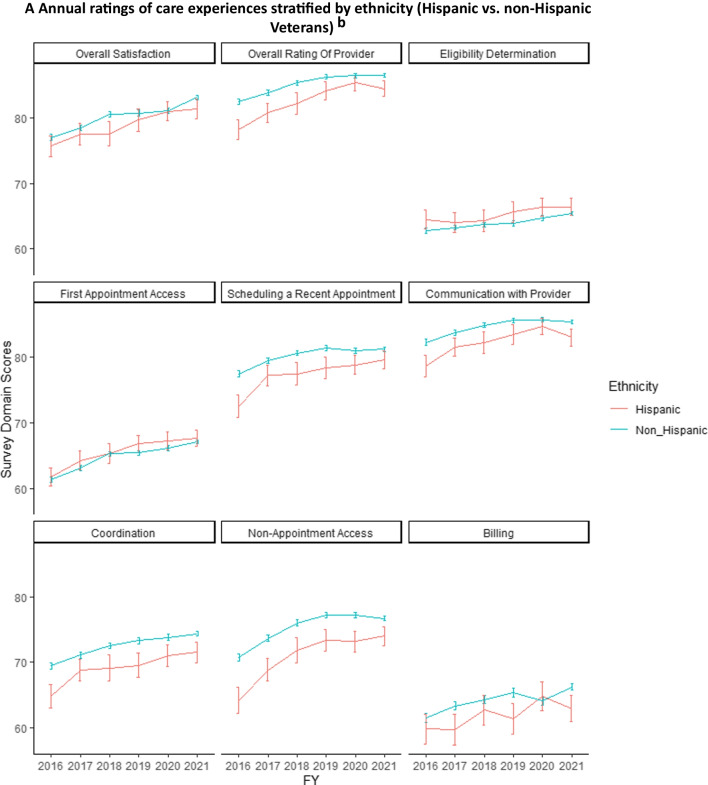
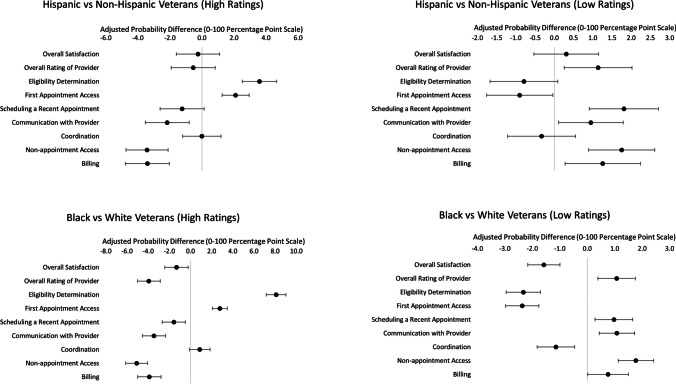
The sample of 231,869 respondents included 24,306 Black Veterans (mean [SD] age 56.5 [12.9] years, 77.5% male) and 16,490 Hispanic Veterans (mean [SD] age 54.6 [15.9] years, 85.3% male). In adjusted analyses pooled across study years, Black and Hispanic Veterans reported significantly lower ratings than their White and non-Hispanic counterparts in five of nine domains (overall rating of community providers, scheduling a recent appointment, provider communication, non-appointment access, and billing), with adjusted differences ranging from - 0.04 to - 0.13 standard deviations (SDs) of domain scores. Black and Hispanic Veterans reported higher ratings with eligibility determination and scheduling initial appointments than their White and non-Hispanic counterparts, and Black Veterans reported higher ratings of care coordination, with adjusted differences of 0.05 to 0.21 SDs. Care ratings improved from 2016 to 2021, but differences between racial and ethnic groups persisted.
This study identified small but persistent racial and ethnic differences in Veterans' experiences with VA-funded community care, with Black and Hispanic Veterans reporting lower ratings in five domains and, respectively, higher ratings in three and two domains. Interventions to improve Black and Hispanic Veterans' patient experience could advance equity in VA community care.
先前的研究记录了退伍军人健康管理局(VA)中医疗保健体验方面的种族和民族差异。对于通过 VA 资助的社区护理计划获得医疗保健的退伍军人,人们对这些差异知之甚少。当 VA 附近或及时无法提供护理时,社区护理可用于退伍军人。
通过自我报告的种族和民族检查退伍军人对 VA 资助的社区护理体验的差异,并评估 2016 年至 2021 年期间这些体验的变化。
通过自我报告的种族和民族观察退伍军人对社区护理体验的评价,对社区护理体验进行观察性分析。我们使用线性和逻辑回归来估计社区护理体验中的种族和民族差异,逐步调整人口统计学、健康、保险和社会经济因素。
VA 医疗保健体验患者-社区护理调查 2016-2021 年调查的受访者。
九个领域的护理评分。
在 231869 名受访者中,有 24306 名黑人退伍军人(平均[标准差]年龄 56.5[12.9]岁,77.5%为男性)和 16490 名西班牙裔退伍军人(平均[标准差]年龄 54.6[15.9]岁,85.3%为男性)。在跨研究年份的综合分析中,黑人退伍军人和西班牙裔退伍军人在九个领域中的五个领域的评分明显低于他们的白人非西班牙裔同行(社区提供者的整体评分、安排最近的预约、提供者沟通、非预约访问和计费),调整后的差异范围为 0.04 至 0.13 个领域评分的标准差。黑人退伍军人和西班牙裔退伍军人在资格确定和安排初始预约方面的评分高于他们的白人非西班牙裔同行,黑人退伍军人在护理协调方面的评分更高,调整后的差异为 0.05 至 0.21 个标准差。从 2016 年到 2021 年,护理评分有所提高,但种族和族裔群体之间的差异仍然存在。
本研究确定了退伍军人对 VA 资助的社区护理体验方面的种族和民族差异较小但持续存在,黑人退伍军人和西班牙裔退伍军人在五个领域的评分较低,而分别在三个和两个领域的评分较高。改善黑人和西班牙裔退伍军人的患者体验的干预措施可以推动 VA 社区护理中的公平。