Faculty of Health, School of Nursing and Midwifery, University of Canberra, Building 10, Office 10B7, 11 Kirinari St, Bruce, Canberra, ACT, 2617, Australia.
Western Sydney University, PO Box 63, Penrith, Sydney, NSW, 2751, Australia.
BMC Womens Health. 2024 May 31;24(1):314. doi: 10.1186/s12905-024-03143-7.
This integrative review summarises original research that explores women's experiences of escaping domestic violence to achieve safe housing.
Integrative review. A robust search strategy was conducted using the following databases: Scopus, Cumulative Index to Nursing and Allied Health (CINAHL), Cochrane, Medline and PubMed. All articles were assessed for quality using the Mixed Methods Appraisal Tools (MMAT) scoring. Whittemore and Knafl's (2005) five stage approach was used to analyse the primary literature related to women's and stakeholders' experiences of escaping domestic violence to achieve safe housing.
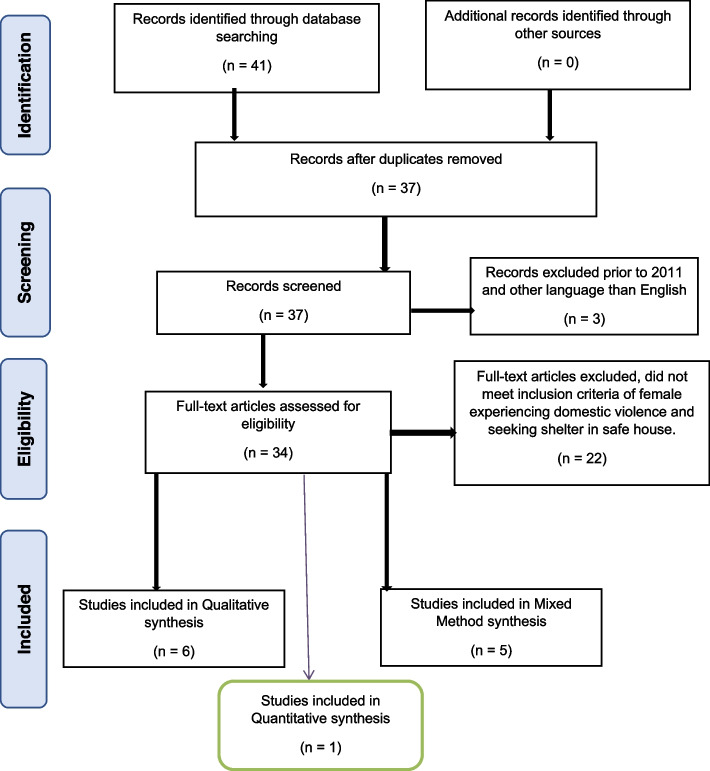
A total of 41 articles were retrieved and 12 papers were included in this review (six qualitative, one quantitative and five mixed methods) that fulfilled the inclusion criteria. Four overarching themes were identified: 'Experiences of leaving domestic violence', 'Barriers to achieving safe housing', 'Facilitators to achieving safe housing' and 'The road to recovery'. The 'Experiences of leaving domestic violence' theme included two subthemes: 'the losses' and 'ongoing contact with the perpetrator'. The 'Barriers to achieving safe housing' theme included three subthemes: 'financial insecurity', 'being judged by others for leaving and service availability'. The 'Facilitators to achieving safe housing' theme included two sub-themes: 'support, partnership, and collaboration between women and service providers' and 'feeling respected and heard'. The 'Road to recovery' theme included two sub-themes: 'being a good mother' and 'empowerment after leaving domestic violence'.
This review has highlighted the need for service and health care providers to work together and collaborate effectively with the woman experiencing and escaping domestic violence, especially in rural and remote areas. This means giving women access to the most suitable educational resources and services that are appropriate for their unique situation. Tailoring support for women is crucial to enable women to achieve safe housing and to be able to live a safe life with their children, away from the perpetrator of the domestic violence.
本综述总结了探索女性摆脱家庭暴力寻求安全住所的经验的原始研究。
综合回顾。使用以下数据库进行了强大的搜索策略:Scopus、护理学与联合健康索引(CINAHL)、Cochrane、Medline 和 PubMed。使用混合方法评估工具(MMAT)评分评估所有文章的质量。使用 Whittemore 和 Knafl(2005)的五个阶段方法分析与女性和利益相关者逃避家庭暴力以获得安全住所的经验相关的主要文献。
共检索到 41 篇文章,其中 12 篇文章符合纳入标准(6 篇定性、1 篇定量和 5 篇混合方法)。确定了四个总体主题:“离开家庭暴力的经历”、“获得安全住所的障碍”、“获得安全住所的促进因素”和“恢复之路”。“离开家庭暴力的经历”主题包括两个子主题:“失去”和“与施虐者持续接触”。“获得安全住所的障碍”主题包括三个子主题:“经济不安全”、“因离开而被他人评判”和“服务可用性”。“获得安全住所的促进因素”主题包括两个子主题:“妇女与服务提供者之间的支持、伙伴关系和合作”和“感到受到尊重和倾听”。“恢复之路”主题包括两个子主题:“成为一个好母亲”和“离开家庭暴力后的赋权”。
本综述强调了服务和医疗保健提供者需要共同努力,与经历和逃避家庭暴力的女性有效合作,特别是在农村和偏远地区。这意味着为女性提供获得最适合其独特情况的教育资源和服务的途径。为女性量身定制支持对于使女性能够获得安全住所并能够在没有家庭暴力施害者的情况下与子女安全生活至关重要。