Department of Medical and Surgical Nursing, School of Nursing and Midwifery, Clinical Research Development Center, Shahid Modarres Educational hospital, Shahid Beheshti University of Medical Sciences, Tehran, Iran.
Master of Critical Care Nursing, School of Nursing and Midwifery, Shahid Beheshti University of Medical Sciences, Tehran, Iran.
BMC Oral Health. 2024 May 31;24(1):643. doi: 10.1186/s12903-024-04386-4.
Since maintaining oral hygiene is essential in nursing care, the present study was conducted to determine the effect of oral care using Mucosamin artificial saliva spray to control dry mouth in ICU patients with COVID-19.
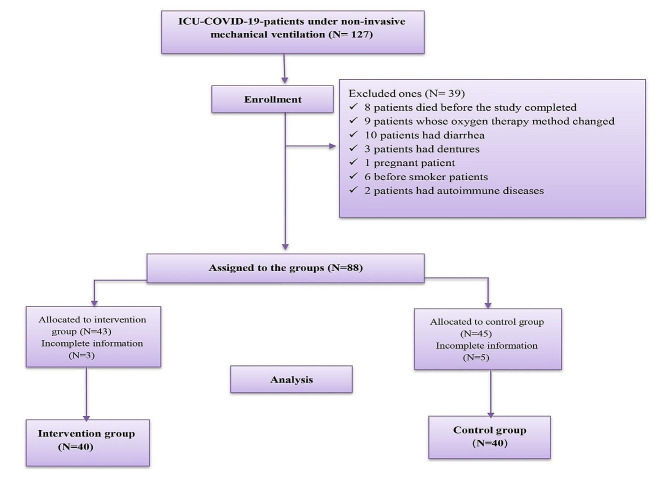
The current semi-experimental research was conducted on eighty patients with COVID-19 selected using the available sampling method. The study tool was a Beck oral assessment scale (BOAS). The case and control groups were selected from two hospitals with relatively similar conditions and treatment procedures. For patients in the intervention group, mucosamin artificial saliva spray was used in addition to the common care, while control group patients received only common care.
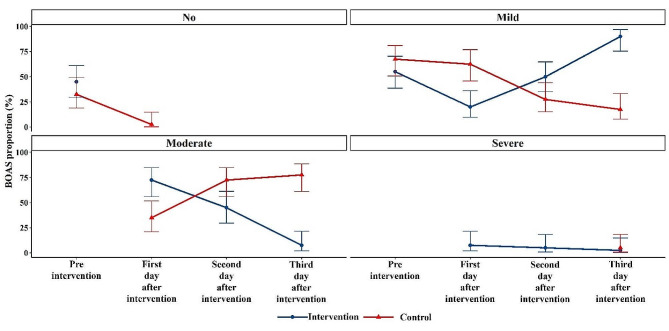
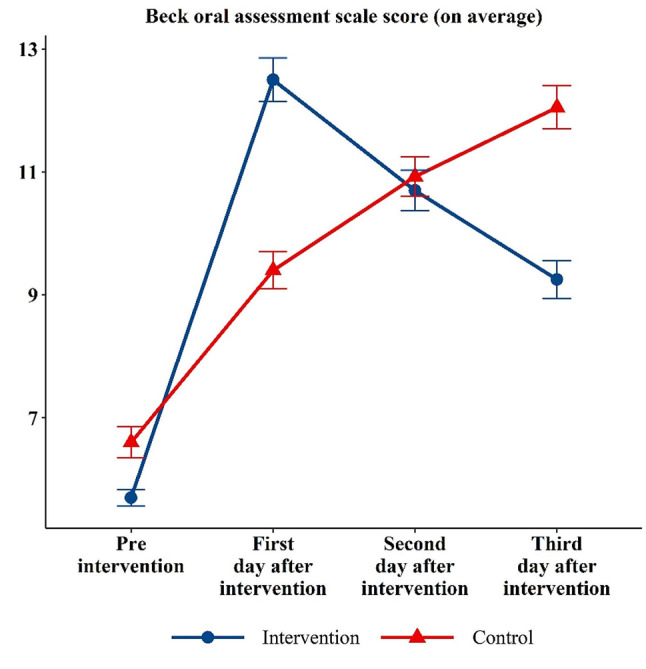
Eighty patients were randomly assigned to two groups named control and intervention (40 patients in each group). The intervention was very effective in reducing the BOAS score after four days in comparison with the control group (9.23 vs. 12.05, respectively; p-value < 0.001). Based on the adjusted model, the application of artificial saliva reduced the BOAS score, indicating improvement in mouth dryness. While the BOAS score was increased in the control group, it had a declining trend in the intervention one.
The study's results showed that using artificial saliva spray could effectively reduce the symptoms of dry mouth in patients with COVID-19 treated with non-invasive mechanical ventilation.
The present study introduced an applicable solution (artificial saliva) to treat mouth dryness in ICU patients under mechanical ventilation.
由于口腔卫生护理在护理中至关重要,本研究旨在确定使用 Mucosamin 人工唾液喷雾来控制 COVID-19 重症监护病房患者口干的效果。
本半实验研究共纳入 80 例 COVID-19 患者,采用方便抽样法进行选择。研究工具是 Beck 口腔评估量表(BOAS)。病例组和对照组是从两个具有相似条件和治疗程序的医院中选择的。对于干预组患者,除了常规护理外,还使用了 mucosamin 人工唾液喷雾,而对照组患者仅接受常规护理。
80 名患者被随机分为两组,分别命名为对照组和干预组(每组 40 名患者)。与对照组相比,干预组在四天后 BOAS 评分显著降低(分别为 9.23 分和 12.05 分;p 值<0.001)。根据调整后的模型,人工唾液的应用降低了 BOAS 评分,表明口干症状有所改善。而对照组的 BOAS 评分增加,干预组则呈下降趋势。
研究结果表明,使用人工唾液喷雾可以有效减轻 COVID-19 患者接受无创机械通气治疗时的口干症状。
本研究提出了一种可应用的解决方案(人工唾液)来治疗机械通气下 ICU 患者的口干问题。