Department of Psychiatry, Dalhousie University, Halifax, Nova Scotia, Canada.
Department of Complex Systems, Institute of Computer Science, Czech Academy of Sciences, Prague, Czech Republic.
Hum Brain Mapp. 2024 Jun 1;45(8):e26682. doi: 10.1002/hbm.26682.
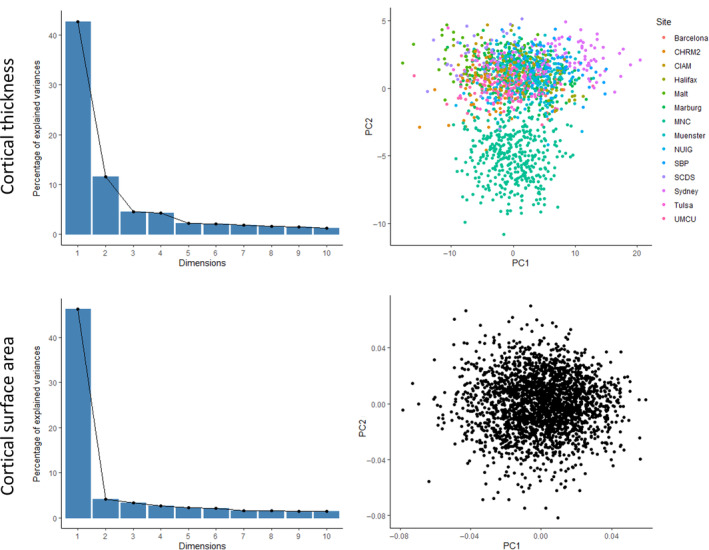
Multivariate techniques better fit the anatomy of complex neuropsychiatric disorders which are characterized not by alterations in a single region, but rather by variations across distributed brain networks. Here, we used principal component analysis (PCA) to identify patterns of covariance across brain regions and relate them to clinical and demographic variables in a large generalizable dataset of individuals with bipolar disorders and controls. We then compared performance of PCA and clustering on identical sample to identify which methodology was better in capturing links between brain and clinical measures. Using data from the ENIGMA-BD working group, we investigated T1-weighted structural MRI data from 2436 participants with BD and healthy controls, and applied PCA to cortical thickness and surface area measures. We then studied the association of principal components with clinical and demographic variables using mixed regression models. We compared the PCA model with our prior clustering analyses of the same data and also tested it in a replication sample of 327 participants with BD or schizophrenia and healthy controls. The first principal component, which indexed a greater cortical thickness across all 68 cortical regions, was negatively associated with BD, BMI, antipsychotic medications, and age and was positively associated with Li treatment. PCA demonstrated superior goodness of fit to clustering when predicting diagnosis and BMI. Moreover, applying the PCA model to the replication sample yielded significant differences in cortical thickness between healthy controls and individuals with BD or schizophrenia. Cortical thickness in the same widespread regional network as determined by PCA was negatively associated with different clinical and demographic variables, including diagnosis, age, BMI, and treatment with antipsychotic medications or lithium. PCA outperformed clustering and provided an easy-to-use and interpret method to study multivariate associations between brain structure and system-level variables. PRACTITIONER POINTS: In this study of 2770 Individuals, we confirmed that cortical thickness in widespread regional networks as determined by principal component analysis (PCA) was negatively associated with relevant clinical and demographic variables, including diagnosis, age, BMI, and treatment with antipsychotic medications or lithium. Significant associations of many different system-level variables with the same brain network suggest a lack of one-to-one mapping of individual clinical and demographic factors to specific patterns of brain changes. PCA outperformed clustering analysis in the same data set when predicting group or BMI, providing a superior method for studying multivariate associations between brain structure and system-level variables.
多元技术更适合于复杂神经精神疾病的解剖结构,这些疾病的特征不是单个区域的改变,而是分布在大脑网络中的变化。在这里,我们使用主成分分析 (PCA) 来识别大脑区域之间协变的模式,并将其与大样本中双相情感障碍患者和对照组的临床和人口统计学变量相关联。然后,我们比较了 PCA 和聚类在相同样本上的性能,以确定哪种方法更能捕捉大脑和临床测量之间的联系。我们使用 ENIGMA-BD 工作组的数据,研究了来自 2436 名双相情感障碍患者和健康对照组的 T1 加权结构 MRI 数据,并对皮质厚度和表面积测量值进行了 PCA。然后,我们使用混合回归模型研究了主要成分与临床和人口统计学变量的关联。我们将 PCA 模型与我们之前对同一数据的聚类分析进行了比较,还在 327 名双相情感障碍或精神分裂症患者和健康对照组的复制样本中进行了测试。第一个主成分,它在所有 68 个皮质区域中索引了更大的皮质厚度,与双相情感障碍、BMI、抗精神病药物和年龄呈负相关,与 Li 治疗呈正相关。PCA 在预测诊断和 BMI 时表现出优于聚类的拟合优度。此外,将 PCA 模型应用于复制样本中,在健康对照组和双相情感障碍或精神分裂症患者之间产生了皮质厚度的显著差异。由 PCA 确定的相同广泛区域网络中的皮质厚度与不同的临床和人口统计学变量呈负相关,包括诊断、年龄、BMI 和抗精神病药物或锂的治疗。PCA 优于聚类,并提供了一种易于使用和解释的方法来研究大脑结构和系统水平变量之间的多变量关联。临床医生要点:在这项对 2770 人的研究中,我们证实了由主成分分析 (PCA) 确定的广泛区域网络中的皮质厚度与相关的临床和人口统计学变量呈负相关,包括诊断、年龄、BMI 和抗精神病药物或锂的治疗。许多不同的系统水平变量与同一大脑网络的显著关联表明,个体临床和人口统计学因素与特定的大脑变化模式之间没有一一对应的映射。PCA 在同一数据集中预测组或 BMI 时优于聚类分析,为研究大脑结构和系统水平变量之间的多变量关联提供了一种更好的方法。