Bailey Katie, Abramovitz Daniela, Rangel Gudelia, Harvey-Vera Alicia, Vera Carlos F, Patterson Thomas L, Arredondo Sánchez-Lira Jaime, Davidson Peter J, Garfein Richard S, Smith Laramie R, Pitpitan Eileen V, Goldenberg Shira M, Strathdee Steffanie A
Department of Medicine, University of California, San Diego, USA.
School of Social Work, San Diego State University, USA.
medRxiv. 2024 May 22:2024.05.21.24307696. doi: 10.1101/2024.05.21.24307696.
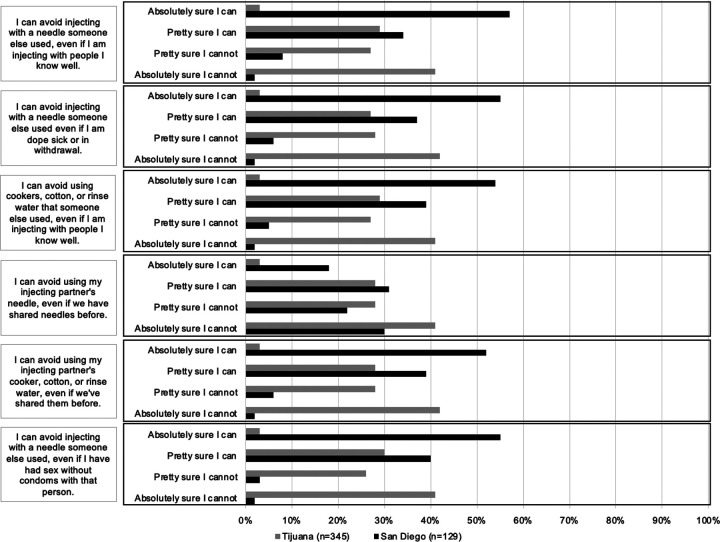
Safe injection self-efficacy (SISE) is negatively associated with injection risk behaviors among people who inject drugs (PWID) but has not been examined in differing risk environments. We compared responses to a validated SISE scale between PWID in San Diego, California and Tijuana, Mexico, and examine correlates of SISE among PWID in Tijuana.
PWID were recruited via street outreach for a longitudinal cohort study from October 2020 - September 2021. We compared SISE scale items by city. Due to low variability in SISE scores among San Diego residents, we restricted analysis of factors associated with SISE to Tijuana residents and identified correlates of SISE scores (low, medium, high) using ordinal logistic regression.
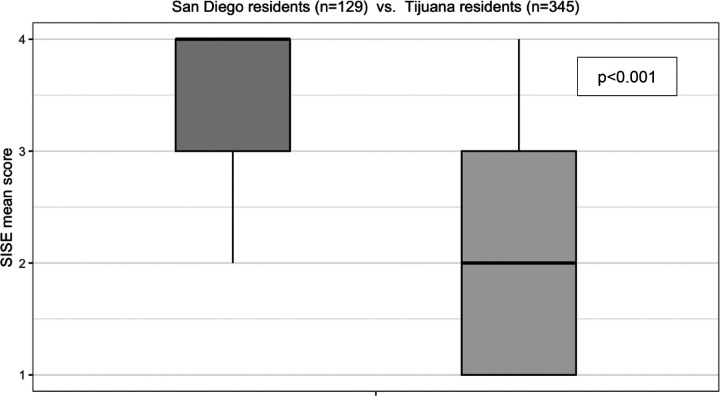
Of 474 participants, most were male (74%), Latinx (78%) and Tijuana residents (73%). Mean age was 44. Mean SISE scores among San Diego residents were high (3.46 of 4 maximum) relative to Tijuana residents (mean: 1.93). Among Tijuana residents, White race and having previously resided in San Diego were associated with higher SISE scores. HCV and HIV seropositivity, homelessness, fentanyl use, polysubstance co-injection, and greater injection frequency were associated with lower SISE scores.
We found profound inequalities between Tijuana and San Diego SISE, likely attributable to differential risk environments. Associations with fentanyl and polysubstance co-injection, injection frequency, and both HIV and HCV seropositivity suggest that SISE contribute to blood-borne infection transmission risks in Tijuana. SISE reflects an actionable intervention target to reduce injection risk behaviors, but structural interventions are required to intervene upon the risk environment.
安全注射自我效能感(SISE)与注射吸毒者(PWID)的注射风险行为呈负相关,但尚未在不同风险环境中进行研究。我们比较了加利福尼亚州圣地亚哥和墨西哥蒂华纳的注射吸毒者对经过验证的 SISE 量表的反应,并研究了蒂华纳注射吸毒者中 SISE 的相关因素。
通过街头外展招募注射吸毒者进行 2020 年 10 月至 2021 年 9 月的纵向队列研究。我们按城市比较了 SISE 量表项目。由于圣地亚哥居民的 SISE 得分变异性较低,我们将与 SISE 相关因素的分析限制在蒂华纳居民中,并使用有序逻辑回归确定 SISE 得分(低、中、高)的相关因素。
在 474 名参与者中,大多数为男性(74%)、拉丁裔(78%)和蒂华纳居民(73%)。平均年龄为 44 岁。圣地亚哥居民的平均 SISE 得分(满分 4 分,平均为 3.46)相对于蒂华纳居民(平均:1.93)较高。在蒂华纳居民中,白人种族和以前居住在圣地亚哥与较高的 SISE 得分相关。丙型肝炎病毒(HCV)和人类免疫缺陷病毒(HIV)血清学阳性、无家可归、使用芬太尼、多种物质联合注射以及更高的注射频率与较低的 SISE 得分相关。
我们发现蒂华纳和圣地亚哥的 SISE 之间存在巨大不平等,这可能归因于不同的风险环境。与芬太尼和多种物质联合注射、注射频率以及 HIV 和 HCV 血清学阳性的关联表明,SISE 会导致蒂华纳血源性感染传播风险。SISE 反映了一个可采取行动的干预目标,以减少注射风险行为,但需要结构性干预来改善风险环境。