Wu Jufei, Wu Jishi, Zhou Yan, Lu Xiaohua, Zhao Wane, Xu Fengmei
Department of Neurosurgery, The First Affiliated Hospital of Jinan University, Guangzhou, People's Republic of China.
Department of General Medicine, The First Affiliated Hospital of Jinan University, Guangzhou, People's Republic of China.
Diabetes Metab Syndr Obes. 2024 May 27;17:2147-2154. doi: 10.2147/DMSO.S436390. eCollection 2024.
To develop a prediction model for hypoglycemia in type 2 diabetes mellitus (T2DM) patients treated with an insulin pump during enteral nutrition.
This retrospective study included T2DM patients treated with an insulin pump during enteral nutrition at the First Affiliated Hospital of Jinan University, Guangzhou Red Cross Hospital, Foshan First People's Hospital, and Guangdong Provincial Hospital of Traditional Chinese Medicine between January 2016 and December 2023. The patients were randomized 3:1 to the training and validation sets. The risk factors for hypoglycemia were analyzed. A prediction model was developed.
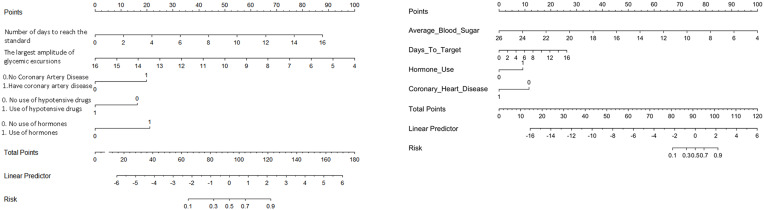
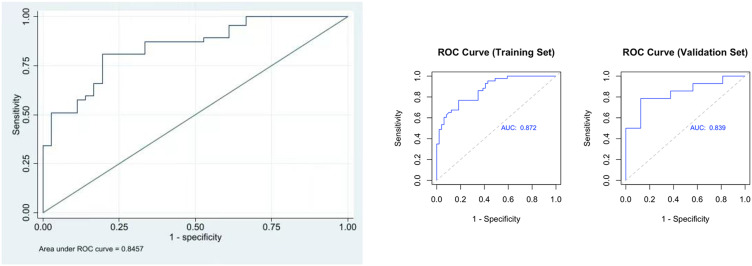
This study included 122 patients, and 57 patients had at least one hypoglycemic event during their hospitalization (46.72%). The multivariable logistic regression analysis showed that the time to reach the glycemic targets (odds ratio (OR)=1.408, 95% confidence interval (CI)=1.084-1.825, P=0.006), average glycemia (OR=0.387, 95% CI=0.233-0.643, P=0.010), coronary heart disease (OR=0.089, 95% CI=0.016-0.497, P<0.001), and the administration of hormone therapy (OR=6.807, 95% CI=1.128-41.081, P=0.037) were independently associated with hypoglycemia. A nomogram was built. The receiver operating characteristics analysis showed that the area under the curve of the model was 0.872 (95% CI=0.0.803-0.940) for the training set and 0.839 (95% CI=0.688-0.991) in the validation set.
A nomogram was successfully built to predict hypoglycemia in T2DM patients treated with an insulin pump during enteral nutrition, based on the time to reach the glycemic targets, average glycemia, coronary heart disease, and the administration of hormone therapy.
建立肠内营养期间接受胰岛素泵治疗的2型糖尿病(T2DM)患者低血糖的预测模型。
这项回顾性研究纳入了2016年1月至2023年12月期间在暨南大学附属第一医院、广州红十字会医院、佛山市第一人民医院和广东省中医院接受肠内营养期间使用胰岛素泵治疗的T2DM患者。患者按3:1随机分为训练集和验证集。分析低血糖的危险因素。建立了一个预测模型。
本研究共纳入122例患者,其中57例患者在住院期间至少发生过一次低血糖事件(46.72%)。多变量逻辑回归分析显示,达到血糖目标的时间(比值比(OR)=1.408,95%置信区间(CI)=1.084-1.825,P=0.006)、平均血糖水平(OR=0.387,95%CI=0.233-0.643,P=0.010)、冠心病(OR=0.089,95%CI=0.016-0.497,P<0.001)以及激素治疗的使用(OR=6.807,95%CI=1.128-41.081,P=0.037)与低血糖独立相关。构建了一个列线图。受试者工作特征分析显示该模型在训练集的曲线下面积为0.872(95%CI=0.803-0.940),在验证集为0.839(95%CI=0.688-0.991)。
基于达到血糖目标的时间、平均血糖水平、冠心病和激素治疗的使用,成功构建了一个列线图,用于预测肠内营养期间接受胰岛素泵治疗的T2DM患者的低血糖情况。