Samuvel Devadoss J, Lemasters John J, Chou C James, Zhong Zhi
Departments of Drug Discovery and Biomedical Sciences, Charleston, SC, United States.
Biochemistry and Molecular Biology, Medical University of South Carolina, Charleston, SC, United States.
Front Pharmacol. 2024 May 17;15:1386238. doi: 10.3389/fphar.2024.1386238. eCollection 2024.
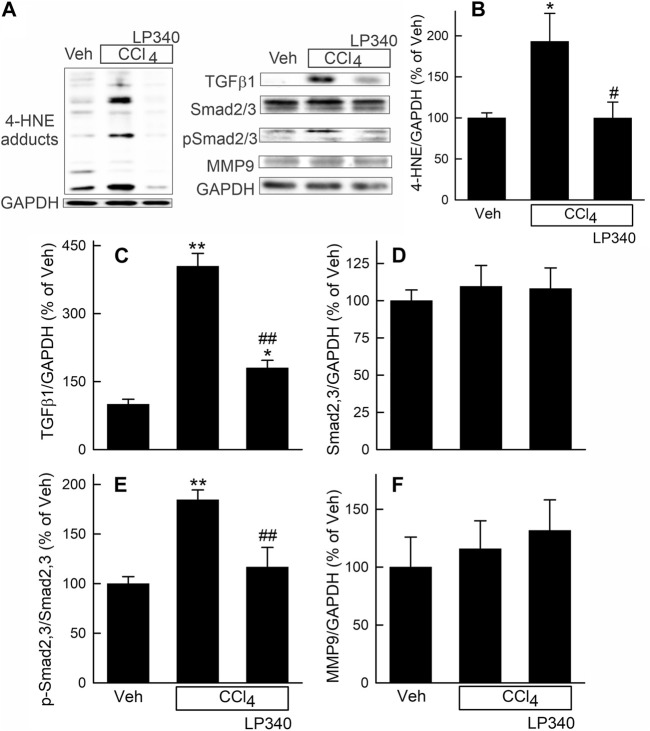
Effective therapy for liver fibrosis is lacking. Here, we examined whether LP340, the lead candidate of a new-generation of hydrazide-based HDAC1,2,3 inhibitors (HDACi), decreases liver fibrosis. Liver fibrosis was induced by CCl treatment and bile duct ligation (BDL) in mice. At 6 weeks after CCl, serum alanine aminotransferase increased, and necrotic cell death and leukocyte infiltration occurred in the liver. Tumor necrosis factor-α and myeloperoxidase markedly increased, indicating inflammation. After 6 weeks, α-smooth muscle actin (αSMA) and collagen-1 expression increased by 80% and 575%, respectively, indicating hepatic stellate cell (HSC) activation and fibrogenesis. Fibrosis detected by trichrome and Sirius-red staining occurred primarily in pericentral regions with some bridging fibrosis in liver sections. 4-Hydroxynonenal adducts (indicator of oxidative stress), profibrotic cytokine transforming growth factor-β (TGFβ), and TGFβ downstream signaling molecules phospho-Smad2/3 also markedly increased. LP340 attenuated indices of liver injury, inflammation, and fibrosis markedly. Moreover, Ski-related novel protein-N (SnoN), an endogenous inhibitor of TGFβ signaling, decreased, whereas SnoN expression suppressor microRNA-23a (miR23a) increased markedly. LP340 (0.05 mg/kg, ig., daily during the last 2 weeks of CCl treatment) decreased 4-hydroxynonenal adducts and miR23a production, blunted SnoN decreases, and inhibited the TGFβ/Smad signaling. By contrast, LP340 had no effect on matrix metalloproteinase-9 expression. LP340 increased histone-3 acetylation but not tubulin acetylation, indicating that LP340 inhibited Class-I but not Class-II HDAC . After BDL, focal necrosis, inflammation, ductular reactions, and portal and bridging fibrosis occurred at 2 weeks, and αSMA and collagen-1 expression increased by 256% and 560%, respectively. LP340 attenuated liver injury, ductular reactions, inflammation, and liver fibrosis. LP340 also decreased 4-hydroxynonenal adducts and miR23a production, prevented SnoN decreases, and inhibited the TGFβ/Smad signaling after BDL. , LP340 inhibited immortal human hepatic stellate cells (hTERT-HSC) activation in culture (αSMA and collagen-1 expression) as well as miR23a production, demonstrating its direct inhibitory effects on HSC. In conclusions, LP340 is a promising therapy for both portal and pericentral liver fibrosis, and it works by inhibiting oxidative stress and decreasing miR23a.
目前仍缺乏有效的肝纤维化治疗方法。在此,我们研究了新一代基于酰肼的HDAC1、2、3抑制剂(HDACi)的主要候选药物LP340是否能减轻肝纤维化。通过对小鼠进行四氯化碳(CCl)处理和胆管结扎(BDL)诱导肝纤维化。CCl处理6周后,血清丙氨酸转氨酶升高,肝脏出现坏死性细胞死亡和白细胞浸润。肿瘤坏死因子-α和髓过氧化物酶显著增加,表明存在炎症。6周后,α平滑肌肌动蛋白(αSMA)和胶原蛋白-1的表达分别增加了80%和575%,表明肝星状细胞(HSC)活化和成纤维作用。通过三色染色和天狼星红染色检测到的纤维化主要发生在肝小叶中央周围区域,肝切片中存在一些桥接纤维化。4-羟基壬烯醛加合物(氧化应激指标)、促纤维化细胞因子转化生长因子-β(TGFβ)以及TGFβ下游信号分子磷酸化Smad2/3也显著增加。LP340显著减轻了肝损伤、炎症和纤维化指标。此外,Ski相关新蛋白-N(SnoN),一种TGFβ信号的内源性抑制剂,减少,而SnoN表达抑制因子微小RNA-23a(miR23a)显著增加。LP340(0.05mg/kg,灌胃,在CCl处理的最后2周每天给药)减少了4-羟基壬烯醛加合物和miR23a的产生,减弱了SnoN的减少,并抑制了TGFβ/Smad信号传导。相比之下,LP340对基质金属蛋白酶-9的表达没有影响。LP340增加了组蛋白-3的乙酰化,但没有增加微管蛋白的乙酰化,表明LP340抑制I类HDAC而非II类HDAC。BDL后2周出现局灶性坏死、炎症、小胆管反应以及门脉和桥接纤维化,αSMA和胶原蛋白-1的表达分别增加了256%和560%。LP340减轻了肝损伤、小胆管反应、炎症和肝纤维化。LP340还减少了4-羟基壬烯醛加合物和miR23a的产生,防止了SnoN的减少,并在BDL后抑制了TGFβ/Smad信号传导。此外,LP340在培养中抑制了永生化人肝星状细胞(hTERT-HSC)的活化(αSMA和胶原蛋白-1的表达)以及miR23a的产生,证明了其对HSC的直接抑制作用。总之,LP340是一种有前景的治疗门脉和中央周围肝纤维化的药物,其作用机制是抑制氧化应激并减少miR23a。