Institute of Vegetables, Wuhan Academy of Agricultural Sciences, Wuhan, Hubei, China.
PLoS One. 2024 Jun 3;19(6):e0302313. doi: 10.1371/journal.pone.0302313. eCollection 2024.
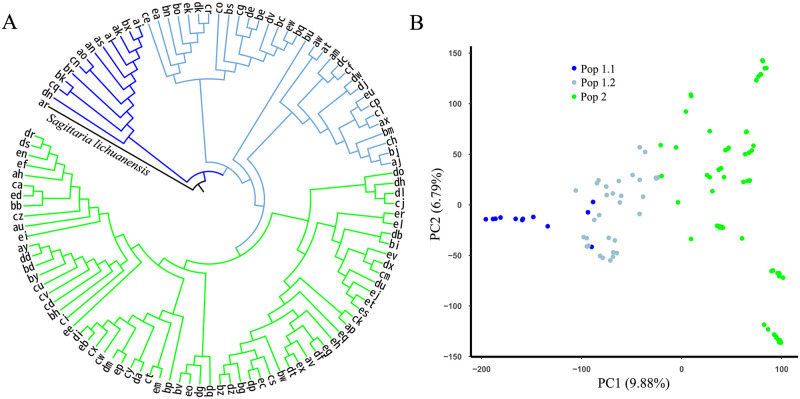
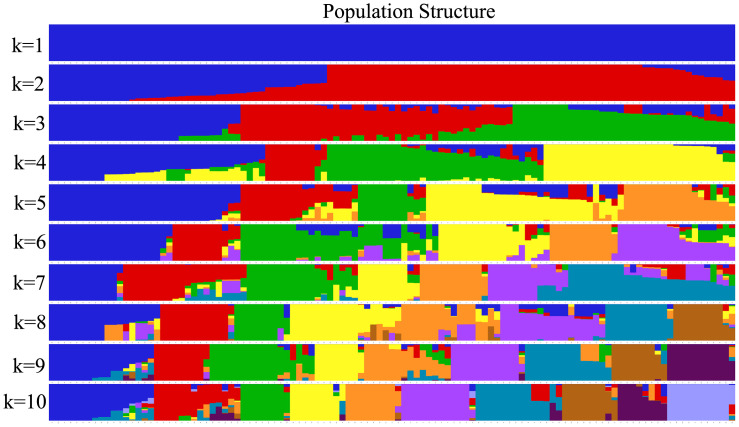
The aquatic perennial herb Sagittaria trifolia L. commonly known as arrowhead, has been utilized in China both as a culinary vegetable and in traditional medicines. Characterizing the phylogenetic relationships and genetic diversity of arrowheads is crucial for improved management, conservation, and efficient utilization of the germplasm resources associated with this species. Herein, we presented the phenotypic traits and genome-wide DNA marker-based analyses of 111 arrowhead accessions, most of which were from China. Cluster analysis revealed that arrowhead could be categorized into two clusters based on 11 phenotypic traits, with Cluster 1 comprising two subclusters. All accessions were clustered into three sub-clusters based primarily on leaf shape and tuber weight. A set of 759,237 high-quality single-nucleotide polymorphisms was identified and used to assess the phylogenetic relationships. Population structure and phylogenetic tree analyses suggested that the accessions could be classified into two major groups, Group I was further subdivided into two subgroups, aligning with the clusters identified through morphological classification. By employing Sagittaria lichuanensis as an outgroup, the rooted tree revealed that the evolutionary relationships within the three groups followed a progression from Group I-1 to Group I-2 and finally to Group II. The landraces were clustered into one group along with the remaining wild accessions. The level of genetic diversity for Group I (π = 0.26) was slightly lower than that which was estimated for Group II (π = 0.29). The lowest pairwise differentiation levels (Fst, 0.008) were obtained from the comparison between groups I-2 and II, indicating that the two groups were the most closely related. This study provides novel insights into germplasm classification, evolutionary relationships, genomics and arrowhead breeding.
水生多年生草本慈姑(Sagittaria trifolia L.)俗称箭头,在中国既作为食用蔬菜,也作为传统药物使用。对慈姑的系统发育关系和遗传多样性进行特征描述,对于该物种相关种质资源的管理、保护和有效利用至关重要。本文呈现了 111 份慈姑材料的表型特征和基于全基因组 DNA 标记的分析结果,其中大部分材料来自中国。聚类分析表明,根据 11 个表型特征,慈姑可分为两个聚类,聚类 1 又分为两个亚聚类。根据叶形和块茎重量,所有材料主要分为三个亚聚类。鉴定了一套 759,237 个高质量的单核苷酸多态性(SNP),并用于评估系统发育关系。种群结构和系统发育树分析表明,供试材料可分为两个主要组,组 I 进一步分为两个亚组,与形态分类鉴定的聚类结果一致。利用慈姑(Sagittaria lichuanensis)作为外群,有根树表明,三组内的进化关系遵循从组 I-1 到组 I-2 再到组 II 的进展。地方品种与其余野生材料聚类在一起。组 I 的遗传多样性水平(π=0.26)略低于组 II 的估计值(π=0.29)。组 I-2 和组 II 之间的最低成对分化水平(Fst,0.008)表明这两个组最相关。本研究为慈姑的种质分类、进化关系、基因组学和慈姑育种提供了新的见解。