Bafekry A, Faraji M, Khan S Hasan, Fadlallah M M, Jappor H R, Shokri B, Ghergherehchi M, Chang Gap Soo
Department of Physics, University of Guilan, Rasht, 41335-1914, Iran.
Department of Physics, Shahid Beheshti University, Tehran, 19839-63113, Iran.
Sci Rep. 2024 Jun 3;14(1):12695. doi: 10.1038/s41598-024-63580-0.
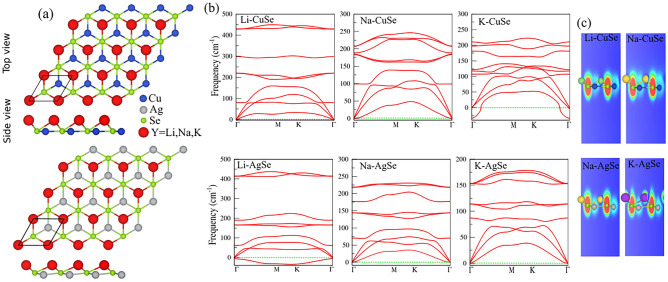
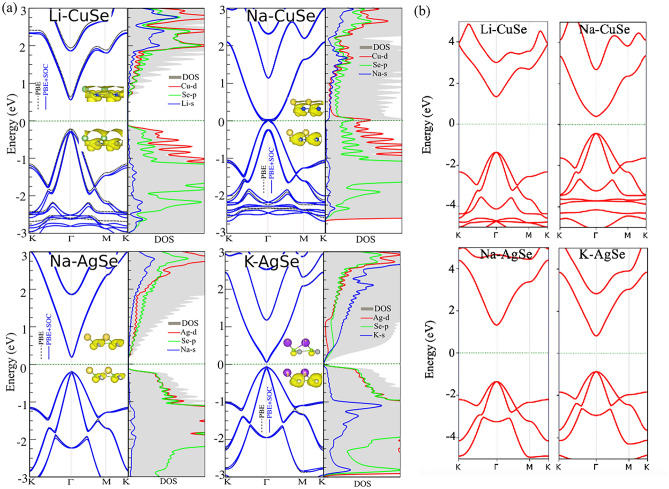
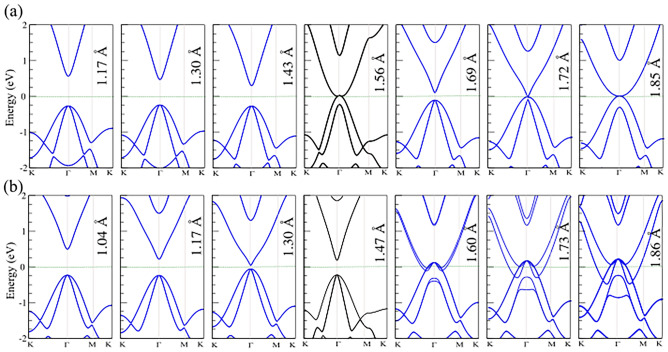
Two-dimensional (2D) materials can be effectively functionalized by chemically modified using doping. Very recently, a flat AgSe monolayer was successfully prepared through direct selenization of the Ag(111) surface. Besides, the results indicate that the AgSe monolayer like CuSe, has a honeycomb lattice. Motivated by the experimental outcomes, in this work, employing first-principles calculations, we systematically investigate the electronic and optical properties of AgSe and CuSe monolayers, as well as the impact of alkali metals (Li, Na and K). Without functionalization, both the CuSe and AgSe monolayers exhibit metallic characteristics. The Li (Na)-CuSe and Na (K)-AgSe systems are dynamically stable while, the K- and Li-CuSe and Li-AgSe are dynamically unstable. Interestingly, the functionalized CuSe system with Li and Na atom as well as AgSe with K and Na atom, can open the band gaps, leading to the actualization of metal to semiconductor transitions. Our results show that, the electronic characteristics of the Na-CuSe/AgSe system can be modulated by adjusting the adsorption heights, which gives rise to the change in the electronic properties and the band gap may be controlled. Furthermore, from the optical properties we can find that the K-AgSe system is the best candidate monolayer to absorb infrared radiation and visible light. Consequently, our findings shed light on the functionalization of 2D materials based CuSe and AgSe monolayers and can potentially enhance and motivate studies in producing these monolayers for current nanodevices and future applications.
二维(2D)材料可以通过掺杂进行化学修饰从而有效地实现功能化。最近,通过对Ag(111)表面进行直接硒化成功制备出了平整的AgSe单层。此外,结果表明,与CuSe一样,AgSe单层具有蜂窝晶格。受实验结果的启发,在这项工作中,我们采用第一性原理计算方法,系统地研究了AgSe和CuSe单层的电子和光学性质,以及碱金属(Li、Na和K)的影响。在未进行功能化处理时,CuSe和AgSe单层均表现出金属特性。Li(Na)-CuSe和Na(K)-AgSe体系是动态稳定的,而K-和Li-CuSe以及Li-AgSe是动态不稳定的。有趣的是,用Li和Na原子功能化的CuSe体系以及用K和Na原子功能化的AgSe体系可以打开带隙,从而实现从金属到半导体的转变。我们的结果表明,通过调整吸附高度可以调节Na-CuSe/AgSe体系的电子特性,这会导致电子性质的变化并且带隙可能得到控制。此外,从光学性质我们可以发现,K-AgSe体系是吸收红外辐射和可见光的最佳单层候选材料。因此,我们的研究结果为基于二维材料的CuSe和AgSe单层的功能化提供了启示,并有可能加强和推动关于为当前纳米器件及未来应用制备这些单层材料的研究。