Craig Tabitha V, Rhodes Ryan E, Sui Wuyou
Department of Exercise Science, Physical & Health Education, University of Victoria, Victoria, BC, Canada.
Behavioural Medicine Lab, Department of Exercise Science, Physical & Health Education, University of Victoria, Victoria, BC, Canada.
JMIR Serious Games. 2024 Jun 4;12:e53999. doi: 10.2196/53999.
The effectiveness of virtual reality (VR) fitness games as a form of moderate to vigorous physical activity has yet to be thoroughly quantified through gold standard energy expenditure measures.
The purpose of this study was to examine the energy expenditure of 2 medium-intensity modes ("Flow and "Boxing") of a VR fitness game, Supernatural, using indirect calorimetry.
Indirect calorimetry was used to examine relative and objective maximal oxygen consumption (VO max), metabolic equivalents of task (METs), and calories burned during medium-intensity bouts of both Flow and Boxing gameplay modes in young (mean age 25.42, SD 3.25 years), active individuals (n=12 female and n=11 male). METs and calories were also compared using a triaxial waist-worn accelerometer, an Apple smartwatch, and a VR headset. Mood states were assessed pre- and postbout using the shortened Profile of Mood States Questionnaire. Paired 2-tailed t tests were used to examine differences in game modes, between sexes, and pre-post exercise sessions.
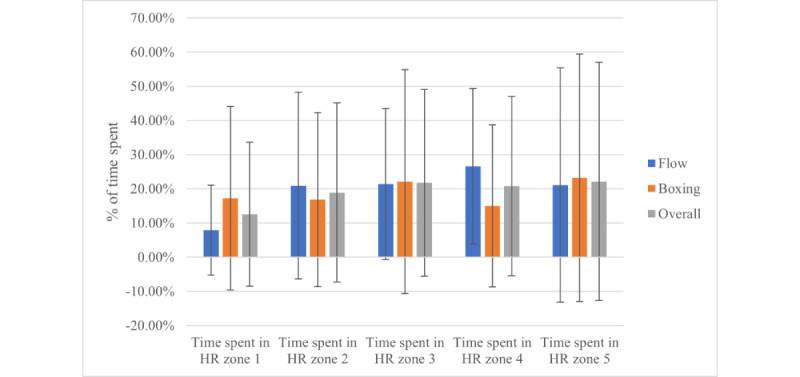
Objective and relative VO max averaged 1.93 (SD 0.44) L/min and 27.61 (SD 5.60) mL/kg/min, respectively, between modes. Flow (mean 8.2, SD 1.54 METs) and Boxing (mean 7.6, SD 1.66 METs) are both classified as high energy expenditure, vigorous activities. Calorie expenditure data of the accelerometer and VR headset differed significantly from the metabolic cart. Mood changes pre- to post exercise were consistent with expected values for moderate- to vigorous-intensity physical activity, with participants reporting that they felt more "active," "full of pep," "vigorous," and "lively" (P<.05) following bouts. Male individuals reported higher objective oxygen consumption (VO) for both Flow and Boxing modes; no other sex-specific differences were observed.
Both Flow and Boxing gameplay modes of Supernatural classify as vigorous physical activity and demonstrate the potential to promote mental and physical health benefits. Supernatural may be an effective exercise modality in a VO training program.
虚拟现实(VR)健身游戏作为一种中等至剧烈强度的体育活动形式,其有效性尚未通过金标准能量消耗测量方法进行全面量化。
本研究旨在使用间接量热法检测VR健身游戏《超凡》的两种中等强度模式(“Flow”和“拳击”)的能量消耗。
使用间接量热法检测年轻(平均年龄25.42岁,标准差3.25岁)、活跃个体(12名女性和11名男性)在“Flow”和“拳击”游戏模式的中等强度回合中相对和客观的最大耗氧量(VO₂max)、代谢当量(METs)以及燃烧的卡路里。还使用三轴腰部佩戴式加速度计、苹果智能手表和VR头显比较了METs和卡路里。使用缩短版情绪状态剖面图问卷在回合前后评估情绪状态。采用配对双尾t检验来检验游戏模式、性别以及运动前后各时段之间的差异。
两种模式之间,客观和相对VO₂max平均分别为1.93(标准差0.44)升/分钟和27.61(标准差5.60)毫升/千克/分钟。“Flow”(平均8.2,标准差1.54 METs)和“拳击”(平均7.6,标准差1.66 METs)均被归类为高能量消耗的剧烈活动。加速度计和VR头显的卡路里消耗数据与代谢车的数据有显著差异。运动前后的情绪变化与中等至剧烈强度体育活动的预期值一致,参与者报告称在回合后他们感觉更“活跃”、“精力充沛”、“有活力”和“充满生气”(P<0.05)。男性个体在“Flow”和“拳击”模式下均报告有更高的客观耗氧量(VO₂);未观察到其他性别特异性差异。
《超凡》的“Flow”和“拳击”游戏模式均归类为剧烈体育活动,并显示出促进身心健康益处的潜力。《超凡》可能是VO₂训练计划中的一种有效运动方式。