College of Agriculture/Anhui Intelligent Crop Planting and Processing Technology Engineering Research Center, Anhui Science and Technology University, Fengyang, 233100, Anhui, China.
Department of Botany, The Islamia University of Bahawalpur, Bahawalpur, Pakistan.
Sci Rep. 2024 Jun 4;14(1):12854. doi: 10.1038/s41598-024-63175-9.
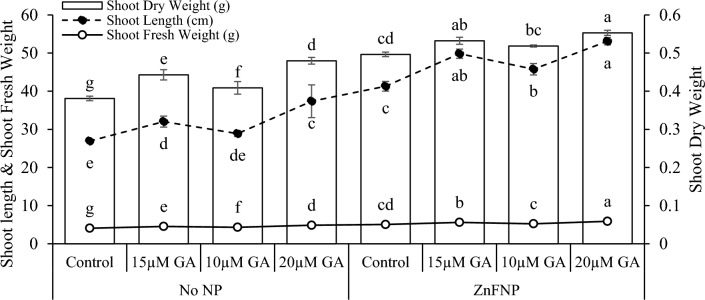
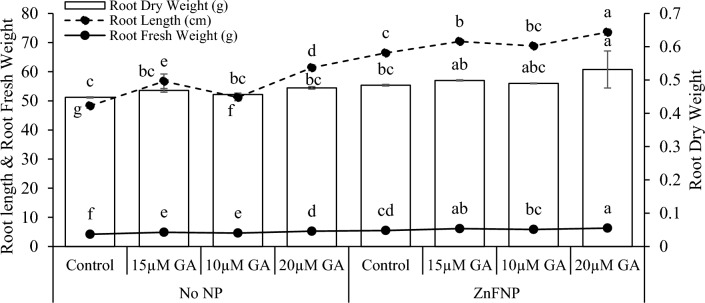
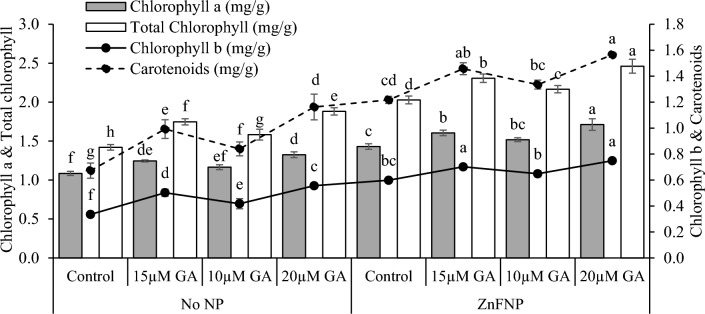
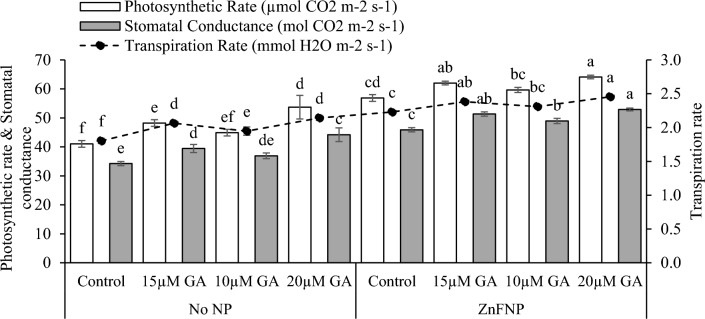
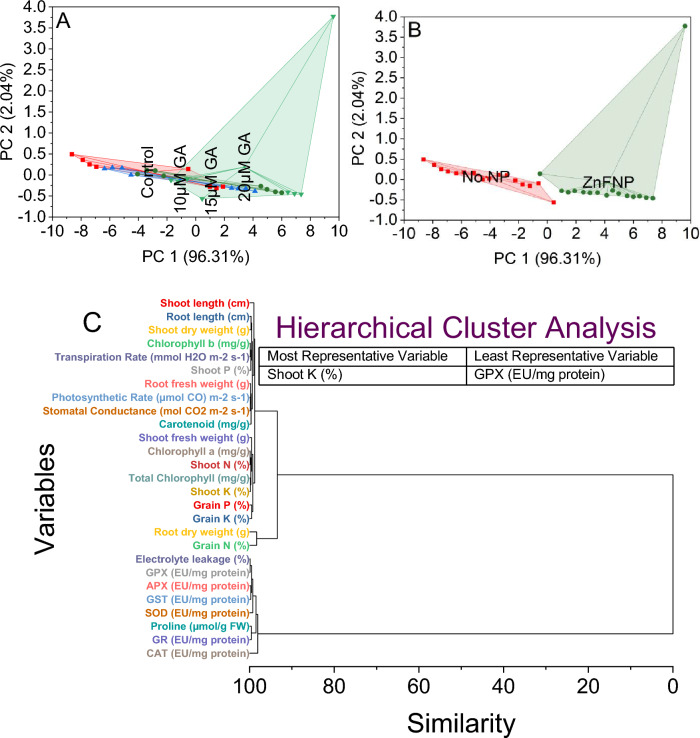
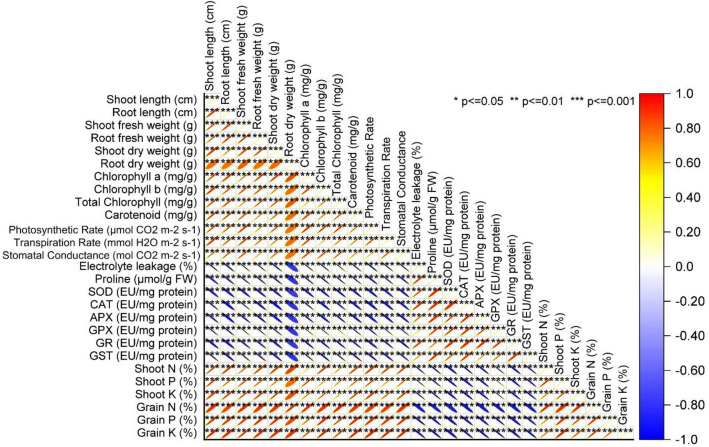
Salinity stress significantly impacts crops, disrupting their water balance and nutrient uptake, reducing growth, yield, and overall plant health. High salinity in soil can adversely affect plants by disrupting their water balance. Excessive salt levels can lead to dehydration, hinder nutrient absorption, and damage plant cells, ultimately impairing growth and reducing crop yields. Gallic acid (GA) and zinc ferrite (ZnFNP) can effectively overcome this problem. GA can promote root growth, boost photosynthesis, and help plants absorb nutrients efficiently. However, their combined application as an amendment against drought still needs scientific justification. Zinc ferrite nanoparticles possess many beneficial properties for soil remediation and medical applications. That's why the current study used a combination of GA and ZnFNP as amendments to wheat. There were 4 treatments, i.e., 0, 10 µM GA, 15 μM GA, and 20 µM GA, without and with 5 μM ZnFNP applied in 4 replications following a completely randomized design. Results exhibited that 20 µM GA + 5 μM ZnFNP caused significant improvement in wheat shoot length (28.62%), shoot fresh weight (16.52%), shoot dry weight (11.38%), root length (3.64%), root fresh weight (14.72%), and root dry weight (9.71%) in contrast to the control. Significant enrichment in wheat chlorophyll a (19.76%), chlorophyll b (25.16%), total chlorophyll (21.35%), photosynthetic rate (12.72%), transpiration rate (10.09%), and stomatal conductance (15.25%) over the control validate the potential of 20 µM GA + 5 μM ZnFNP. Furthermore, improvement in N, P, and K concentration in grain and shoot verified the effective functioning of 20 µM GA + 5 μM ZnFNP compared to control. In conclusion, 20 µM GA + 5 μM ZnFNP can potentially improve the growth, chlorophyll contents and gas exchange attributes of wheat cultivated in salinity stress. More investigations are suggested to declare 20 µM GA + 5 μM ZnFNP as the best amendment for alleviating salinity stress in different cereal crops.
盐胁迫显著影响作物,破坏其水分平衡和养分吸收,从而降低生长、产量和整体植物健康。土壤中的高盐分会通过破坏水分平衡对植物产生不利影响。过多的盐分会导致脱水、阻碍养分吸收并损害植物细胞,最终影响生长并降低作物产量。没食子酸(GA)和锌铁氧体(ZnFNP)可以有效地解决这个问题。GA 可以促进根的生长,促进光合作用,帮助植物有效地吸收养分。然而,它们作为一种抗旱改良剂的联合应用仍需要科学依据。锌铁氧体纳米粒子具有许多用于土壤修复和医学应用的有益特性。这就是为什么当前的研究使用 GA 和 ZnFNP 的组合作为小麦的改良剂。有 4 种处理,即 0、10µM GA、15µM GA 和 20µM GA,在完全随机设计的 4 次重复下,分别添加和不添加 5µM ZnFNP。结果表明,与对照相比,20µM GA+5µM ZnFNP 使小麦地上部分长度(28.62%)、地上部分鲜重(16.52%)、地上部分干重(11.38%)、根长(3.64%)、根鲜重(14.72%)和根干重(9.71%)显著增加。与对照相比,小麦叶绿素 a(19.76%)、叶绿素 b(25.16%)、总叶绿素(21.35%)、光合速率(12.72%)、蒸腾速率(10.09%)和气孔导度(15.25%)的显著富集验证了 20µM GA+5µM ZnFNP 的潜力。此外,与对照相比,籽粒和地上部分氮、磷、钾浓度的提高验证了 20µM GA+5µM ZnFNP 的有效作用。总之,20µM GA+5µM ZnFNP 可能会改善盐胁迫下小麦的生长、叶绿素含量和气体交换特性。建议进行更多的研究,以宣布 20µM GA+5µM ZnFNP 是缓解不同谷物作物盐胁迫的最佳改良剂。