Lin Yanting, Gao Rui, Jing Dongquan, Liu Yiming, Da Huijuan, Birnbaumer Lutz, Yang Yong, Gao Xinghua, Gao Zhenhua, Cao Qiuhua
Center for New Drug Safety Evaluation and Research, State Key Laboratory of Natural Medicines, China Pharmaceutical University, Nanjing, Jiangsu, China.
Institute of Biomedical Research (BIOMED), Catholic University of Argentina, Buenos Aires, Argentina.
Front Pharmacol. 2024 May 21;15:1392328. doi: 10.3389/fphar.2024.1392328. eCollection 2024.
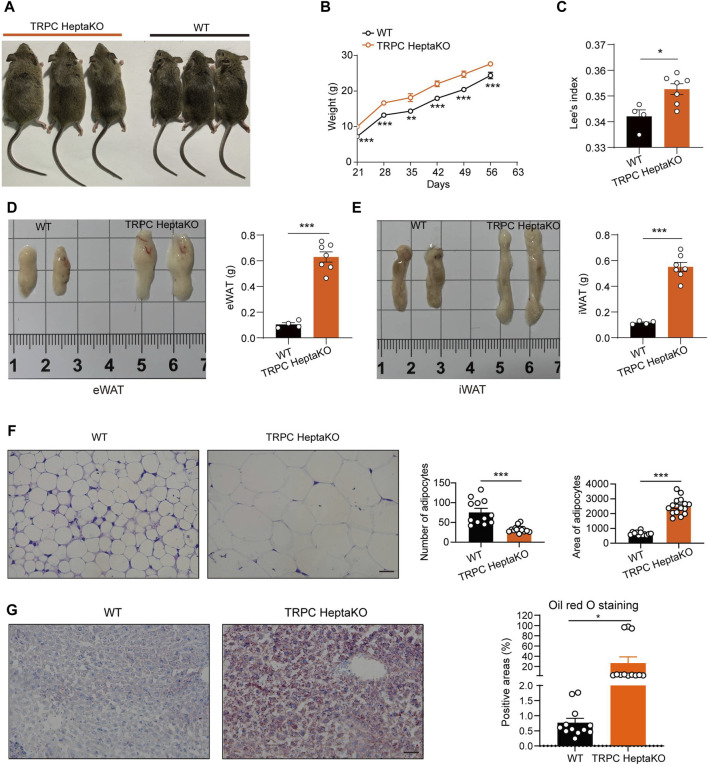
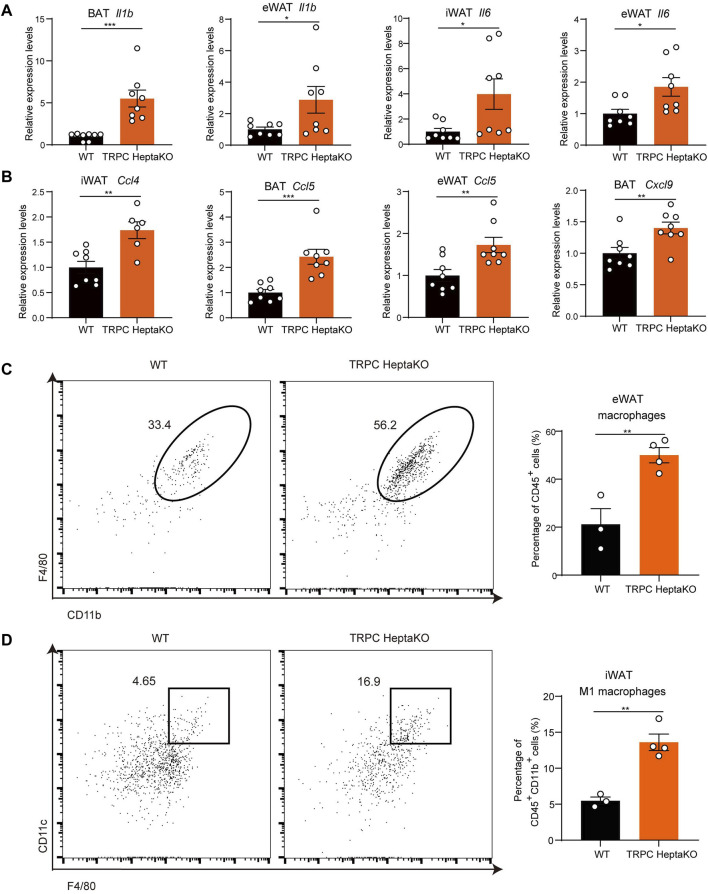
During the past half-century, although numerous interventions for obesity have arisen, the condition's prevalence has relentlessly escalated annually. Obesity represents a substantial public health challenge, especially due to its robust correlation with co-morbidities, such as colorectal cancer (CRC), which often thrives in an inflammatory tumor milieu. Of note, individuals with obesity commonly present with calcium and vitamin D insufficiencies. Transient receptor potential canonical (TRPC) channels, a subclass within the broader TRP family, function as critical calcium transporters in calcium-mediated signaling pathways. However, the exact role of TRPC channels in both obesity and CRC pathogenesis remains poorly understood. This study set out to elucidate the part played by TRPC channels in obesity and CRC development using a mouse model lacking all seven TRPC proteins (TRPC HeptaKO mice). Relative to wild-type counterparts, TRPC HeptaKO mice manifested severe obesity, evidenced by significantly heightened body weights, augmented weights of epididymal white adipose tissue (eWAT) and inguinal white adipose tissue (iWAT), increased hepatic lipid deposition, and raised serum levels of total cholesterol (T-CHO) and low-density lipoprotein cholesterol (LDL-C). Moreover, TRPC deficiency was accompanied by an decrease in thermogenic molecules like PGC1-α and UCP1, alongside a upsurge in inflammatory factors within adipose tissue. Mechanistically, it was revealed that pro-inflammatory factors originating from inflammatory macrophages in adipose tissue triggered lipid accumulation and exacerbated obesity-related phenotypes. Intriguingly, considering the well-established connection between obesity and disrupted gut microbiota balance, substantial changes in the gut microbiota composition were detected in TRPC HeptaKO mice, contributing to CRC development. This study provides valuable insights into the role and underlying mechanisms of TRPC deficiency in obesity and its related complication, CRC. Our findings offer a theoretical foundation for the prevention of adverse effects associated with TRPC inhibitors, potentially leading to new therapeutic strategies for obesity and CRC prevention.
在过去的半个世纪里,尽管出现了众多针对肥胖症的干预措施,但肥胖症的患病率仍在逐年无情攀升。肥胖是一项重大的公共卫生挑战,尤其是因为它与诸如结直肠癌(CRC)等合并症有着密切关联,而结直肠癌往往在炎症性肿瘤环境中滋生。值得注意的是,肥胖个体通常存在钙和维生素D不足的情况。瞬时受体电位经典型(TRPC)通道是更广泛的TRP家族中的一个亚类,在钙介导的信号通路中作为关键的钙转运体发挥作用。然而,TRPC通道在肥胖症和结直肠癌发病机制中的确切作用仍知之甚少。本研究旨在利用缺乏所有七种TRPC蛋白的小鼠模型(TRPC七基因敲除小鼠)来阐明TRPC通道在肥胖症和结直肠癌发展过程中所起的作用。与野生型小鼠相比,TRPC七基因敲除小鼠表现出严重肥胖,体重显著增加、附睾白色脂肪组织(eWAT)和腹股沟白色脂肪组织(iWAT)重量增加、肝脏脂质沉积增加以及血清总胆固醇(T-CHO)和低密度脂蛋白胆固醇(LDL-C)水平升高均证明了这一点。此外,TRPC缺乏伴随着产热分子如PGC1-α和UCP1的减少,同时脂肪组织中的炎症因子激增。从机制上讲,研究发现脂肪组织中炎症巨噬细胞产生的促炎因子引发脂质积累并加剧肥胖相关表型。有趣的是,鉴于肥胖与肠道微生物群平衡失调之间已确立的联系,在TRPC七基因敲除小鼠中检测到肠道微生物群组成发生了重大变化,这促进了结直肠癌的发展。本研究为TRPC缺乏在肥胖症及其相关并发症结直肠癌中的作用和潜在机制提供了有价值的见解。我们的研究结果为预防与TRPC抑制剂相关的不良反应提供了理论基础,可能会带来肥胖症和结直肠癌预防的新治疗策略。