Department of Gastroenterology, The First Affiliated Hospital with Nanjing Medical University, Nanjing, Jiangsu, China.
Front Immunol. 2024 May 22;15:1401733. doi: 10.3389/fimmu.2024.1401733. eCollection 2024.
Crohn's disease (CD) is a chronic inflammatory disease. Approximately 50% of patients with CD progressed from inflammation to fibrosis. Currently, there are no effective drugs for treating intestinal fibrosis. Biologic therapies for CD such as ustekinumab have benefited patients; however, up to 30% of patients with CD have no response to initial treatment, and the effect of ustekinumab on intestinal fibrosis is still uncertain. Therefore, it is of great significance to explore the predictive factors of ustekinumab treatment response and the effect of ustekinumab on intestinal fibrosis.
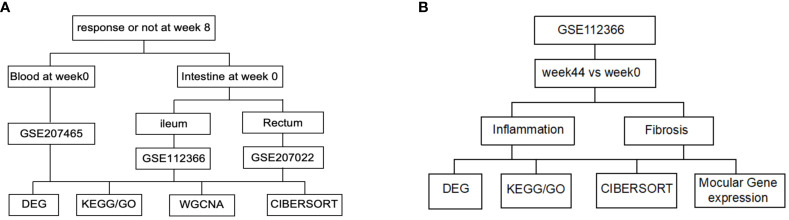
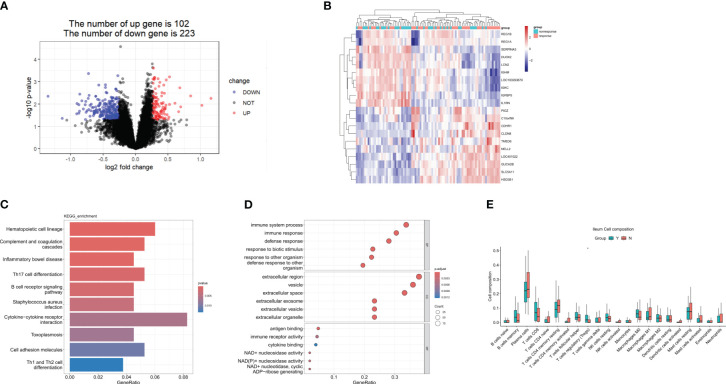
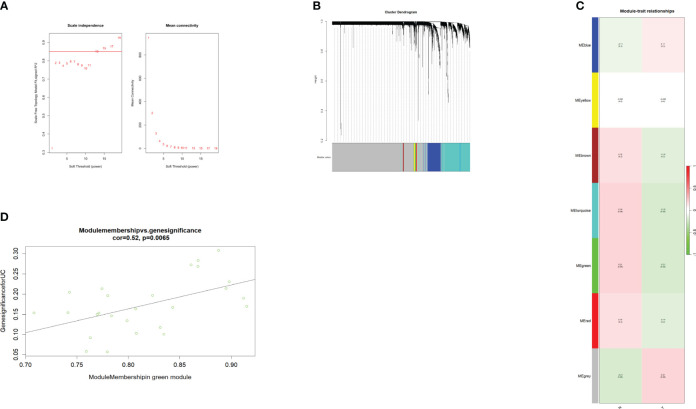
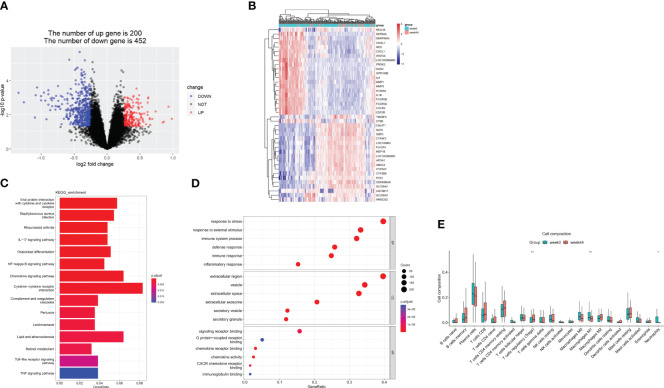
Public datasets-GSE207465 (blood samples) and GSE112366 and GSE207022 (intestinal samples)-were downloaded and analyzed individually (unmerged) based on the treatment response. Differentially expressed genes (DEGs) were identified by the "limma" R package and changes in immune cell infiltration were determined by the "CIBERSORT" R package in both blood and intestinal samples at week 0 (before treatment). To find predictive factors of ustekinumab treatment response, the weighted gene co-expression network analysis (WGCNA) R package was used to identify hub genes in GSE112366. Hub genes were then verified in GSE207022, and a prediction model was built by random forest algorithm. Furthermore, fibrosis-related gene changes were analyzed in ileal samples before and after treatment with ustekinumab.
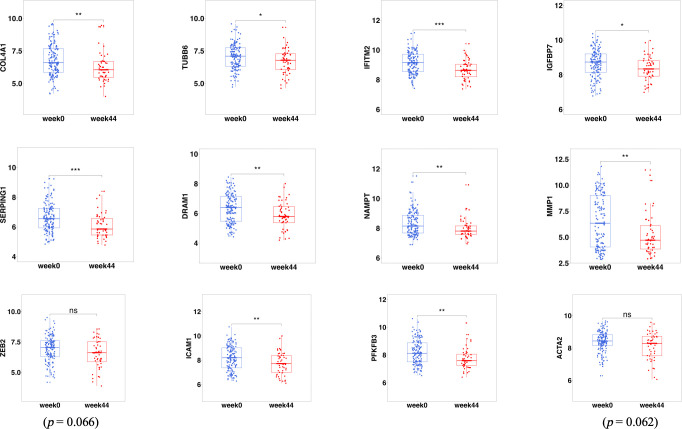
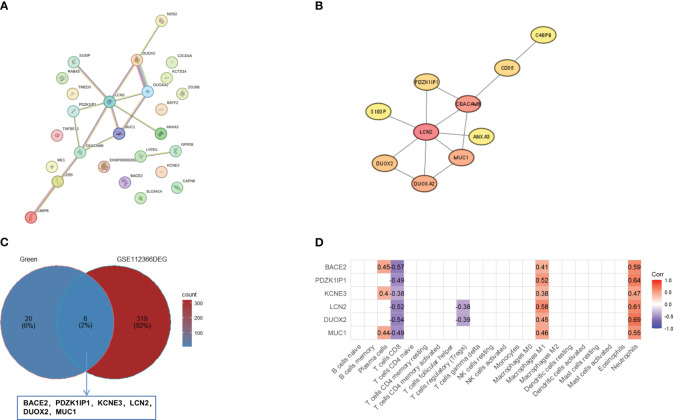
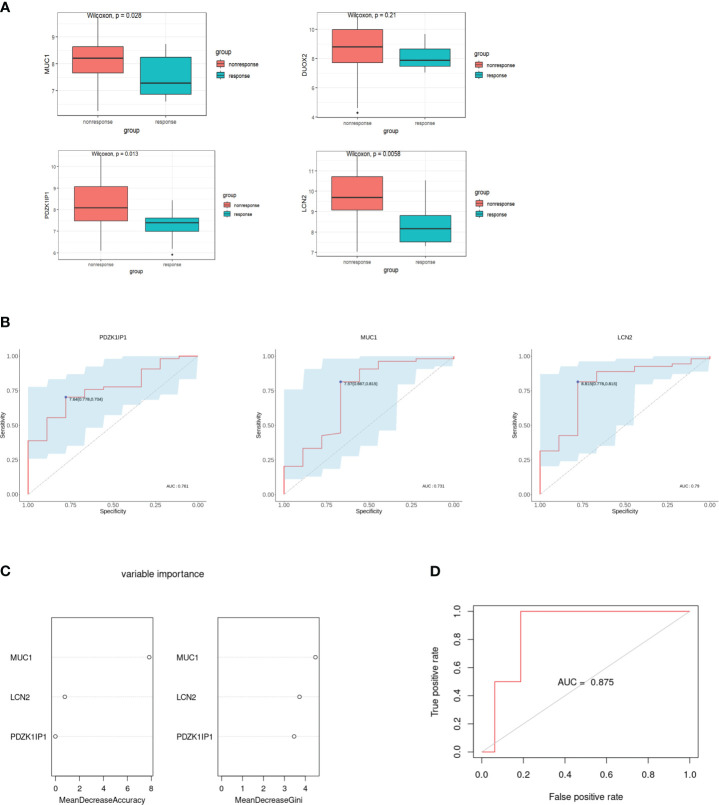
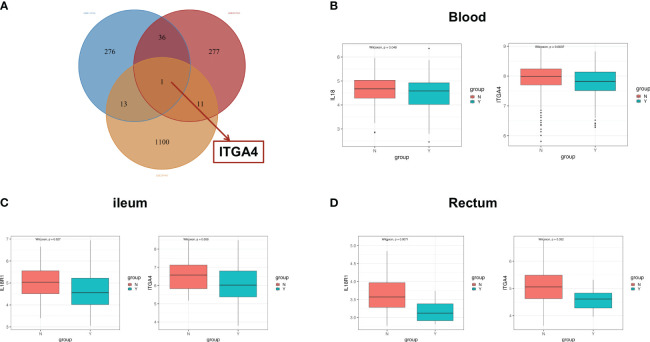
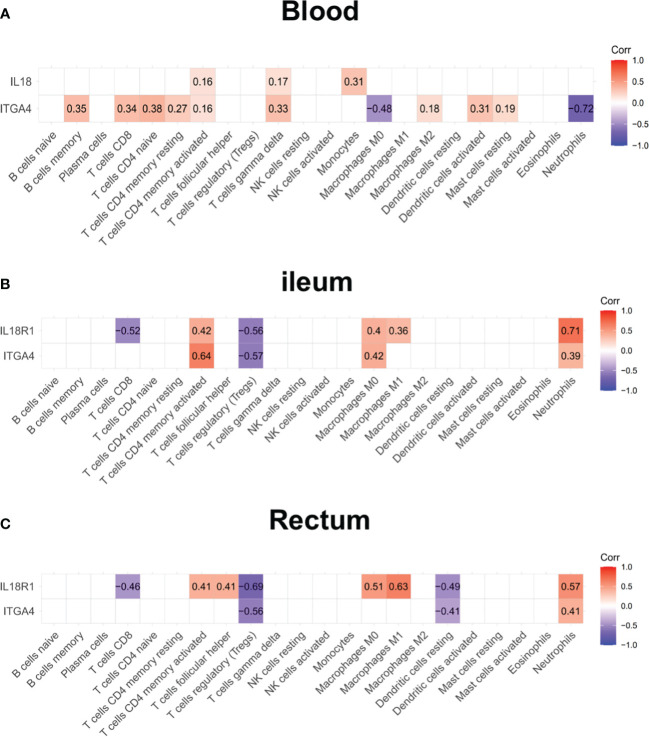
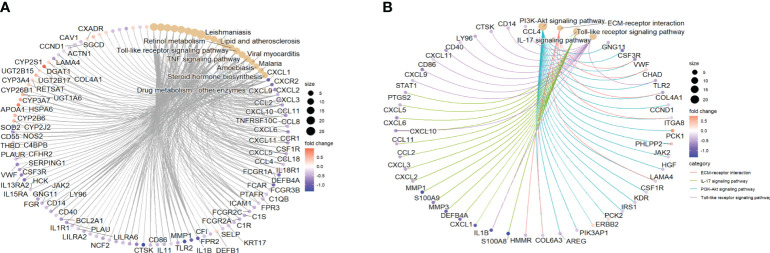
(1) Our analysis found that , , , and were hub genes in GSE112366. GSE207022 revealed that (AUC:0.761), (AUC:0.79), and (AUC:0.731) were also lower in the response group. Moreover, the random forest model was shown to have strong predictive capabilities in identifying responders (AUC = 0.875). To explore the relationship between intestinal tissue and blood, we found that had lower expression in the intestinal and blood samples of responders. The expression of is also lower in responders' intestines. , the ligand of , was also found to have lower expression in the blood samples from responders vs. non-responders. (2) GSE112366 revealed a significant decrease in fibrosis-related module genes (, , , , , , , , , , and ) and fibrosis-related pathways (ECM-receptor interaction and PI3K-AKT pathways) after ustekinumab treatment.
, , and were identified as hub genes in intestinal samples, with lower expression indicating a positive prediction of ustekinumab treatment response. Moreover, and may be involved in the treatment response in blood and intestinal samples. Finally, ustekinumab treatment was shown to significantly alter fibrotic genes and pathways.
克罗恩病(CD)是一种慢性炎症性疾病。大约 50%的 CD 患者从炎症进展为纤维化。目前,尚无有效的治疗肠道纤维化的药物。生物疗法如乌司奴单抗对 CD 患者有益;然而,高达 30%的 CD 患者对初始治疗无反应,乌司奴单抗对肠道纤维化的效果仍不确定。因此,探索乌司奴单抗治疗反应的预测因素以及乌司奴单抗对肠道纤维化的影响具有重要意义。
下载公共数据集-GSE207465(血液样本)和 GSE112366、GSE207022(肠道样本)-并根据治疗反应单独(未合并)进行分析。通过“limma”R 包鉴定差异表达基因(DEGs),并通过“CIBERSORT”R 包确定血液和肠道样本在第 0 周(治疗前)中免疫细胞浸润的变化。为了寻找乌司奴单抗治疗反应的预测因素,使用加权基因共表达网络分析(WGCNA)R 包在 GSE112366 中识别枢纽基因。然后在 GSE207022 中验证枢纽基因,并通过随机森林算法构建预测模型。此外,还分析了乌司奴单抗治疗前后回肠样本中的纤维化相关基因变化。
(1)我们的分析发现,、、和在 GSE112366 中是枢纽基因。GSE207022 显示,在反应组中,(AUC:0.761)、(AUC:0.79)和(AUC:0.731)也较低。此外,随机森林模型在识别应答者方面表现出很强的预测能力(AUC=0.875)。为了探索肠道组织与血液之间的关系,我们发现,在应答者的肠道和血液样本中表达较低。应答者肠道中也表达较低。配体,也发现在应答者的血液样本中表达较低,而非应答者。(2)GSE112366 显示,乌司奴单抗治疗后纤维化相关模块基因(、、、、、、、、、和)和纤维化相关途径(ECM-受体相互作用和 PI3K-AKT 途径)显著降低。
在肠道样本中,被鉴定为枢纽基因,表达较低预示着乌司奴单抗治疗反应的阳性预测。此外,和可能参与血液和肠道样本的治疗反应。最后,乌司奴单抗治疗显著改变了纤维化基因和途径。