Department of Interventional Radiology and Vascular Surgery, Peking University First Hospital, Beijing, China.
Department of Hematology, Peking University First Hospital, Beijing, China.
Front Immunol. 2022 Jun 20;13:896645. doi: 10.3389/fimmu.2022.896645. eCollection 2022.
Crohn's disease (CD) and peripheral arterial disease (PAD) are closely related. The pathophysiological mechanisms underlying the coexistence of CD and PAD are unknown. The aim of this study was to investigate the key molecules and pathways mediating the co-occurrence of CD and PAD through quantitative bioinformatic analysis of a public RNA sequencing database.
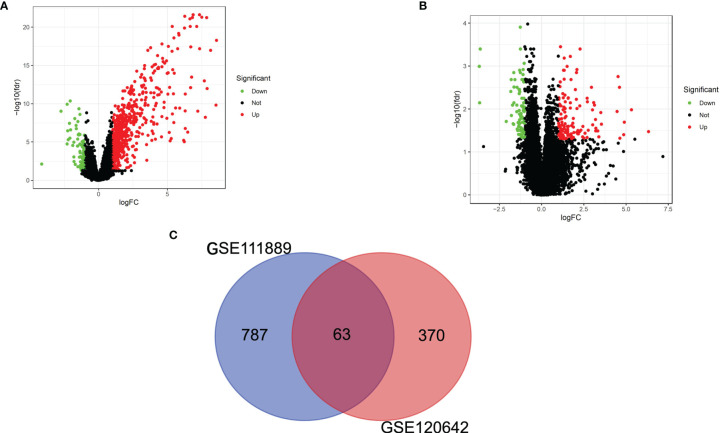
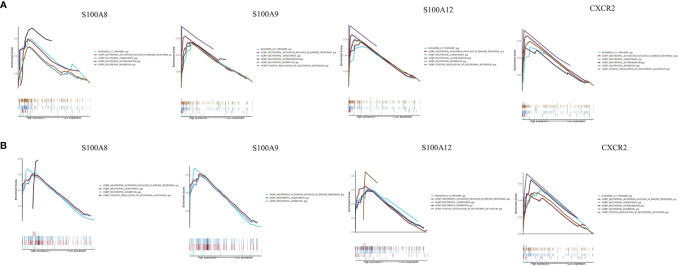
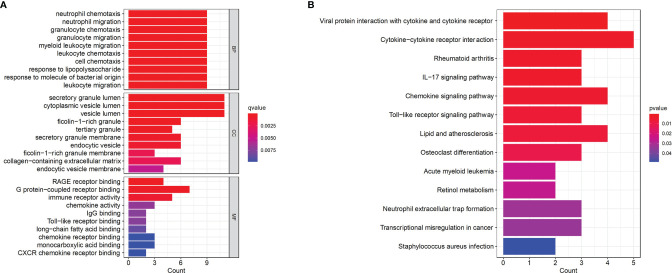
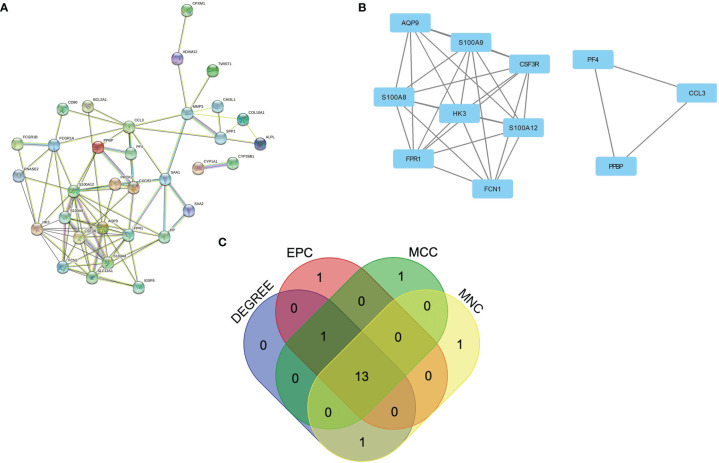
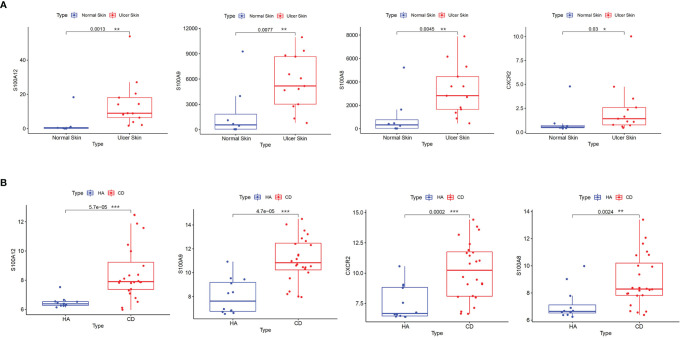
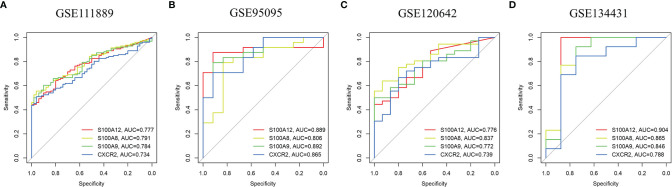
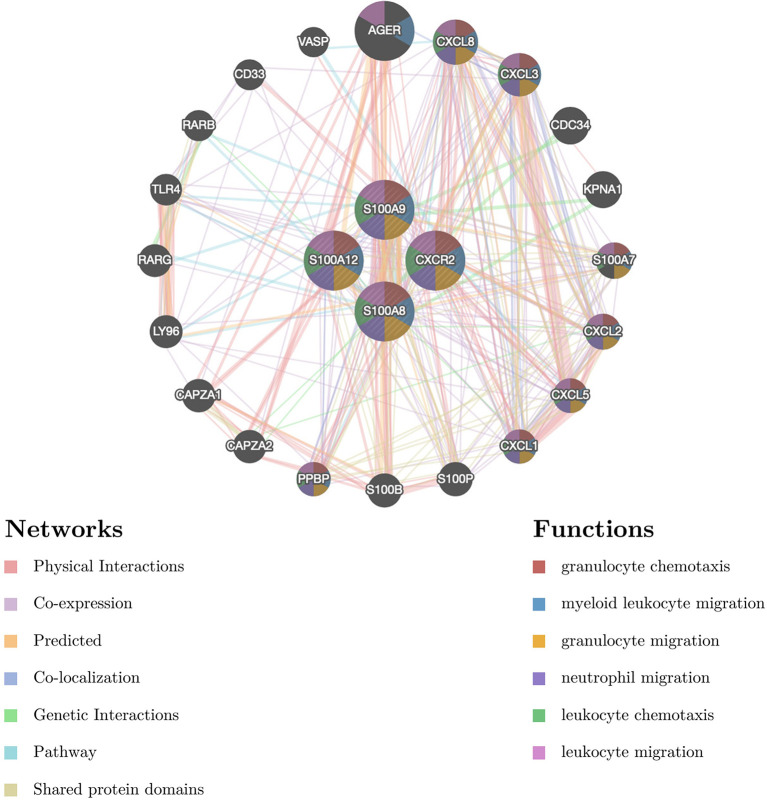
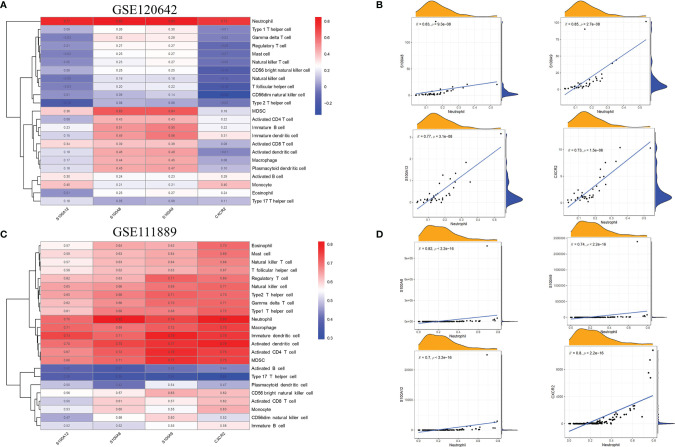
Datasets of CD (GSE111889) and PAD (GSE120642) were downloaded from the Gene Expression Omnibus (GEO) database. Differentially expressed genes (DEGs) were analyzed using the 'edgeR' and 'limma' packages of R. Gene Ontology and Kyoto Encyclopedia analyses of common DEGs were performed to explore the functions of DEGs. Protein-protein interaction (PPI) networks were established by the Search Tool for the Retrieval of Interacting Genes (STRING) database and visualized by Cytoscape. Hub genes were selected using the plugin cytoHubba. Hub gene validation was performed in GSE95095 for CD and GSE134431 for PAD. Receiver operating characteristic curves were used to evaluate the predictive values of the hub genes. Gene set enrichment analysis and immune infiltration of the hub genes were performed.
A total of 54 common DEGs (2 downregulated and 52 upregulated) were identified. Pathways of neutrophil chemotaxis, neutrophil migration and cytokine and cytokine receptors were enriched in CD and PAD. S100A8, S100A9, S100A12 and CXCR2 were identified as hub genes after validation, with all area under the curve > 0.7 for both CD and PAD. Neutrophil infiltration was associated with upregulation of the hub genes. Pathways of immune processes, including neutrophil activation, neutrophil chemotaxis, neutrophil migration were significantly correlated with high expression of S100A8, S100A9, S100A12 and CXCR2 in both CD and PAD.
This bioinformatic study elucidates S100A8, S100A9, S100A12 and CXCR2 as hub genes for the co-occurrence of Crohn's disease and peripheral artery disease. Inflammation and immune regulation modulated by neutrophil infiltration play a central role in the development of CD and PAD and may be potential targets for diagnosis and treatment.
克罗恩病(CD)和外周动脉疾病(PAD)密切相关。CD 和 PAD 共存的病理生理机制尚不清楚。本研究旨在通过对公共 RNA 测序数据库进行定量生物信息学分析,研究介导 CD 和 PAD 同时发生的关键分子和途径。
从基因表达综合数据库(GEO)下载 CD(GSE111889)和 PAD(GSE120642)数据集。使用 R 中的'edgeR'和'limma'包分析差异表达基因(DEGs)。对共同 DEGs 进行基因本体论和京都基因与基因组百科全书分析,以探讨 DEGs 的功能。通过 Search Tool for the Retrieval of Interacting Genes(STRING)数据库建立蛋白质-蛋白质相互作用(PPI)网络,并通过 Cytoscape 可视化。使用插件 cytoHubba 选择枢纽基因。在 GSE95095 中验证 CD 中的枢纽基因,在 GSE134431 中验证 PAD 中的枢纽基因。使用接收器工作特征曲线评估枢纽基因的预测值。对枢纽基因进行基因集富集分析和免疫浸润分析。
共鉴定出 54 个共同 DEGs(2 个下调和 52 个上调)。CD 和 PAD 中富含中性粒细胞趋化、中性粒细胞迁移和细胞因子及细胞因子受体途径。经过验证,S100A8、S100A9、S100A12 和 CXCR2 被确定为枢纽基因,两者的曲线下面积均大于 0.7。中性粒细胞浸润与枢纽基因的上调有关。免疫过程途径,包括中性粒细胞激活、中性粒细胞趋化、中性粒细胞迁移,与 CD 和 PAD 中 S100A8、S100A9、S100A12 和 CXCR2 的高表达显著相关。
这项生物信息学研究阐明了 S100A8、S100A9、S100A12 和 CXCR2 是 CD 和 PAD 同时发生的枢纽基因。由中性粒细胞浸润调节的炎症和免疫调节在 CD 和 PAD 的发生发展中起核心作用,可能是诊断和治疗的潜在靶点。