Chung J N, Dong Jun, Wang Hao, Han Huang Bo, Hartwig Jason
Cryogenics Heat Transfer Laboratory, Department of Mechanical and Aerospace Engineering, University of Florida, Gainesville, FL, 32611-6300, USA.
NASA Glenn, Research Center, Cleveland, OH, USA.
NPJ Microgravity. 2024 Jun 6;10(1):65. doi: 10.1038/s41526-024-00403-6.
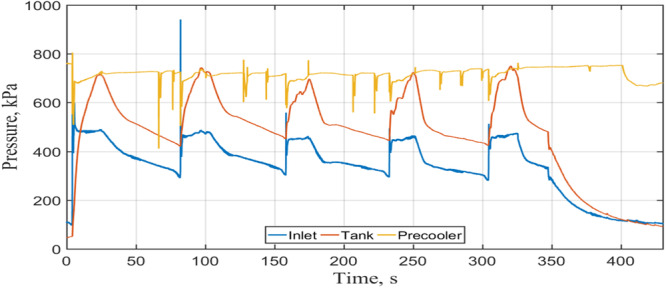
The space exploration from a low earth orbit to a high earth orbit, then to Moon, Mars, and possibly asteroids and moons of other planets is one of the biggest challenges for scientists and engineers for the new millennium. The enabling of in-space cryogenic rocket engines and the Lower-Earth-Orbit (LEO) cryogenic fuel depots for these future manned and robotic space exploration missions begins with the technology development of advanced cryogenic thermal-fluid management systems for the propellant transfer line and storage tank system. One of the key thermal-fluid management operations is the chilldown and filling of the propellant storage tank in space. As a result, highly energy efficient, breakthrough concepts for quenching heat transfer to conserve and minimize the cryogen consumption during chilldown have become the focus of engineering research and development, especially for the deep-space mission to Mars. In this paper, we introduce such thermal transport concepts and demonstrate their feasibilities in space for cryogenic propellant storage tank chilldown and filling in a simulated space microgravity condition on board an aircraft flying a parabolic trajectory. In order to maximize the storage tank chilldown thermal efficiency for the least amount of required cryogen consumption, the breakthrough quenching heat transfer concepts developed include the combination of charge-hold-vent (CHV) and no-vent-hold (NVF). The completed flight experiments successfully demonstrated the feasibility of the concepts and discovered that spray cooling combined with hold and vent is more efficient than the pure spray cooling for storage tank chilldown in microgravity. In microgravity, the data shows that the CHV thermal efficiency can reach 39.5%. The CHV efficiency in microgravity is 6.9% lower than that in terrestrial gravity. We also found that pulsing the spray can increase CHV efficiency by 6.1% in microgravity.
从低地球轨道到高地球轨道,再到月球、火星,甚至可能包括其他行星的小行星和卫星的太空探索,是新千年科学家和工程师面临的最大挑战之一。为这些未来的载人及机器人太空探索任务启用太空低温火箭发动机和低地球轨道(LEO)低温燃料库,始于推进剂输送管路和储存箱系统先进低温热流体管理系统的技术开发。关键的热流体管理操作之一是太空推进剂储存箱的冷却和加注。因此,在冷却过程中高效节能、突破性的淬火传热概念,以节约并尽量减少低温剂消耗,已成为工程研发的重点,尤其是对于火星深空任务而言。在本文中,我们介绍了此类热传输概念,并在沿抛物线轨迹飞行的飞机上模拟的太空微重力条件下,展示了它们在太空用于低温推进剂储存箱冷却和加注的可行性。为了以最少的所需低温剂消耗实现储存箱冷却的热效率最大化,所开发的突破性淬火传热概念包括充注-保持-排放(CHV)和无排放-保持(NVF)相结合。完成的飞行实验成功证明了这些概念的可行性,并发现喷雾冷却与保持和排放相结合,在微重力环境下对储存箱冷却比单纯喷雾冷却更有效。在微重力环境下,数据显示CHV热效率可达39.5%。微重力环境下CHV效率比地球重力环境下低6.9%。我们还发现脉冲喷雾可使微重力环境下的CHV效率提高6.1%。