Department of Internal Medicine II, University Hospital Regensburg, Franz-Josef-Strauss-Allee 11, 93053, Regensburg, Germany.
Centre of Clinical Studies, University Hospital Regensburg, Franz-Josef-Strauss-Allee 11, 93053, Regensburg, Germany.
Cardiovasc Diabetol. 2024 Jun 6;23(1):195. doi: 10.1186/s12933-024-02289-w.
Micro- and macrovascular diseases are common in patients with type 2 diabetes mellitus (T2D) and may be partly caused by nocturnal hypoxemia. The study aimed to characterize the composition of nocturnal hypoxemic burden and to assess its association with micro- and macrovascular disease in patients with T2D.
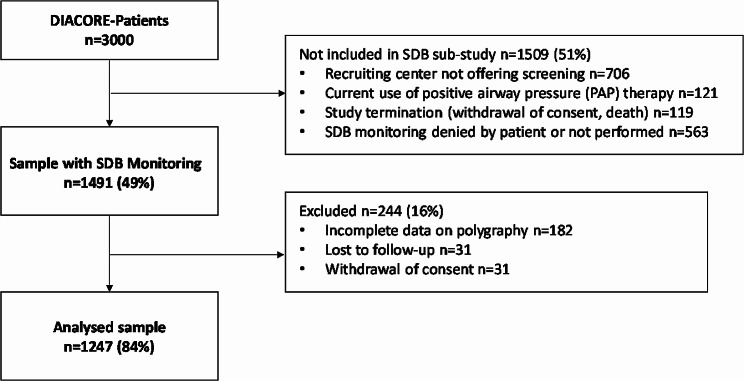
This cross-sectional analysis includes overnight oximetry from 1247 patients with T2D enrolled in the DIACORE (DIAbetes COhoRtE) study. Night-time spent below a peripheral oxygen saturation of 90% (T90) as well as T90 associated with non-specific drifts in oxygen saturation (T90), T90 associated with acute oxygen desaturation (T90) and desaturation depths were assessed. Binary logistic regression analyses adjusted for known risk factors (age, sex, smoking status, waist-hip ratio, duration of T2D, HbA1c, pulse pressure, low-density lipoprotein, use of statins, and use of renin-angiotensin-aldosterone system inhibitors) were used to assess the associations of such parameters of hypoxemic burden with chronic kidney disease (CKD) as a manifestation of microvascular disease and a composite of cardiovascular diseases (CVD) reflecting macrovascular disease.
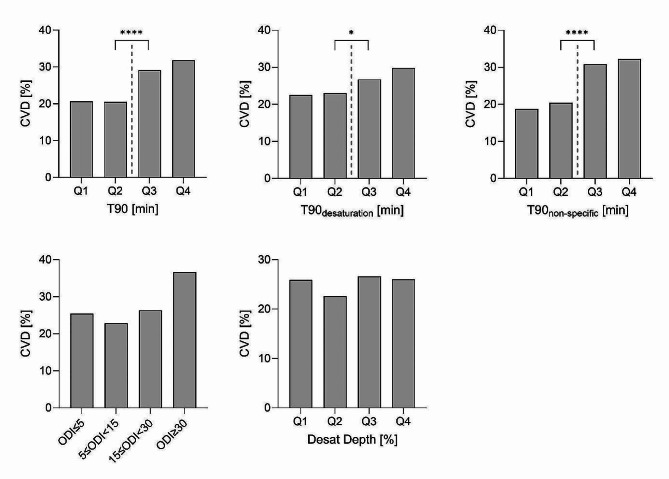
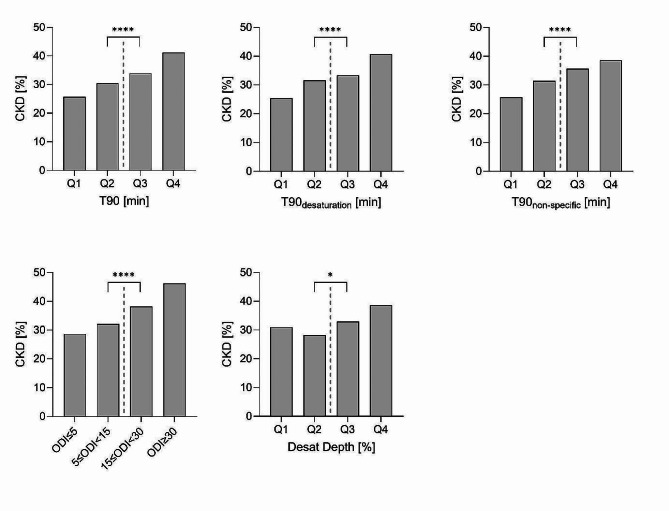
Patients with long T90 were significantly more often affected by CKD and CVD than patients with a lower hypoxemic burden (CKD 38% vs. 28%, p < 0.001; CVD 30% vs. 21%, p < 0.001). Continuous T90 and desaturation depth were associated with CKD (adjusted OR 1.01 per unit, 95% CI [1.00; 1.01], p = 0.008 and OR 1.30, 95% CI [1.06; 1.61], p = 0.013, respectively) independently of other known risk factors for CKD. For CVD there was a thresholdeffect, and only severly and very severly increased T90 was associated with CVD ([Q3;Q4] versus [Q1;Q2], adjusted OR 1.51, 95% CI [1.12; 2.05], p = 0.008) independently of other known risk factors for CVD.
While hypoxemic burden due to oxygen desaturations and the magnitude of desaturation depth were significantly associated with CKD, only severe hypoxemic burden due to non-specific drifts was associated with CVD. Specific types of hypoxemic burden may be related to micro- and macrovascular disease.
微血管和大血管疾病在 2 型糖尿病(T2D)患者中很常见,可能部分由夜间低氧血症引起。本研究旨在描述夜间低氧血症负担的构成,并评估其与 T2D 患者微血管和大血管疾病的关系。
本横断面分析纳入了 DIACORE(糖尿病队列研究)研究中 1247 例 T2D 患者的夜间血氧监测数据。评估夜间血氧饱和度低于 90%的时间(T90)以及与血氧饱和度非特异性漂移相关的 T90(T90)、与急性血氧下降相关的 T90(T90)和下降深度。采用二元逻辑回归分析,调整已知危险因素(年龄、性别、吸烟状况、腰臀比、T2D 病程、HbA1c、脉压、低密度脂蛋白、他汀类药物使用和肾素-血管紧张素-醛固酮系统抑制剂使用),评估低氧血症负担的这些参数与慢性肾脏病(CKD)作为微血管疾病表现和心血管疾病(CVD)复合的关联,后者反映大血管疾病。
T90 较长的患者发生 CKD 和 CVD 的比例明显高于低低氧血症负担的患者(CKD 为 38%比 28%,p<0.001;CVD 为 30%比 21%,p<0.001)。连续 T90 和下降深度与 CKD 相关(每单位调整后的 OR 为 1.01,95%CI [1.00;1.01],p=0.008;OR 为 1.30,95%CI [1.06;1.61],p=0.013),独立于其他已知的 CKD 危险因素。对于 CVD,存在一个阈值效应,只有严重和非常严重的 T90 升高与 CVD 相关([Q3;Q4]与 [Q1;Q2],调整后的 OR 为 1.51,95%CI [1.12;2.05],p=0.008),独立于其他已知的 CVD 危险因素。
虽然由于氧饱和度下降引起的低氧血症负担和下降深度与 CKD 显著相关,但只有由于非特异性漂移引起的严重低氧血症负担与 CVD 相关。低氧血症负担的特定类型可能与微血管和大血管疾病有关。