Tafelmeier Maria, Blagoeva Verka-Georgieva, Trum Maximilian, Hegner Philipp, Floerchinger Bernhard, Camboni Daniele, Creutzenberg Marcus, Zeman Florian, Schmid Christof, Maier Lars Siegfried, Wagner Stefan, Linz Dominik, Baumert Mathias, Arzt Michael
Department of Internal Medicine II (Cardiology, Pneumology, and Intensive Care), University Medical Center Regensburg, 93053 Regensburg, Germany.
Department of Cardiothoracic Surgery, University Medical Center Regensburg, 93053 Regensburg, Germany.
Biomedicines. 2023 Sep 28;11(10):2665. doi: 10.3390/biomedicines11102665.
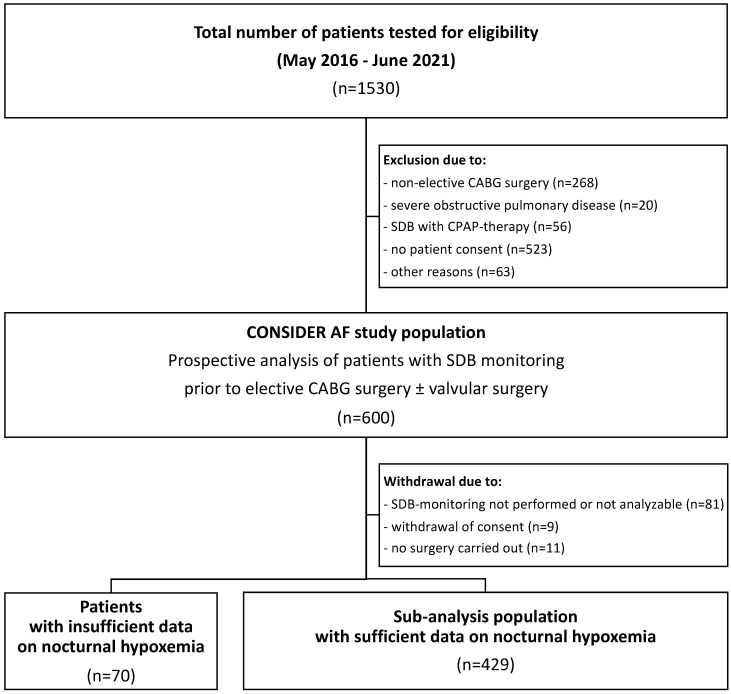
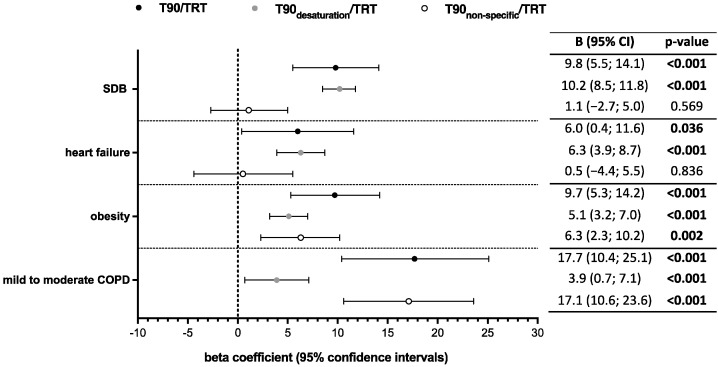
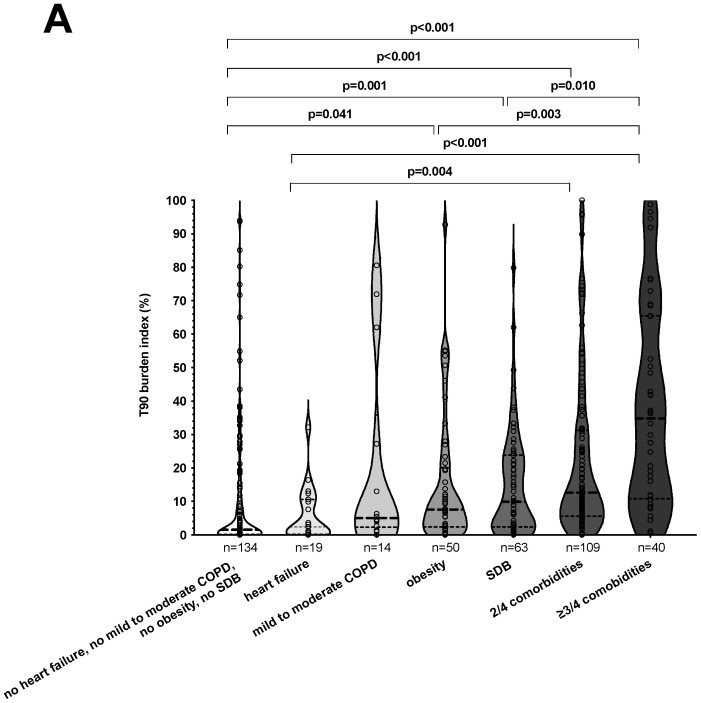
Nocturnal hypoxemia has been linked to increased cardiovascular morbidity and mortality. Several common diseases, such as sleep-disordered breathing (SDB), heart failure (HF), obesity, and pulmonary disease, coincide with an elevated nocturnal hypoxemic burden with and without repetitive desaturations. This study aimed to evaluate the association of relevant common diseases with distinctive metrics of nocturnal hypoxemic burden with and without repetitive desaturations in patients undergoing coronary artery bypass grafting surgery. In this subanalysis of the prospective observational study, CONSIDER-AF (NCT02877745) portable SDB monitoring was performed on 429 patients with severe coronary artery disease the night before cardiac surgery. Pulse oximetry was used to determine nocturnal hypoxemic burden, as defined by total recording time spent with oxygen saturation levels < 90% (T90). T90 was further characterized as T90 due to intermittent hypoxemia (T90) and T90 due to nonspecific and noncyclic SpO-drifts (T90). Multivariable linear regression analysis identified SDB (apnea-hypopnea-index ≥ 15/h; B [95% CI]: 6.5 [0.4; 12.5], = 0.036), obesity (8.2 [2.5; 13.9], = 0.005), and mild-to-moderate chronic obstructive pulmonary disease (COPD, 16.7 [8.5; 25.0], < 0.001) as significant predictors of an increased nocturnal hypoxemic burden. Diseases such as SDB, obesity and HF were significantly associated with elevated T90. In contrast, obesity and mild-to-moderate COPD were significant modulators of T90. SDB and leading causes for SDB, such as obesity and HF, are associated with an increased nocturnal hypoxemic burden with repetitive desaturations. Potential causes for hypoventilation syndromes, such as obesity and mild-to-moderate COPD, are linked to an increased hypoxemic burden without repetitive desaturations. ClinicalTrials.gov identifier: NCT02877745.
夜间低氧血症与心血管疾病发病率和死亡率的增加有关。几种常见疾病,如睡眠呼吸紊乱(SDB)、心力衰竭(HF)、肥胖和肺部疾病,无论有无反复血氧饱和度下降,夜间低氧血症负担均会升高。本研究旨在评估冠状动脉搭桥手术患者中,相关常见疾病与有无反复血氧饱和度下降的夜间低氧血症负担的不同指标之间的关联。在这项前瞻性观察研究的亚分析中,对429例严重冠状动脉疾病患者在心脏手术前一晚进行了CONSIDER-AF(NCT02877745)便携式SDB监测。采用脉搏血氧饱和度测定法确定夜间低氧血症负担,定义为氧饱和度水平<90%的总记录时间(T90)。T90进一步分为间歇性低氧血症导致的T90(T90)和非特异性、非周期性SpO漂移导致的T90(T90)。多变量线性回归分析确定SDB(呼吸暂停低通气指数≥15次/小时;B[95%CI]:6.5[0.4;12.5],P = 0.036)、肥胖(8.2[2.5;13.9],P = 0.005)和轻度至中度慢性阻塞性肺疾病(COPD,16.7[8.5;25.0],P<0.001)是夜间低氧血症负担增加的显著预测因素。SDB、肥胖和HF等疾病与T90升高显著相关。相比之下,肥胖和轻度至中度COPD是T90的显著调节因素。SDB及其主要病因,如肥胖和HF,与伴有反复血氧饱和度下降的夜间低氧血症负担增加有关。通气不足综合征的潜在病因,如肥胖和轻度至中度COPD,与无反复血氧饱和度下降的低氧血症负担增加有关。ClinicalTrials.gov标识符:NCT02877745。