Department of Fish and Wildlife Conservation, Virginia Tech, Blacksburg, VA, USA.
Department of Biomedical Sciences and Pathobiology, Virginia Tech, Blacksburg, VA, USA.
Parasit Vectors. 2024 Jun 6;17(1):248. doi: 10.1186/s13071-024-06330-5.
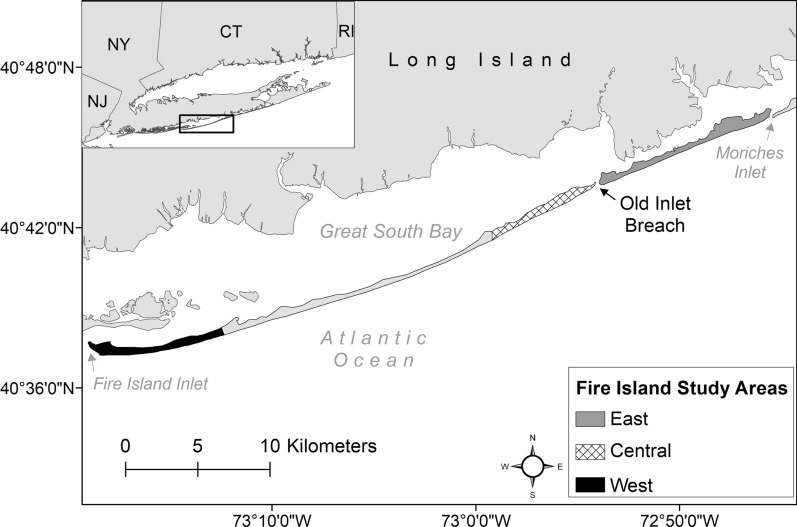
Sarcoptic mange is a skin disease caused by the contagious ectoparasite Sarcoptes scabiei, capable of suppressing and extirpating wild canid populations. Starting in 2015, we observed a multi-year epizootic of sarcoptic mange affecting a red fox (Vulpes vulpes) population on Fire Island, NY, USA. We explored the ecological factors that contributed to the spread of sarcoptic mange and characterized the epizootic in a landscape where red foxes are geographically constrained.
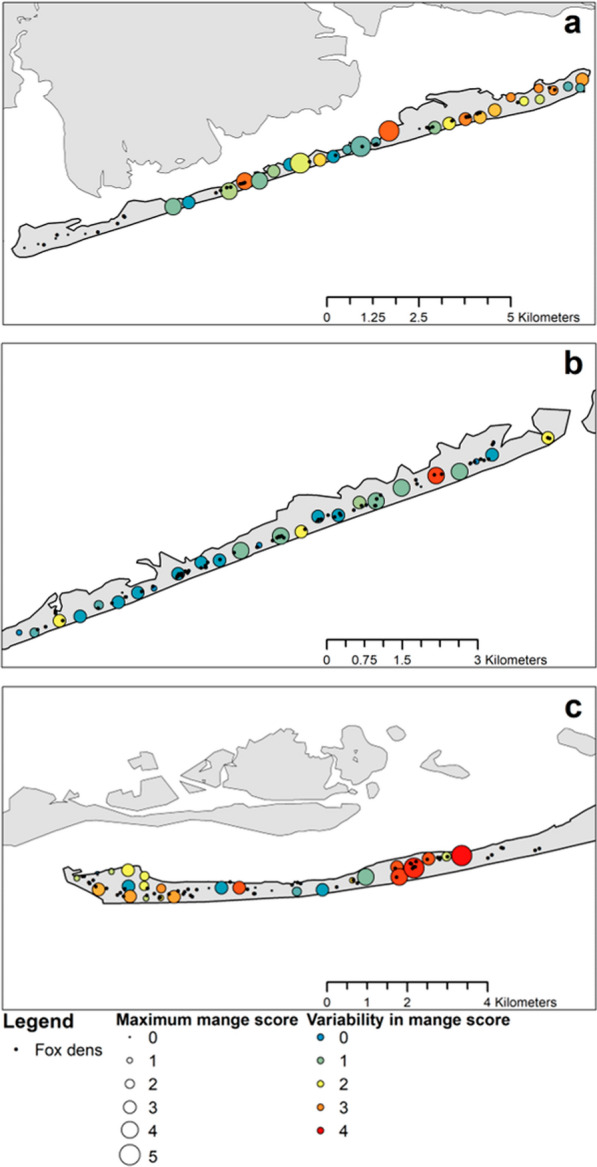
We tested for the presence of S. scabiei DNA in skin samples collected from deceased red foxes with lesions visibly consistent with sarcoptic mange disease. We deployed 96-100 remote trail camera stations each year to capture red fox occurrences and used generalized linear mixed-effects models to assess the affects of red fox ecology, human and other wildlife activity, and island geography on the frequency of detecting diseased red foxes. We rated the extent of visual lesions in diseased individuals and mapped the severity and variability of the sarcoptic mange disease.
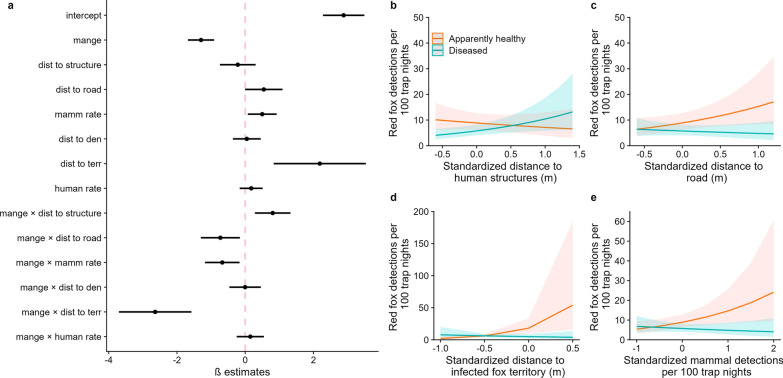
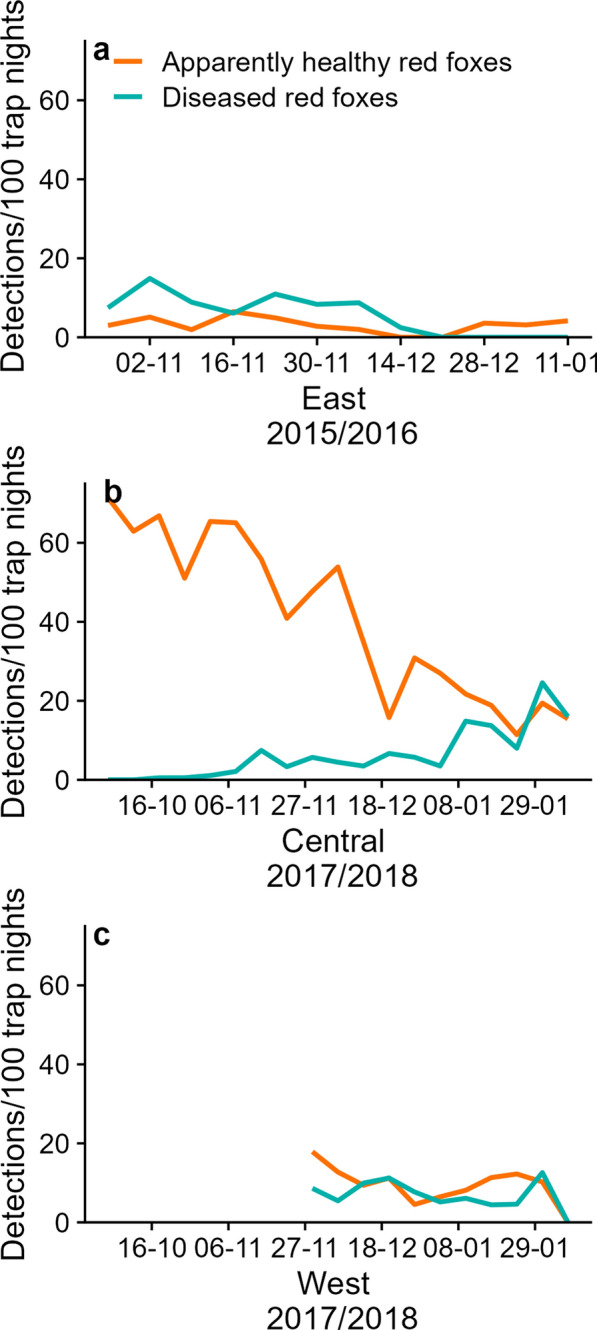
Skin samples that we analyzed demonstrated 99.8% similarity to S. scabiei sequences in GenBank. Our top-ranked model (weight = 0.94) showed that diseased red foxes were detected more frequently close to roadways, close to territories of other diseased red foxes, away from human shelters, and in areas with more mammal activity. There was no evidence that detection rates in humans and their dogs or distance to the nearest red fox den explained the detection rates of diseased red foxes. Although detected infrequently, we observed the most severe signs of sarcoptic mange at the periphery of residential villages. The spread of visual signs of the disease was approximately 7.3 ha/week in 2015 and 12.1 ha/week in 2017.
We quantified two separate outbreaks of sarcoptic mange disease that occurred > 40 km apart and were separated by a year. Sarcoptic mange revealed an unfettered spread across the red fox population. The transmission of S. scabiei mites in this system was likely driven by red fox behaviors and contact between individuals, in line with previous studies. Sarcoptic mange is likely an important contributor to red fox population dynamics within barrier island systems.
疥螨病是一种由传染性外寄生虫疥螨引起的皮肤疾病,能够抑制和消灭野生犬科动物种群。从 2015 年开始,我们观察到美国纽约火岛的红狐( Vulpes vulpes )种群中发生了多年的疥螨病流行。我们探讨了导致疥螨病传播的生态因素,并在红狐受到地理限制的景观中对该病进行了特征描述。
我们从有明显疥螨病病变的患病红狐尸体上采集皮肤样本,检测是否存在 S. scabiei DNA。每年,我们部署了 96-100 个远程步道相机站来捕捉红狐的出现情况,并使用广义线性混合效应模型来评估红狐生态学、人类和其他野生动物活动以及岛屿地理对检测患病红狐频率的影响。我们对患病个体的视觉病变程度进行了评分,并绘制了疥螨病的严重程度和变异性图。
我们分析的皮肤样本与 GenBank 中的 S. scabiei 序列相似度达到 99.8%。排名最高的模型(权重=0.94)显示,靠近道路、靠近其他患病红狐领地、远离人类住所和哺乳动物活动较多的地方,患病红狐更容易被检测到。没有证据表明人类及其狗的出现频率或距离最近的红狐巢穴可以解释患病红狐的检测率。尽管患病频率较低,但我们在居民区边缘观察到了最严重的疥螨病症状。2015 年,疾病视觉症状的传播速度约为每周 7.3 公顷,2017 年为每周 12.1 公顷。
我们量化了两次相隔 40 多公里且相隔一年的独立疥螨病爆发。疥螨病在红狐种群中不受控制地传播。在这个系统中, S. scabiei 螨虫的传播很可能是由红狐的行为和个体之间的接触驱动的,这与之前的研究一致。疥螨病很可能是滩涂岛屿系统中红狐种群动态的一个重要因素。