Browne Elizabeth, Driessen Michael M, Ross Robert, Roach Michael, Carver Scott
Department of Biological Sciences, University of Tasmania, Australia.
Department of Primary Industries, Parks, Water and Environment, Tasmanian Government, Australia.
Int J Parasitol Parasites Wildl. 2021 Aug 10;16:37-47. doi: 10.1016/j.ijppaw.2021.08.003. eCollection 2021 Dec.
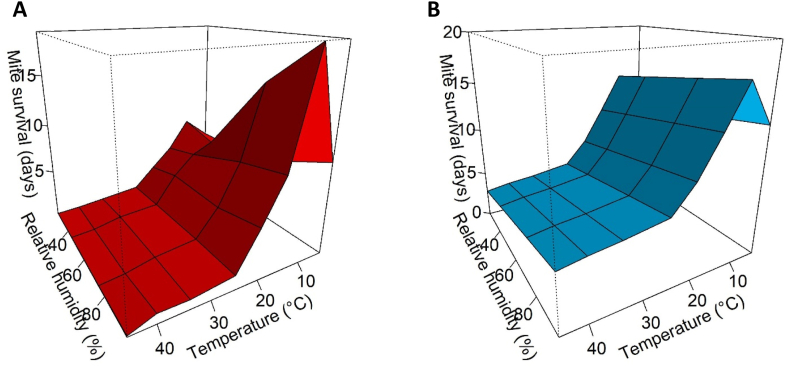
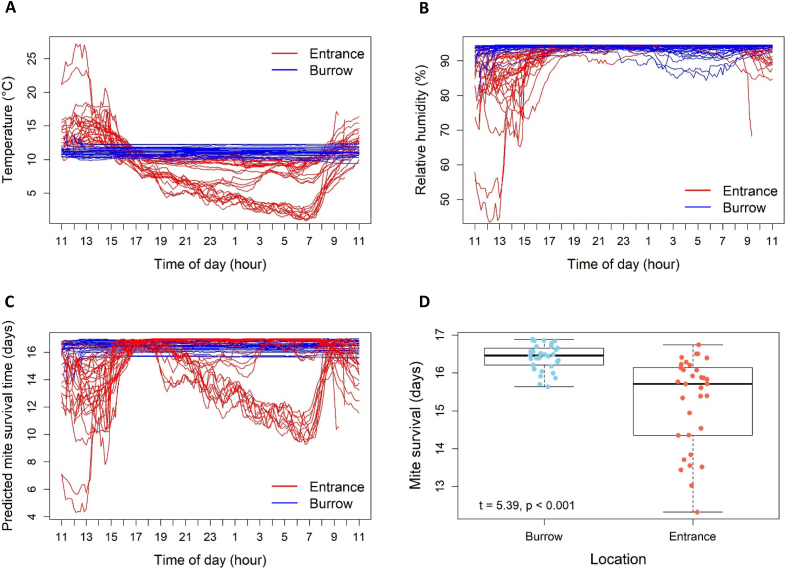
Some of the most important pathogens affecting wildlife are transmitted indirectly via the environment. Yet the environmental stages of pathogens are often poorly understood, relative to infection in the host, making this an important research frontier. Sarcoptic mange is a globally widespread disease caused by the parasitic mite . The bare-nosed wombat () is particularly susceptible, and their solitary nature and overlapping use of burrows strongly indicate the importance of environmental transmission. However, due to the challenge of accessing and monitoring within wombat burrows, there has been limited research into their suitability for off-host mite survival and environmental transmission (i.e., to serve as a fomite). We created a model using published laboratory data to predict mite survival times based on temperature and humidity. We then implemented innovative technologies (ground-penetrating radar and a tele-operated robotic vehicle) to map and access wombat burrows to record temperature and relative humidity. We found that the stable conditions within burrows were conducive for off-host survival of particularly in winter (estimated mite survival of 16.41 ± 0.34 days) and less so in warmer and drier months (summer estimated survival of 5.96 ± 0.37 days). We also compared two areas with higher and lower average mange prevalence in wombats (13.35% and 4.65%, respectively), finding estimated mite survival was slightly higher in the low prevalence area (10.10 and 12.12 days, respectively), contrary to our expectations, suggesting other factors are also important for population prevalence. Our study is the first to demonstrate the suitability of the bare-nosed wombat burrow for off-host mite survival and environmental transmission. Our findings have implications for understanding observed patterns of mange, disease dynamics and disease management for not only bare-nosed wombats, but also other burrow or den-obligate species exposed to via environmental transmission.
一些影响野生动物的最重要病原体是通过环境间接传播的。然而,相对于病原体在宿主体内的感染情况,其在环境中的阶段往往了解甚少,这使其成为一个重要的研究前沿领域。疥螨病是一种由寄生螨引起的全球广泛传播的疾病。裸鼻袋熊()对此特别易感,它们的独居习性以及洞穴的重叠使用强烈表明了环境传播的重要性。然而,由于进入和监测袋熊洞穴存在挑战,关于洞穴对离开宿主的螨虫生存及环境传播(即作为媒介物)的适宜性研究有限。我们利用已发表的实验室数据创建了一个模型,以根据温度和湿度预测螨虫的存活时间。然后,我们采用了创新技术(探地雷达和遥控机器人车辆)来绘制和进入袋熊洞穴,记录温度和相对湿度。我们发现,洞穴内的稳定条件有利于离开宿主的螨虫生存,尤其是在冬季(估计螨虫存活时间为16.41±0.34天),而在较温暖和干燥的月份(夏季估计存活时间为5.96±0.37天)则不太利于其生存。我们还比较了袋熊平均疥螨病患病率较高和较低的两个区域(分别为13.35%和4.65%),发现患病率较低区域的估计螨虫存活时间略长(分别为10.10天和12.12天),这与我们的预期相反,表明其他因素对种群患病率也很重要。我们的研究首次证明了裸鼻袋熊洞穴对离开宿主的螨虫生存及环境传播的适宜性。我们的研究结果不仅对于理解裸鼻袋熊的疥螨病观察模式、疾病动态和疾病管理具有重要意义,对于理解其他通过环境传播接触到该螨虫的穴居或依赖洞穴的物种也具有重要意义。