Faculty of Medicine, School of Basic Medicine, Dalian University of Technology, No.2 Linggong Road, Dalian, Liaoning Province 116024, China; Shandong Laboratory of Yantai Drug Discovery, Bohai Rim Advanced Research Institute for Drug Discovery, Yantai, Shandong Province 264000, China.
Department of Microbiology, Government Postgraduate College Mandian, Abbottabad, Pakistan.
Virus Res. 2024 Aug;346:199414. doi: 10.1016/j.virusres.2024.199414. Epub 2024 Jun 12.
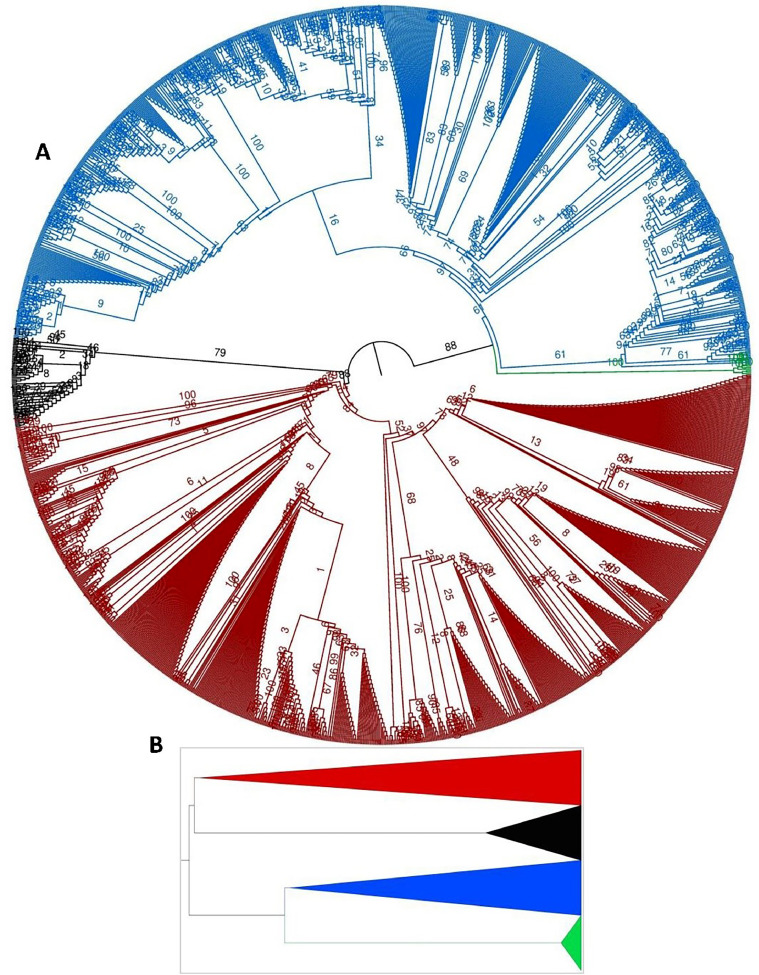
The human JC polyomavirus (JCV) is a widespread, neurotropic, opportunistic pathogen responsible for progressive multifocal leukoencephalopathy (PML) as well as other diseases in immunosuppressed individuals, including granule cell neuronopathy, JCV-associated nephropathy, encephalitis, and meningitis in rare cases. JCV classification is still unclear, where the ICTV (International Committee on Taxonomy of Viruses) has grouped all the strains into human polyomavirus 2, with no classification on clade and subclade levels. Therefore, JCV strains were previously classified using different genomic regions, e.g., full-length, VP1, and the V-T intergenic region etc., and the strains were grouped into several types related to various geographic locations and human ethnicities. However, neither of these classifications and nomenclature contemplates all the groups described so far. Herein, we evaluated all the available full-length coding genomes, VP1, and large T antigen nucleotide sequences of JCV reported during 1993-2023 and classified them into four major phylogenetic clades, i.e., GI-GIV, where GI is further grouped into two types GI.1 and GI.2 with five sub-clades each (GI.1/GI.2 a-e), GII into three (GII a-c), GIII as a separate clade, and GIV into seven sub-clades (GIV a-g). Similarly, the phylogeographic network analysis indicated four major clusters corresponding to GI-GIV clades, each with multiple subclusters and mutational sub-branches corresponding to the subclades. GI and GIV clusters are connected via GI.1-e reported from Europe and America, GII, GIII and GIV clusters are connected by GII-b and GII-c strains reported from Africa, while GIV cluster strains are connected to the Russia-Italy JCV haplotype. Furthermore, we identified JCV-variant-GS/B-Germany-1997 (GenBank ID: AF004350.1) as an inter-genotype recombinant having major and minor parents in the GI.1-e and GII-a clades, respectively. Additionally, the amino acid variability analysis revealed high entropy across all proteins. The large T antigen exhibited the highest variability, while the small t antigen showed the lowest variability. Our phylogenetic and phylogeographic analyses provide a new approach to genotyping and sub-genotyping and present a comprehensive classification system of JCV strains based on their genetic characteristics and geographic distribution, while the genetic recombination and amino acid variability can help identify pathogenicity and develop effective preventive and control measures against JCV infections.
人类 JC 多瘤病毒(JCV)是一种广泛存在的神经嗜性机会性病原体,可导致进行性多灶性白质脑病(PML)以及免疫抑制个体中的其他疾病,包括颗粒细胞神经元病、JCV 相关性肾病、脑炎和脑膜炎等罕见情况。JCV 的分类尚不清楚,国际病毒分类委员会(ICTV)将所有毒株归类为人类多瘤病毒 2,但在科和亚科水平上没有分类。因此,以前使用不同的基因组区域对 JCV 株进行分类,例如全长、VP1 和 V-T 间区等,并且根据与各种地理位置和人类种族有关的不同分类将毒株分为几种类型。然而,这些分类和命名法都没有考虑到迄今为止描述的所有群组。在此,我们评估了 1993 年至 2023 年期间报告的所有 JCV 全长编码基因组、VP1 和大 T 抗原核苷酸序列,并将其分为四个主要的系统发育进化枝,即 GI-GIV,其中 GI 进一步分为 GI.1 和 GI.2 两种类型,各有五个亚组(GI.1/GI.2 a-e),GII 分为三个(GII a-c),GIII 作为一个独立的进化枝,GIV 分为七个亚组(GIV a-g)。同样,系统地理网络分析表明存在四个主要的聚类,分别对应 GI-GIV 进化枝,每个聚类都有多个亚聚类和对应于亚组的突变子分支。GI 和 GIV 聚类通过来自欧洲和美洲的报告的 GI.1-e 连接,GII、GIII 和 GIV 聚类通过来自非洲的报告的 GII-b 和 GII-c 菌株连接,而 GIV 聚类菌株与俄罗斯-意大利 JCV 单倍型连接。此外,我们鉴定出 JCV 变体-GS/B-德国-1997(GenBank ID:AF004350.1)作为一种主要亲本为 GI.1-e 和次要亲本为 GII-a 进化枝的基因型间重组体。此外,氨基酸变异性分析显示所有蛋白质的熵都很高。大 T 抗原的变异性最高,而小 t 抗原的变异性最低。我们的系统发育和系统地理分析为基因分型和亚基因分型提供了一种新方法,并根据遗传特征和地理分布呈现了 JCV 株的综合分类系统,而遗传重组和氨基酸变异性可以帮助识别致病性并制定针对 JCV 感染的有效预防和控制措施。