Varidel Mathew, Hickie Ian B, Prodan Ante, Skinner Adam, Marchant Roman, Cripps Sally, Oliveria Rafael, Chong Min K, Scott Elizabeth, Scott Jan, Iorfino Frank
Brain and Mind Centre, The University of Sydney, Sydney, NSW, Australia.
Translational Health Research Institute, Western Sydney University, Sydney, NSW, Australia.
Npj Ment Health Res. 2024 Jun 7;3(1):26. doi: 10.1038/s44184-024-00071-0.
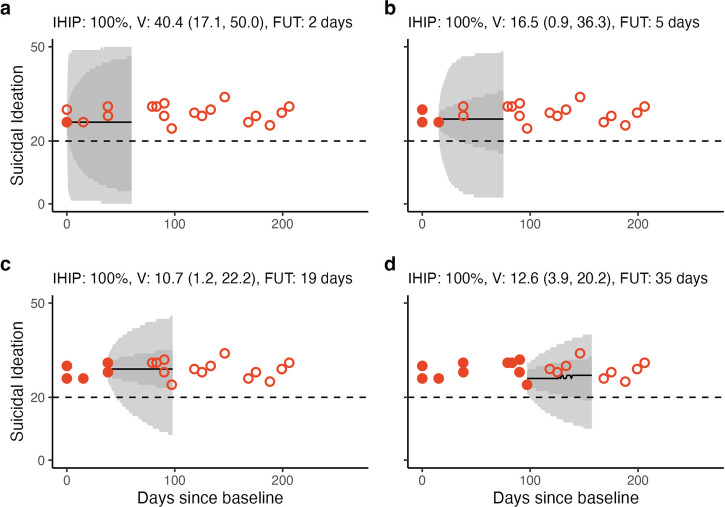
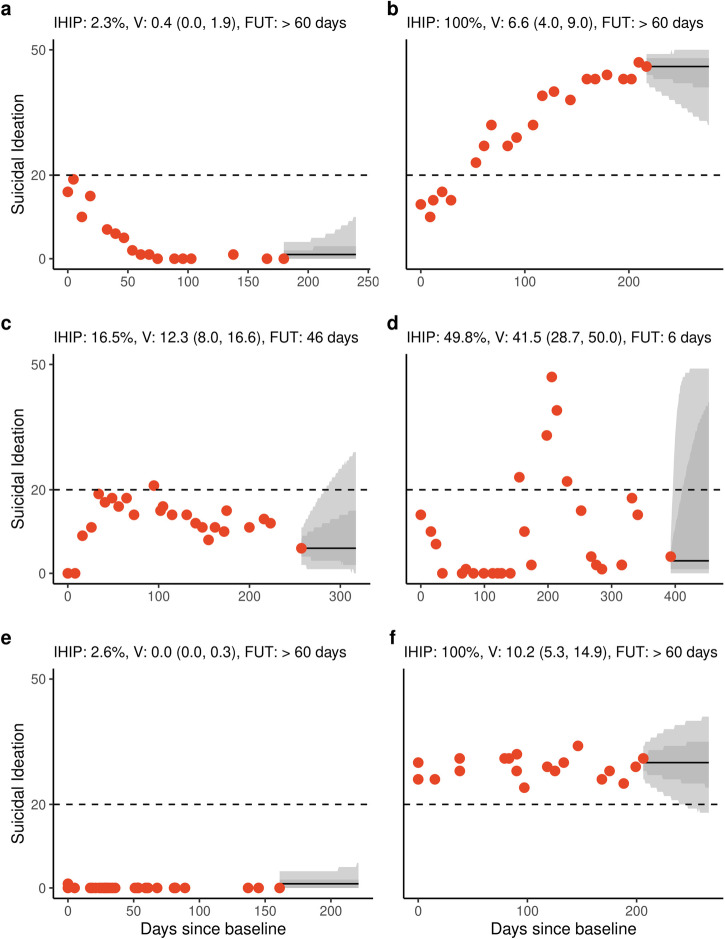
There has recently been an increase in ongoing patient-report routine outcome monitoring for individuals within clinical care, which has corresponded to increased longitudinal information about an individual. However, many models that are aimed at clinical practice have difficulty fully incorporating this information. This is in part due to the difficulty in dealing with the irregularly time-spaced observations that are common in clinical data. Consequently, we built individual-level continuous-time trajectory models of suicidal ideation for a clinical population (N = 585) with data collected via a digital platform. We demonstrate how such models predict an individual's level and variability of future suicide ideation, with implications for the frequency that individuals may need to be observed. These individual-level predictions provide a more personalised understanding than other predictive methods and have implications for enhanced measurement-based care.
最近,针对临床护理中的个体进行的患者报告常规结局监测有所增加,这与关于个体的纵向信息增加相对应。然而,许多针对临床实践的模型难以充分纳入这些信息。部分原因在于处理临床数据中常见的时间间隔不规则的观察结果存在困难。因此,我们利用通过数字平台收集的数据,为一个临床群体(N = 585)构建了自杀意念的个体水平连续时间轨迹模型。我们展示了此类模型如何预测个体未来自杀意念的水平和变异性,这对观察个体的频率具有启示意义。这些个体水平的预测比其他预测方法提供了更个性化的理解,并对基于测量的护理的加强具有启示意义。