Okurut Samuel, Boulware David R, Manabe Yukari C, Tugume Lillian, Skipper Caleb P, Ssebambulidde Kenneth, Rhein Joshua, Musubire Abdu K, Akampurira Andrew, Okafor Elizabeth, Olobo Joseph O, Janoff Edward N, Meya David B
Research Department, Infectious Diseases Institute, Makerere University, Kampala, Uganda.
Department of Medical Microbiology, School of Biomedical Sciences, College of Health Sciences, Makerere University, Kampala, Uganda.
medRxiv. 2024 May 31:2024.05.29.24308130. doi: 10.1101/2024.05.29.24308130.
Cryptococcal meningitis remains a prominent cause of death in persons with advanced HIV disease. CSF leukocyte infiltration predicts survival at 18 weeks; however, how CSF immune response relates to CSF leukocyte infiltration is unknown.
We enrolled 401 adults with HIV-associated cryptococcal meningitis in Uganda who received amphotericin and fluconazole induction therapy. We assessed the association of CSF leukocytes, chemokine, and cytokine responses with 18-week survival.
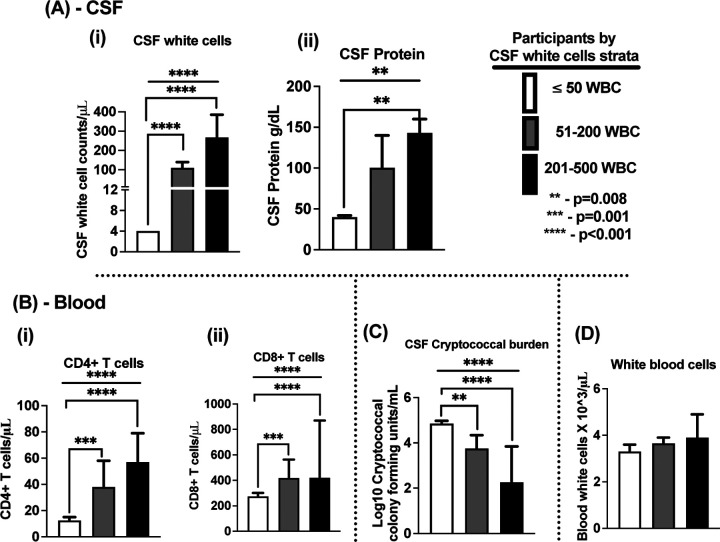
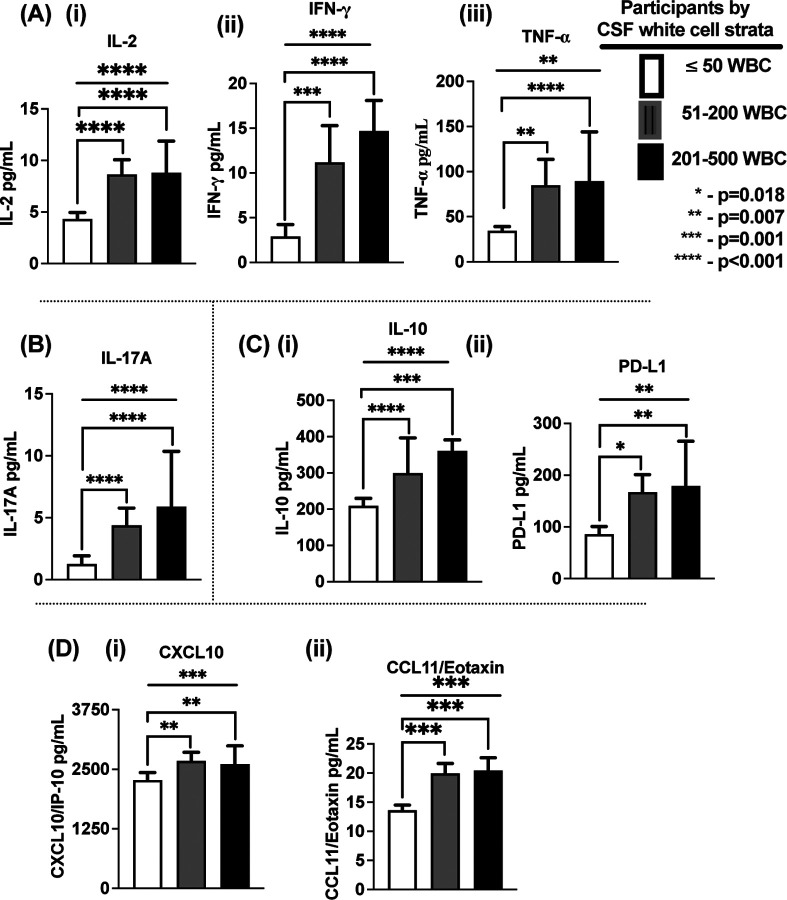
Participants with CSF leukocytes ≥50/μL, had higher probability 68% (52/77) of 18-week survival compared with 52% (151/292) 18-week survival in those with ≤50 cells/μL (Hazard Ratio=1.63, 95% confidence intervals 1.14-2.23; p=0.008). Survival was also associated with higher expression of T helper (Th)-1, Th17 cytokines, and immune regulatory elements. CSF levels of Programmed Death-1 Ligand, CXCL10, and Interleukin (IL)-2 independently predicted survival. In multivariate analysis, CSF leukocytes were inversely associated with CSF fungal burden and positively associated with CSF protein, interferon-gamma (IFN-γ), IL-17A, tumor necrosis factor (TNF)-α, and peripheral blood CD4 and CD8 T cells expression.
18-week survival after diagnosis of cryptococcal meningitis was associated with higher CSF leukocytes at baseline with greater T helper 1 (IFN-γ, IL-2 and TNF-α cytokines), T helper 17 (IL-17A cytokine) and CXCR3 T cell (CXCL10 chemokine) responses. These results highlight the interdependent contribution of soluble and cellular immune responses in predicting survival with HIV-associated cryptococcal meningitis.
隐球菌性脑膜炎仍然是晚期艾滋病患者死亡的一个主要原因。脑脊液白细胞浸润可预测18周时的生存率;然而,脑脊液免疫反应与脑脊液白细胞浸润之间的关系尚不清楚。
我们招募了乌干达401名患有HIV相关隐球菌性脑膜炎且接受两性霉素和氟康唑诱导治疗的成年人。我们评估了脑脊液白细胞、趋化因子和细胞因子反应与18周生存率之间的关联。
脑脊液白细胞≥50/μL的参与者18周生存率较高,为68%(52/77),而脑脊液白细胞≤50/μL的参与者18周生存率为52%(151/292)(风险比=1.63,95%置信区间1.14-2.23;p=0.008)。生存率还与辅助性T(Th)-1、Th17细胞因子以及免疫调节因子的高表达相关。程序性死亡-1配体、CXCL10和白细胞介素(IL)-2的脑脊液水平可独立预测生存率。在多变量分析中,脑脊液白细胞与脑脊液真菌负荷呈负相关,与脑脊液蛋白、干扰素-γ(IFN-γ)、IL-17A、肿瘤坏死因子(TNF)-α以及外周血CD4和CD8 T细胞表达呈正相关。
隐球菌性脑膜炎诊断后18周生存率与基线时较高的脑脊液白细胞以及更强的辅助性T细胞1(IFN-γ、IL-2和TNF-α细胞因子)、辅助性T细胞17(IL-17A细胞因子)和CXCR3 T细胞(CXCL10趋化因子)反应相关。这些结果突出了可溶性和细胞免疫反应在预测HIV相关隐球菌性脑膜炎生存率方面的相互依存作用。