Tarek Ghaly Salma, Eldemerdash Usama Nour, El-Shazly A H
Chemical and Petrochemical Engineering Department, Egypt-Japan University of Science and Technology, New Borg AL Arab City, 21934 Alexandria, Egypt.
Central Metallurgical Research and Development Institute (CMRDI), P.O. Box 87 Helwan, 11421 Cairo, Egypt.
ACS Omega. 2024 May 21;9(22):23512-23522. doi: 10.1021/acsomega.4c00671. eCollection 2024 Jun 4.
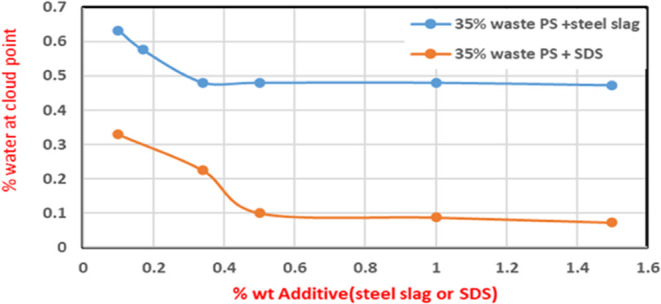
The development of the membrane surface and cross-sectional morphology is pivotal in influencing the effectiveness of membrane separation. In this study, evaluating the separation rates between the solvent and nonsolvent in the casting solution and the related thermodynamic alteration analysis were illustrated. Additionally, the rheological variations were determined by measuring the viscosity of the resulting dope solutions, providing an initial estimation of the phase separation kinetics. Asymmetric polystyrene (PS)/slag composite membrane, incorporating slag waste as an inorganic additive, was developed. Dimethylformamide (DMF) was utilized as the solvent, and sodium dodecyl sulfate (SDS) was employed as an anionic surfactant to facilitate the casting process. A tertiary system diagram approach involving waste PS, DMF, and water introducing slag as an inorganic additive and SDS as a surfactant was attained to promote the separation of the solvent and nonsolvent in the casting solution. These novel composite mixtures exhibited increased thermodynamic instability within the coagulation bath, facilitating the rapid separation of solid membranes from the dope solutions and forming composite membranes with significantly increased porosity (exceeding a 20% increase) compared to that of plain waste materials. The composite membrane characteristics were assessed with the widely used poly(vinylidene difluoride) (PVDF) membrane, showing comparative features and performance when tested on a membrane distillation (MD) cell; it gave a flux of 1 kg/m·h. These promising characteristics positioned this novel PS/slag composite membrane as a candidate for various water-related applications.
膜表面和横截面形态的发展对于影响膜分离的有效性至关重要。在本研究中,阐述了评估铸膜液中溶剂与非溶剂之间的分离速率以及相关的热力学变化分析。此外,通过测量所得铸膜液的粘度来确定流变学变化,从而对相分离动力学进行初步估计。开发了一种以矿渣废料作为无机添加剂的不对称聚苯乙烯(PS)/矿渣复合膜。使用二甲基甲酰胺(DMF)作为溶剂,并采用十二烷基硫酸钠(SDS)作为阴离子表面活性剂以促进铸膜过程。获得了一种三元体系图方法,该方法涉及将废PS、DMF和水引入矿渣作为无机添加剂以及SDS作为表面活性剂,以促进铸膜液中溶剂与非溶剂的分离。这些新型复合混合物在凝固浴中表现出更高的热力学不稳定性,有利于从铸膜液中快速分离出固体膜,并形成孔隙率比普通废料显著增加(超过20%)的复合膜。使用广泛应用的聚偏氟乙烯(PVDF)膜对复合膜特性进行了评估,在膜蒸馏(MD)池中测试时显示出可比的特征和性能;其通量为1 kg/m·h。这些有前景的特性使这种新型PS/矿渣复合膜成为各种与水相关应用的候选材料。