Yeom Jeyun, Lorenzin Giacomo, Ghisalberti Lea, Cancellieri Claudia, Janczak-Rusch Jolanta
Empa, Swiss Federal Laboratories for Materials Science and Technology, Laboratory for Joining Technologies and Corrosion, Dübendorf, Switzerland.
Sci Technol Adv Mater. 2024 May 22;25(1):2357536. doi: 10.1080/14686996.2024.2357536. eCollection 2024.
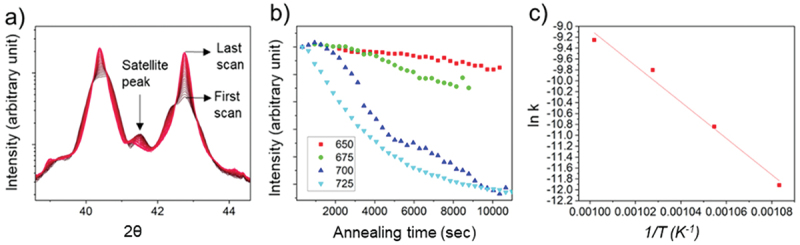
The microstructural evolution of Cu/Mo nanomultilayers upon annealing was investigated by X-ray diffraction and transmission electron microscopy. The isothermal annealing process in the temperature ranges of 300-850°C was conducted to understand the thermal behavior of the sample and follow the transformation into a nanocomposite. Annealing at 600°C led to the initiation of grain grooving in the investigated nanomultilayer, and it degraded into a spheroidized nanocomposite structure at 800°C. The sample kept the as-deposited Cu {111}//Mo{110} fiber texture up to 850°C. The residual stress was investigated to explain microstructure changes. The activation energy of degradation kinetics of Cu/Mo nanomultilayers was determined to understand the rate-determining mechanism for the degradation of nanolaminate structures.
通过X射线衍射和透射电子显微镜研究了Cu/Mo纳米多层膜退火后的微观结构演变。在300-850°C温度范围内进行等温退火过程,以了解样品的热行为并追踪其向纳米复合材料的转变。在600°C退火导致所研究的纳米多层膜中出现晶粒刻蚀,并在800°C时降解为球化的纳米复合结构。样品在高达850°C时仍保持沉积态的Cu{111}//Mo{110}纤维织构。研究了残余应力以解释微观结构的变化。确定了Cu/Mo纳米多层膜降解动力学的活化能,以了解纳米层状结构降解的速率决定机制。