Center for Inflammatory Bowel Disease, Tokyo Yamate Medical Center, Japan Community Healthcare Organization, Tokyo, Japan,
Department of Gastroenterology, Faculty of Medicine, Oita University, Oita, Japan.
Digestion. 2024;105(5):373-379. doi: 10.1159/000539682. Epub 2024 Jun 10.
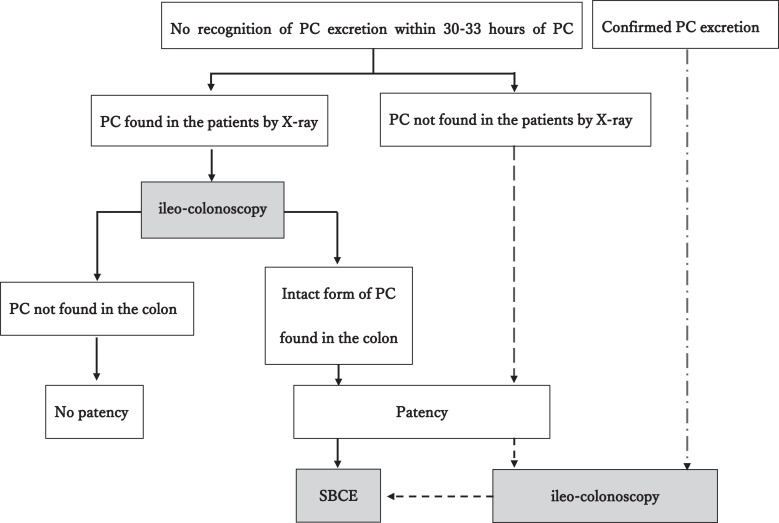
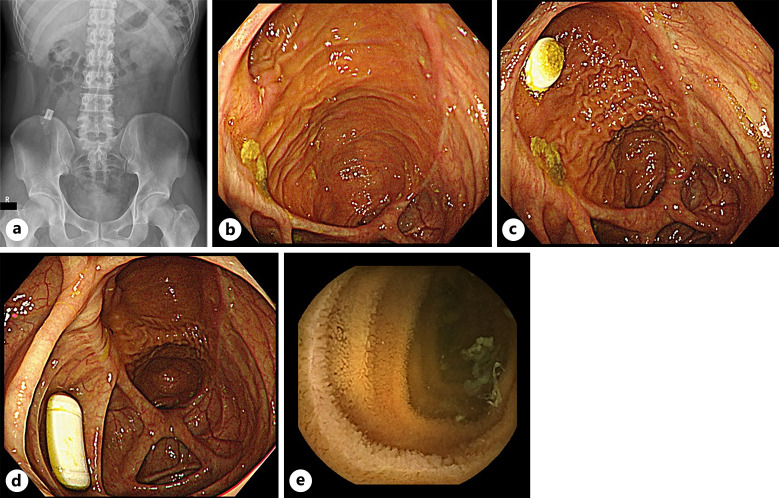
Patients with Crohn's disease (CD) require an assessment of small bowel lesions, while difficulties exist in performing small intestinal examinations, especially in small-sized medical offices. Small bowel capsule endoscopy (SBCE) is handy and can be performed in most clinical settings. The only drawback of SBCE is a requirement of patency testing prior to the exam because it sometimes requires CT scanning to localize the ingested patency capsule (PC), which may be a substantial burden for the patient. We have developed a novel PC detection system named PICS (patency capsule, ileocolonoscopy, and small bowel capsule endoscopy) method by which we can avoid CT scanning. In the PICS method, ileocolonoscopy (ICS) is performed after 30-33 h of PC ingestion and the PC can be localized by ICS in patients who have not excreted the PC, and the entire intestine can be examined in combination with subsequent SBCE without additional bowel preparation. The aim of this study was to assess the usefulness and safety of the PICS method for CD patients.
CD patients who underwent PICS method from April 2021 to March 2023 were reviewed for clinical data, outcome of PICS method including the rates of PC detection by ICS, the number of patients underwent SBCE, and adverse events. Lewis score was used to assess SBCE results.
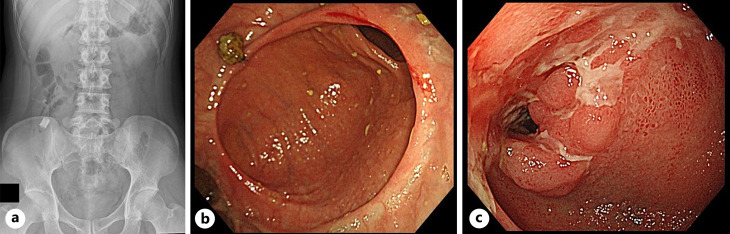
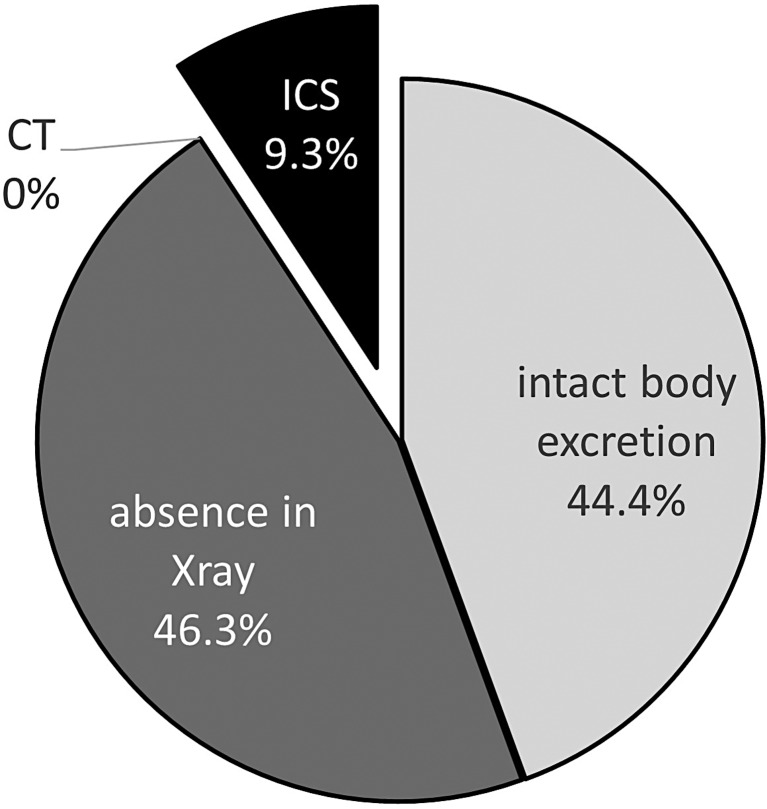
The PICS method was performed in 54 patients. The median age of patients was 28.5 years old, and 64.8% of them were ileocolic type. The median disease duration was 10.5 months and 24.1% had history of small bowel resection. Five cases (9.3%) confirmed gastrointestinal patency by ICS, and none of the cases required CT scanning. One patient who could not be confirmed patency by ICS, and the other patient who excreted PC but was found ileal stenosis by ICS did not undergo SBCE. Remaining 52 patients received SBCE, and the median Lewis score of them was 0 (IQR 0, 450). There were no adverse events including small bowel obstruction by PC and SBCE retention in this series.
The PICS method is not only feasible and safe but also convenient to assess disease extent in patients with CD. By localizing PC with ICS, additional CT scanning could be unnecessary for SBCE, which benefits both physicians and CD patients.
患有克罗恩病(CD)的患者需要评估小肠病变,但进行小肠检查存在困难,尤其是在规模较小的医疗机构中。小肠胶囊内镜(SBCE)操作简便,可在大多数临床环境中进行。SBCE 的唯一缺点是在检查前需要进行通畅性测试,因为有时需要 CT 扫描来定位摄入的通畅胶囊(PC),这可能给患者带来很大的负担。我们开发了一种新的 PC 检测系统,命名为 PICS(通畅胶囊、结肠镜检查和小肠胶囊内镜)方法,可以避免 CT 扫描。在 PICS 方法中,在 PC 摄入后 30-33 小时进行结肠镜检查,如果患者尚未排出 PC,可以通过 ICS 定位 PC,并且可以在不进行额外肠道准备的情况下结合后续的 SBCE 检查整个肠道。本研究的目的是评估 PICS 方法在 CD 患者中的实用性和安全性。
回顾性分析 2021 年 4 月至 2023 年 3 月期间接受 PICS 方法的 CD 患者的临床资料,包括 ICS 检测 PC 的检出率、接受 SBCE 的患者数量和不良事件。使用 Lewis 评分评估 SBCE 结果。
54 例患者进行了 PICS 方法。患者的中位年龄为 28.5 岁,64.8%为回结肠型。中位疾病持续时间为 10.5 个月,24.1%有小肠切除史。5 例(9.3%)通过 ICS 证实胃肠道通畅,无 1 例需要 CT 扫描。1 例 ICS 无法证实通畅的患者,另 1 例 PC 排出但 ICS 发现回肠狭窄的患者未行 SBCE。其余 52 例患者接受了 SBCE,中位 Lewis 评分为 0(IQR 0,450)。本系列研究中无 PC 导致的小肠梗阻和 SBCE 滞留等不良事件。
PICS 方法不仅可行且安全,而且方便评估 CD 患者的疾病程度。通过 ICS 定位 PC,SBCE 可无需额外进行 CT 扫描,这对医生和 CD 患者都有益。