The Affiliated Mental Health Center of Jiangnan University, Wuxi Central Rehabilitation Hospital, Wuxi, China.
Stanley Center for Psychiatric Research, Broad Institute of MIT and Harvard, Cambridge, United States.
BMC Psychiatry. 2024 Jun 10;24(1):433. doi: 10.1186/s12888-024-05882-1.
Objective and quantifiable markers are crucial for developing novel therapeutics for mental disorders by 1) stratifying clinically similar patients with different underlying neurobiological deficits and 2) objectively tracking disease trajectory and treatment response. Schizophrenia is often confounded with other psychiatric disorders, especially bipolar disorder, if based on cross-sectional symptoms. Awake and sleep EEG have shown promise in identifying neurophysiological differences as biomarkers for schizophrenia. However, most previous studies, while useful, were conducted in European and American populations, had small sample sizes, and utilized varying analytic methods, limiting comprehensive analyses or generalizability to diverse human populations. Furthermore, the extent to which wake and sleep neurophysiology metrics correlate with each other and with symptom severity or cognitive impairment remains unresolved. Moreover, how these neurophysiological markers compare across psychiatric conditions is not well characterized. The utility of biomarkers in clinical trials and practice would be significantly advanced by well-powered transdiagnostic studies. The Global Research Initiative on the Neurophysiology of Schizophrenia (GRINS) project aims to address these questions through a large, multi-center cohort study involving East Asian populations. To promote transparency and reproducibility, we describe the protocol for the GRINS project.
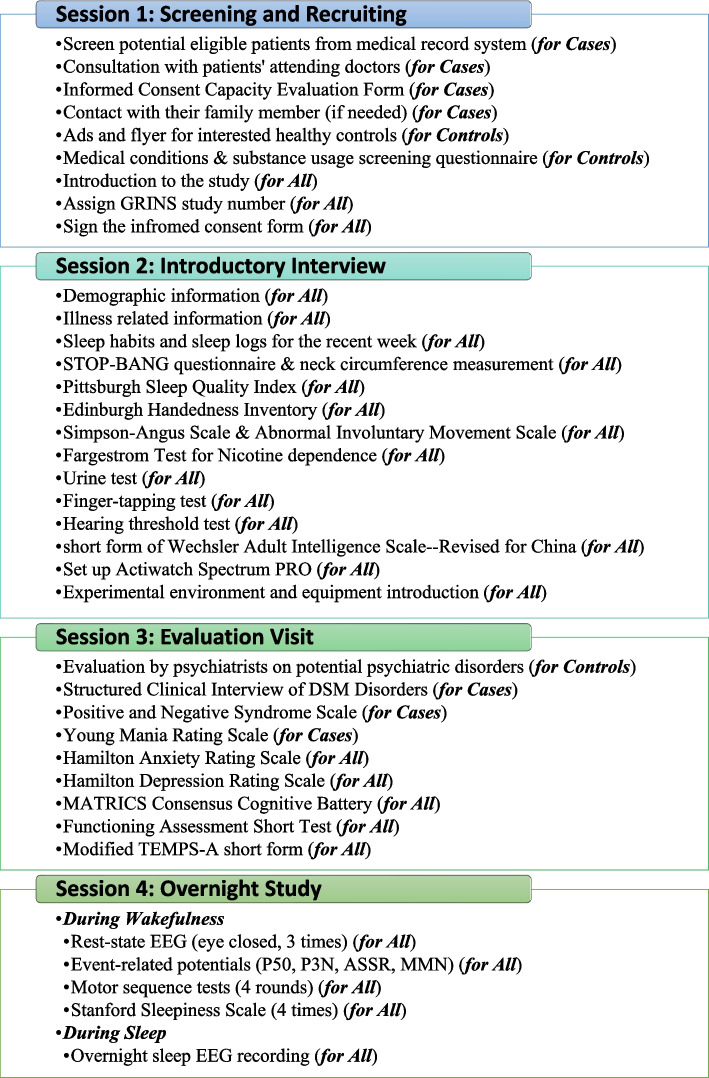
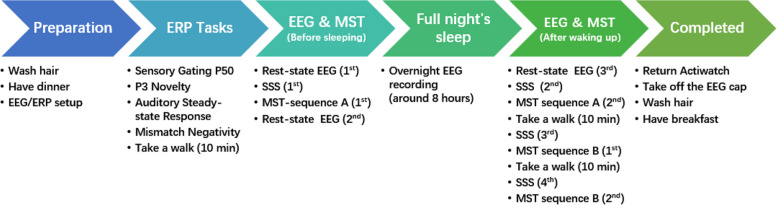
The research procedure consists of an initial screening interview followed by three subsequent sessions: an introductory interview, an evaluation visit, and an overnight neurophysiological recording session. Data from multiple domains, including demographic and clinical characteristics, behavioral performance (cognitive tasks, motor sequence tasks), and neurophysiological metrics (both awake and sleep electroencephalography), are collected by research groups specialized in each domain.
Pilot results from the GRINS project demonstrate the feasibility of this study protocol and highlight the importance of such research, as well as its potential to study a broader range of patients with psychiatric conditions. Through GRINS, we are generating a valuable dataset across multiple domains to identify neurophysiological markers of schizophrenia individually and in combination. By applying this protocol to related mental disorders often confounded with each other, we can gather information that offers insight into the neurophysiological characteristics and underlying mechanisms of these severe conditions, informing objective diagnosis, stratification for clinical research, and ultimately, the development of better-targeted treatment matching in the clinic.
通过以下两种方式,客观且可量化的标志物对于开发精神障碍的新型疗法至关重要:1)将具有不同潜在神经生物学缺陷的临床相似患者进行分层;2)客观跟踪疾病轨迹和治疗反应。如果基于横断面症状,精神分裂症常与其他精神障碍(尤其是双相情感障碍)相混淆。清醒和睡眠 EEG 已显示出作为精神分裂症生物标志物的潜力,可以识别神经生理差异。然而,尽管大多数先前的研究具有一定的实用性,但它们是在欧洲和美国人群中进行的,样本量较小,且使用了不同的分析方法,限制了对不同人群的全面分析或推广。此外,清醒和睡眠神经生理学指标彼此之间以及与症状严重程度或认知障碍之间的相关性仍未得到解决。此外,这些神经生理学标志物在不同精神障碍中的表现情况尚未得到很好的描述。通过采用基于大量患者的跨诊断研究,可显著推进生物标志物在临床试验和实践中的应用。全球精神分裂症神经生理学研究倡议(GRINS)项目旨在通过涉及东亚人群的大型多中心队列研究来解决这些问题。为了提高透明度和可重复性,我们描述了 GRINS 项目的研究方案。
研究程序包括初始筛选访谈,随后进行三次后续访谈:介绍性访谈、评估访问和夜间神经生理学记录访谈。来自多个领域的数据,包括人口统计学和临床特征、行为表现(认知任务、运动序列任务)和神经生理学指标(清醒和睡眠脑电图),由各领域专业研究小组收集。
GRINS 项目的初步结果表明,该研究方案具有可行性,并强调了此类研究的重要性及其在研究更广泛的精神障碍患者方面的潜力。通过 GRINS,我们正在跨多个领域生成有价值的数据集,以单独和组合的方式确定精神分裂症的神经生理学标志物。通过将该方案应用于与精神分裂症经常混淆的其他相关精神障碍,我们可以收集有关这些严重疾病的神经生理特征和潜在机制的信息,为客观诊断、临床研究分层以及最终在临床上实现更有针对性的治疗匹配提供信息。