Cao Conghui, Luo Jing, Wang Xiaoli
Department of Endocrinology and Metabolism, Institute of Endocrinology, NHC Key Laboratory of Diagnosis and Treatment of Thyroid Diseases, The First Hospital of China Medical University, Shenyang, China.
Department of Endocrinology and Metabolism, Tieling Central Hospital, Tieling, China.
Front Neurosci. 2024 May 27;18:1381840. doi: 10.3389/fnins.2024.1381840. eCollection 2024.
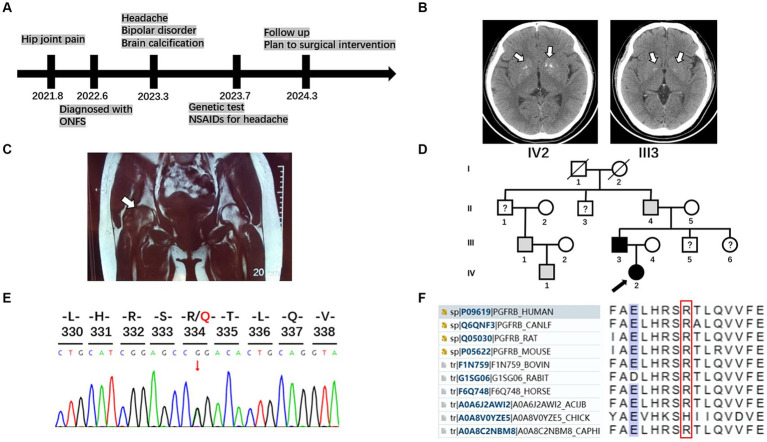
Primary familial brain calcification (PFBC) is a rare genetic neurodegenerative disorder characterized by bilateral calcifications in the brain. PFBC may manifest with a broad spectrum of motor, cognitive, and neuropsychiatric symptoms. Several causal genes have been identified in PFBC, which are inherited as both autosomal dominant and autosomal recessive traits. Herein, we present the case of a Chinese family diagnosed with PFBC. The family members carry a rare heterozygous variant (p. R334Q) in exon 7 of () gene. The platelet-derived growth factor-B/PDGF receptor (PDGF-B/PDGFRβ) signaling pathway plays a crucial role in pericyte development in various organs and tissues. Notably, this variant uniquely coexists with nontraumatic osteonecrosis of the femoral head. Additionally, we reviewed previous studies on PFBC-causing variants in .
原发性家族性脑钙化(PFBC)是一种罕见的遗传性神经退行性疾病,其特征是脑部出现双侧钙化。PFBC可能表现出广泛的运动、认知和神经精神症状。在PFBC中已鉴定出几个致病基因,它们以常染色体显性和常染色体隐性性状遗传。在此,我们报告一例被诊断为PFBC的中国家庭病例。该家庭成员在()基因的第7外显子中携带一种罕见的杂合变异(p.R334Q)。血小板衍生生长因子-B/血小板衍生生长因子受体(PDGF-B/PDGFRβ)信号通路在各种器官和组织的周细胞发育中起关键作用。值得注意的是,这种变异与非创伤性股骨头坏死独特地共存。此外,我们回顾了先前关于()中导致PFBC的变异的研究。