Emergency Department, The First Affiliated Hospital of Jinan University, Guangzhou, China.
Department of Clinical Research, The First Affiliated Hospital of Jinan University, Guangzhou, China.
BMC Infect Dis. 2024 Jun 11;24(1):577. doi: 10.1186/s12879-024-09476-w.
Sepsis is a common and severe disease with a high mortality rate in intensive care unit (ICU). The hemoglobin (HGB) level is a key parameter for oxygen supply in sepsis. Although HGB is associated with the progression of inflammation in sepsis patients, its role as a marker following sepsis treatment remains unclear. Here, we studied the correlation between early temporal changes in HGB levels and long-term mortality rates in septic patients.
In this retrospective study of data on patients with sepsis from the Medical Information Mart for Intensive Care (MIMIC) IV database, the outcome was long-term mortality. Patients were divided based on the cut-off of the HGB percentage for receiver operating characteristic (ROC) curve calculation. Kaplan-Meier (KM) survival curves and Cox proportional hazards regression models were used to analyse the associations between groups and outcomes. Propensity score matching (PSM) was used to verify the results.
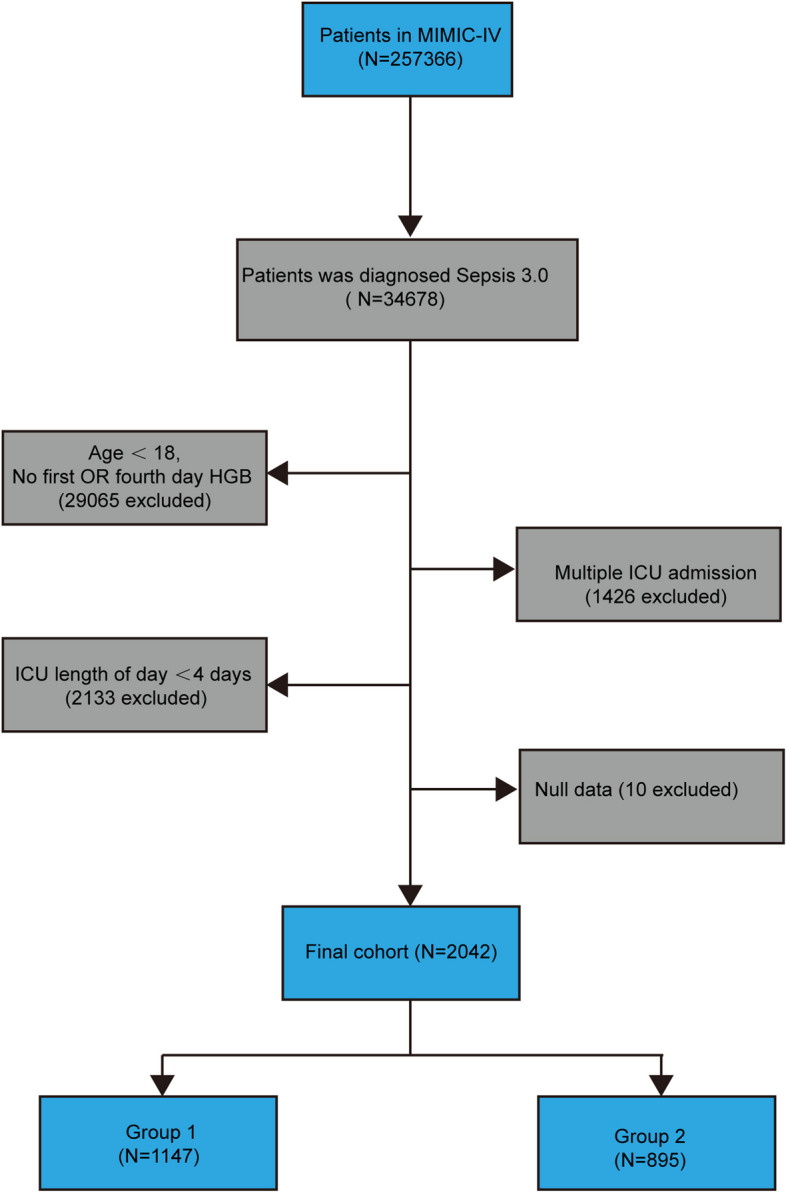
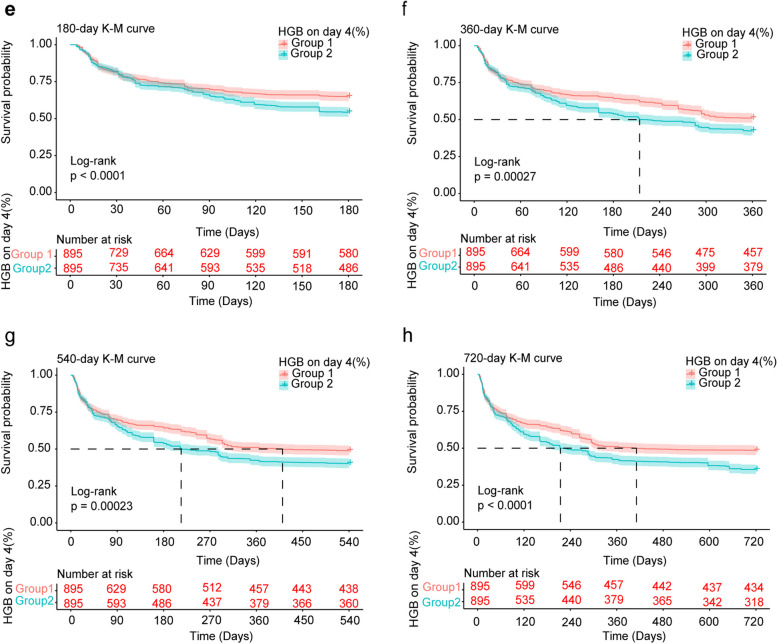
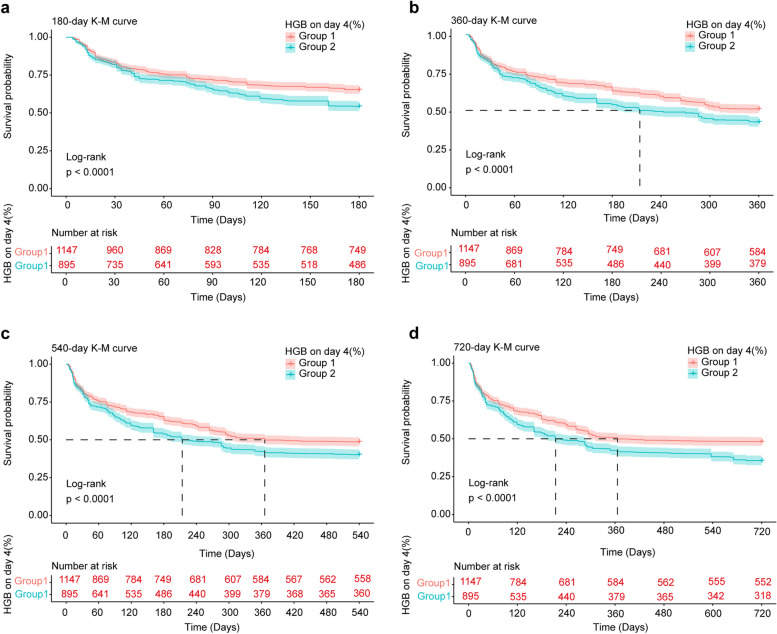
In this study, 2042 patients with sepsis and changes in HGB levels at day 4 after admission compared to day 1 were enrolled and divided into two groups: group 1 (n = 1147) for those with reduction of HGB < 7% and group 2 (n = 895) for those with dropping ≥ 7%. The long-term survival chances of sepsis with less than a 7% reduction in the proportion of HGB at day four were significantly higher than those of patients in the group with a reduction of 7% or more. After adjusting for covariates in the Cox model, the hazard ratios (HRs) with 95% confidence intervals (CIs) for long-term all-cause mortality in the group with a reduction of 7% or more were as follows: 180 days [HR = 1.41, 95% CI (1.22 to 1.63), P < 0.001]; 360 days [HR = 1.37, 95% CI (1.21 to 1.56), P < 0.001]; 540 days [HR = 1.35, 95% CI (1.20 to 1.53), P < 0.001]; 720 days [HR = 1.45, 95% CI (1.29 to 1.64), P < 0.001]. Additionally, the long-term survival rates, using Kaplan-Meier analysis, for the group with a reduction of 7% or more were lower compared to the group with less than 7% reduction at 180 days (54.3% vs. 65.3%, P < 0.001), 360 days (42.3% vs. 50.9%, P < 0.001), 540 days (40.2% vs. 48.6%, P < 0.001), and 720 days (35.5% vs. 46.1%, P < 0.001). The same trend was obtained after using PSM.
A ≥ 7% decrease in HGB levels on Day 4 after admission was associated with worse long-term prognosis in sepsis patients admitted to the ICU.
脓毒症是重症监护病房(ICU)中一种常见且严重的高死亡率疾病。血红蛋白(HGB)水平是脓毒症患者供氧的关键参数。虽然 HGB 与脓毒症患者炎症的进展有关,但它作为脓毒症治疗后标志物的作用仍不清楚。在这里,我们研究了脓毒症患者 HGB 水平的早期时间变化与长期死亡率之间的相关性。
在这项对 MIMIC-IV 数据库中脓毒症患者数据的回顾性研究中,结局是长期死亡率。根据受试者工作特征(ROC)曲线计算的 HGB 百分比截断值将患者分为两组。Kaplan-Meier(KM)生存曲线和 Cox 比例风险回归模型用于分析组间和结局之间的关系。采用倾向评分匹配(PSM)验证结果。
本研究共纳入了 2042 例脓毒症患者,这些患者在入院第 4 天和第 1 天的 HGB 水平发生了变化,并分为两组:组 1(n=1147),HGB 降低<7%;组 2(n=895),HGB 降低≥7%。第 4 天 HGB 比例下降<7%的脓毒症患者的长期生存机会明显高于下降≥7%的患者。在 Cox 模型中调整了协变量后,下降≥7%的组中,长期全因死亡率的危险比(HR)及其 95%置信区间(CI)如下:180 天[HR=1.41,95%CI(1.22 至 1.63),P<0.001];360 天[HR=1.37,95%CI(1.21 至 1.56),P<0.001];540 天[HR=1.35,95%CI(1.20 至 1.53),P<0.001];720 天[HR=1.45,95%CI(1.29 至 1.64),P<0.001]。此外,Kaplan-Meier 分析显示,下降≥7%的组的长期生存率在 180 天(54.3% vs. 65.3%,P<0.001)、360 天(42.3% vs. 50.9%,P<0.001)、540 天(40.2% vs. 48.6%,P<0.001)和 720 天(35.5% vs. 46.1%,P<0.001)时均低于下降<7%的组。使用 PSM 后也得到了相同的趋势。
入院第 4 天 HGB 水平下降≥7%与 ICU 收治的脓毒症患者的长期预后不良相关。