Department of Neurosurgery, The First Medical Center, Chinese PLA General Hospital, 28 Fuxing Road, Beijing, 100853, China.
Department of Neurosurgery, Jingzhou Central Hospital, Hubei, China.
BMC Med. 2024 Jun 13;22(1):244. doi: 10.1186/s12916-024-03468-y.
Intracerebral hemorrhage (ICH) is a common stroke type with high morbidity and mortality. There are mainly three surgical methods for treating ICH. Unfortunately, thus far, no specific surgical method has been proven to be the most effective. We carried out this study to investigate whether minimally invasive surgeries with endoscopic surgery or stereotactic aspiration (frameless navigated aspiration) will improve functional outcomes in patients with supratentorial ICH compared with small-bone flap craniotomy.
In this parallel-group multicenter randomized controlled trial conducted at 16 centers, patients with supratentorial hypertensive ICH were randomized to receive endoscopic surgery, stereotactic aspiration, or craniotomy at a 1:1:1 ratio from July 2016 to June 2022. The follow-up duration was 6 months. Patients were randomized to receive endoscopic evacuation, stereotactic aspiration, or small-bone flap craniotomy. The primary outcome was favorable functional outcome, defined as the proportion of patients who achieved a modified Rankin scale (mRS) score of 0-2 at the 6-month follow-up.
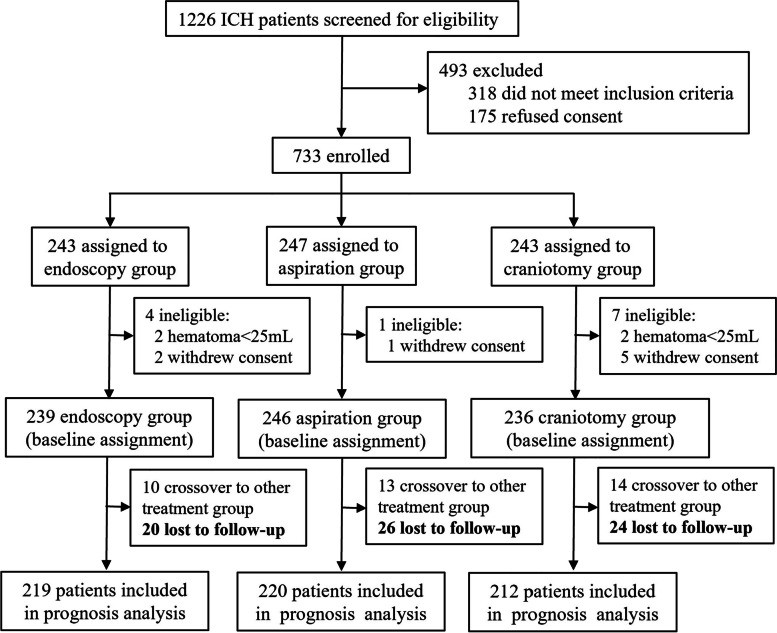
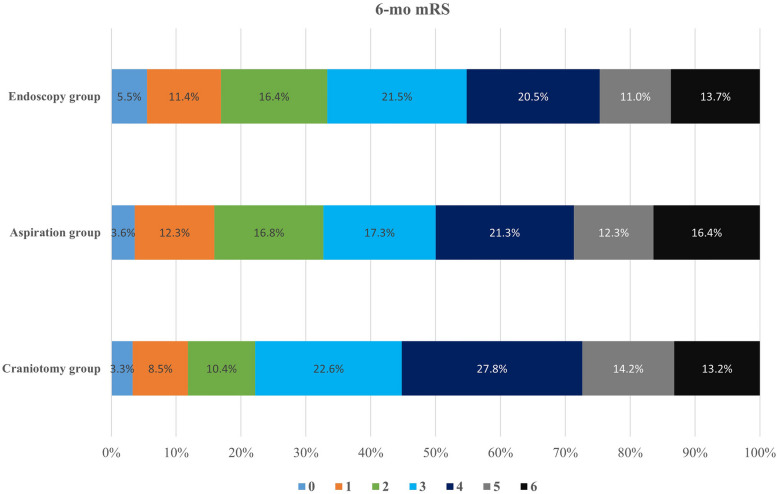
A total of 733 patients were randomly allocated to three groups: 243 to the endoscopy group, 247 to the aspiration group, and 243 to the craniotomy group. Finally, 721 patients (239 in the endoscopy group, 246 in the aspiration group, and 236 in the craniotomy group) received treatment and were included in the intention-to-treat analysis. Primary efficacy analysis revealed that 73 of 219 (33.3%) in the endoscopy group, 72 of 220 (32.7%) in the aspiration group, and 47 of 212 (22.2%) in the craniotomy group achieved favorable functional outcome at the 6-month follow-up (P = .017). We got similar results in subgroup analysis of deep hemorrhages, while in lobar hemorrhages the prognostic outcome was similar among three groups. Old age, deep hematoma location, large hematoma volume, low preoperative GCS score, craniotomy, and intracranial infection were associated with greater odds of unfavorable outcomes. The mean hospitalization expenses were ¥92,420 in the endoscopy group, ¥77,351 in the aspiration group, and ¥100,947 in the craniotomy group (P = .000).
Compared with small bone flap craniotomy, endoscopic surgery and stereotactic aspiration improved the long-term outcome of hypertensive ICH, especially deep hemorrhages.
ClinicalTrials.gov Identifier: NCT02811614.
脑出血(ICH)是一种常见的脑卒中类型,具有高发病率和死亡率。目前主要有三种手术方法可用于治疗 ICH。遗憾的是,迄今为止,尚无特定的手术方法被证明是最有效的。我们开展这项研究旨在探讨与小骨瓣开颅术相比,内镜手术或立体定向抽吸(无框架导航抽吸)的微创手术是否会改善幕上 ICH 患者的功能预后。
本项平行分组多中心随机对照试验在 16 家中心进行,纳入了 2016 年 7 月至 2022 年 6 月间患有幕上高血压性 ICH 的患者,按 1:1:1 的比例随机分配至内镜手术组、立体定向抽吸组或小骨瓣开颅术组。随访时间为 6 个月。患者随机分配至内镜清除术、立体定向抽吸或小骨瓣开颅术。主要结局为有利的功能预后,定义为在 6 个月随访时达到改良 Rankin 量表(mRS)评分 0-2 的患者比例。
共纳入 733 例患者,按 3 组随机分配:内镜组 243 例,抽吸组 247 例,开颅组 243 例。最终,721 例患者(内镜组 239 例,抽吸组 246 例,开颅组 236 例)接受了治疗并纳入意向治疗分析。主要疗效分析显示,内镜组 219 例患者中 73 例(33.3%)、抽吸组 220 例患者中 72 例(32.7%)和开颅组 212 例患者中 47 例(22.2%)在 6 个月随访时达到了有利的功能预后(P=0.017)。我们在深部出血的亚组分析中得到了相似的结果,而在脑叶出血中,三组的预后结果相似。高龄、深部血肿位置、较大的血肿体积、术前 GCS 评分较低、开颅术和颅内感染与不良结局的可能性更大相关。内镜组的平均住院费用为 92420 元,抽吸组为 77351 元,开颅组为 100947 元(P=0.000)。
与小骨瓣开颅术相比,内镜手术和立体定向抽吸术改善了高血压性 ICH 的长期预后,特别是深部出血患者的预后。
ClinicalTrials.gov 标识符:NCT02811614。