Rodríguez-Santiago Yair, Garay-Canales Claudia Angelica, Nava-Castro Karen Elizabeth, Morales-Montor Jorge
Departamento de Inmunología, Instituto de Investigaciones Biomédicas, Universidad Nacional Autónoma de México, Coyoacán, Mexico City, 04510, México.
Posgrado en Ciencias Biológicas, Universidad Nacional Autónoma de México, Edificio D, 1er piso, Circuito de Posgrados, Ciudad Universitaria, Ciudad de México, 04510, México.
Biol Sex Differ. 2024 Jun 12;15(1):48. doi: 10.1186/s13293-024-00623-1.
Sexual dimorphism significantly influences cancer incidence and prognosis. Notably, females exhibit a lower risk and favorable prognosis for non-reproductive cancers compared to males, a pattern observable beyond the scope of risk behaviors such as alcohol consumption and smoking. Colorectal cancer, ranking third in global prevalence and second in mortality, disproportionately affects men. Sex steroid hormones, particularly estrogens and androgens, play crucial roles in cancer progression, considering epidemiological in vivo and in vitro, in general estrogens imparting a protective effect in females and androgens correlating with an increasing risk of colorectal cancer development.
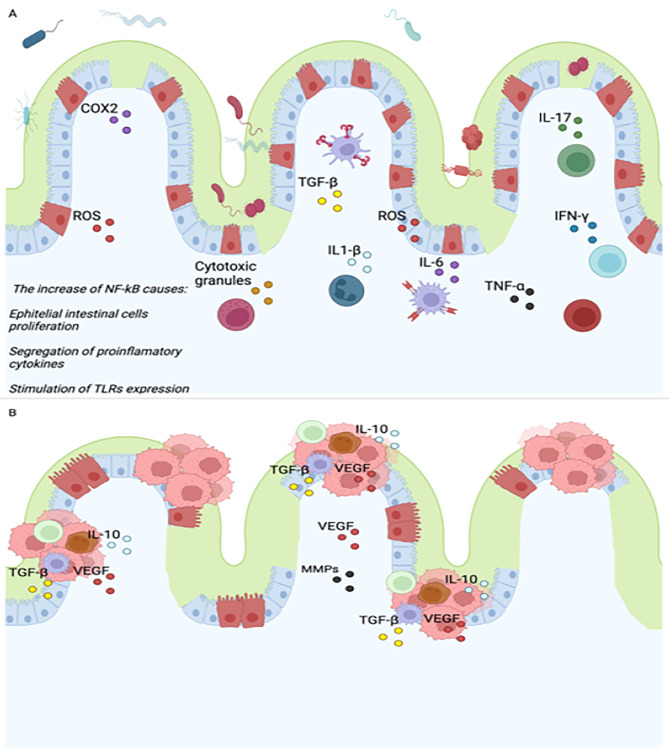
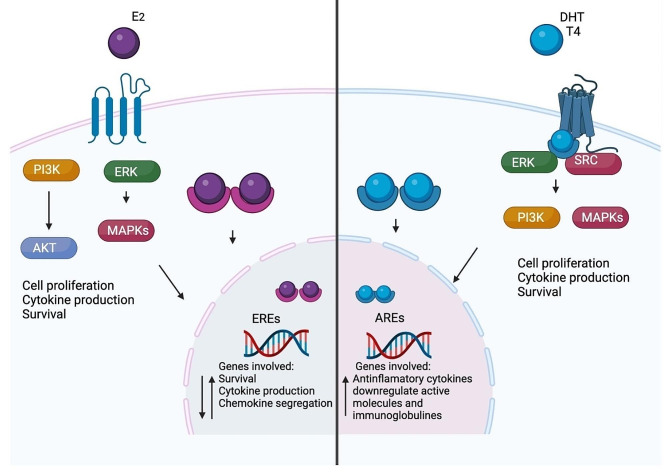
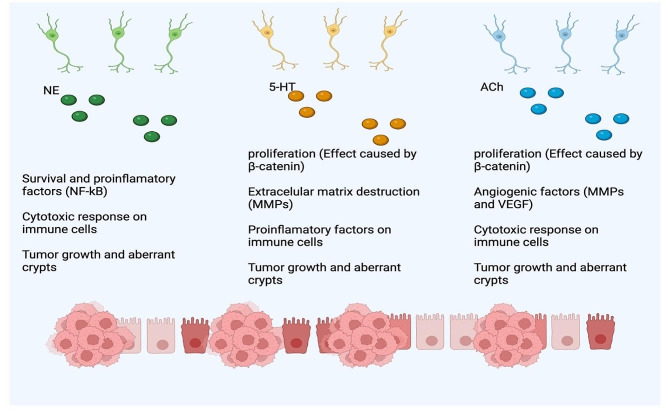
The hormonal impact on immune response is mediated by receptor interactions, resulting in heightened inflammation, modulation of NF-kB, and fostering an environment conducive to cancer progression and metastasis. These molecules also influence the enteric nervous system, that is a pivotal in neuromodulator release and intestinal neuron stimulation, also contributes to cancer development, as evidenced by nerve infiltration into tumors. Microbiota diversity further intersects with immune, hormonal, and neural mechanisms, influencing colorectal cancer dynamics. A comprehensive understanding of hormonal influences on colorectal cancer progression, coupled with the complex interplay between immune responses, microbiota diversity and neurotransmitter imbalances, underpins the development of more targeted and effective therapies.
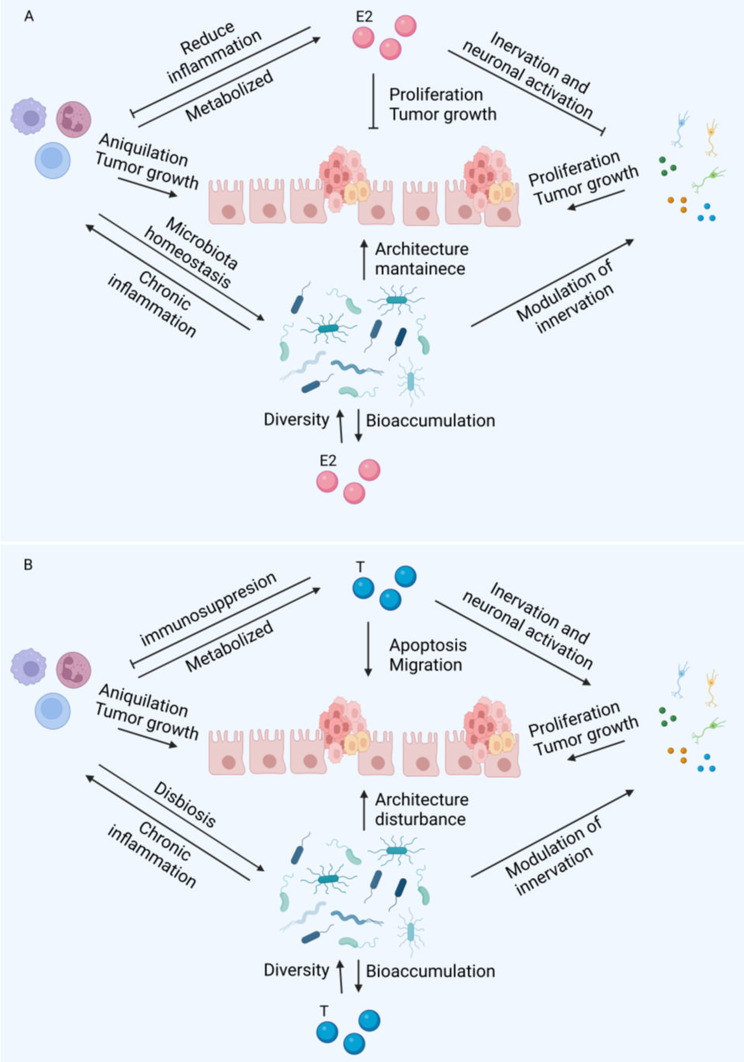
Estrogens mitigate colorectal cancer risk by modulating anti-tumor immune responses, enhancing microbial diversity, and curbing the pro-tumor actions of the sympathetic and enteric nervous systems. Conversely, androgens escalate tumor growth by dampening anti-tumor immune activity, reducing microbial diversity, and facilitating the release of tumor-promoting factors by the nervous system. These findings hold significant potential for the strategic purposing of drugs to fine-tune the extensive impacts of sex hormones within the tumor microenvironment, promising advancements in colorectal cancer therapies.
性别二态性显著影响癌症的发病率和预后。值得注意的是,与男性相比,女性在非生殖系统癌症方面表现出较低的风险和较好的预后,这种模式在诸如饮酒和吸烟等风险行为范围之外也可观察到。结直肠癌在全球患病率中排名第三,在死亡率中排名第二,对男性的影响尤为严重。考虑到体内和体外的流行病学研究,性类固醇激素,特别是雌激素和雄激素,在癌症进展中起着关键作用,一般来说,雌激素对女性具有保护作用,而雄激素与结直肠癌发生风险增加相关。
激素对免疫反应的影响是通过受体相互作用介导的,导致炎症加剧、核因子-κB的调节以及促进有利于癌症进展和转移的环境。这些分子还影响肠神经系统,肠神经系统在神经调节剂释放和肠神经元刺激中起关键作用,也有助于癌症发展,神经浸润到肿瘤中就证明了这一点。微生物群多样性进一步与免疫、激素和神经机制相互作用,影响结直肠癌的动态变化。全面了解激素对结直肠癌进展的影响,以及免疫反应、微生物群多样性和神经递质失衡之间的复杂相互作用,是开发更有针对性和更有效治疗方法的基础。
雌激素通过调节抗肿瘤免疫反应、增强微生物多样性以及抑制交感神经系统和肠神经系统的促肿瘤作用来降低结直肠癌风险。相反,雄激素通过抑制抗肿瘤免疫活性、降低微生物多样性以及促进神经系统释放促肿瘤因子来加速肿瘤生长。这些发现对于战略性地设计药物以微调性激素在肿瘤微环境中的广泛影响具有巨大潜力,有望推动结直肠癌治疗的进展。