Xia Yu, Li Xiang, Wu Ziqi, Nie Cailong, Cheng Zhanwen, Sun Yuhong, Liu Lei, Zhang Tong
School of Environmental Science and Engineering, College of Engineering Southern University of Science and Technology Shenzhen China.
State Environmental Protection Key Laboratory of Integrated Surface Water-Groundwater Pollution Control, School of Environmental Science and Engineering Southern University of Science and Technology Shenzhen China.
Imeta. 2023 Jan 9;2(1):e72. doi: 10.1002/imt2.72. eCollection 2023 Feb.
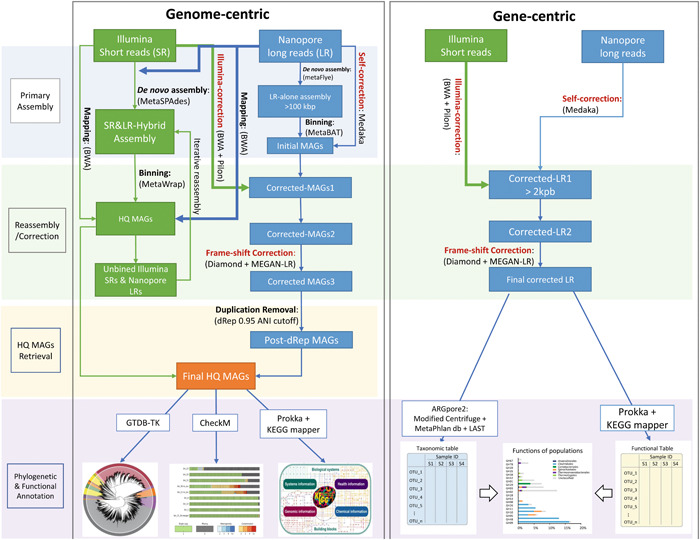
Metagenomic strategy serves as the foundation for the ecological exploration of novel bioresources (e.g., industrial enzymes and bioactive molecules) and biohazards (e.g., pathogens and antibiotic resistance genes) in natural and engineered microbial systems across multiple disciplines. Recent advancements in sequencing technology have fostered rapid development in the field of microbiome research where an increasing number of studies have applied both illumina short reads (SRs) and nanopore long reads (LRs) sequencing in their metagenomic workflow. However, given the high complexity of an environmental microbiome data set and the bioinformatic challenges caused by the unique features of these sequencing technologies, integrating SRs and LRs is not as straightforward as one might assume. The fast renewal of existing tools and growing diversity of new algorithms make access to this field even more difficult. Therefore, here we systematically summarized the complete workflow from DNA extraction to data processing strategies for applying illumina and nanopore-integrated metagenomics in the investigation in environmental microbiomes. Overall, this review aims to provide a timely knowledge framework for researchers that are interested in or are struggling with the SRs and LRs integration in their metagenomic analysis. The discussions presented will facilitate improved ecological understanding of community functionalities and assembly of natural, engineered, and human microbiomes, benefiting researchers from multiple disciplines.
宏基因组学策略是跨多学科对自然和工程微生物系统中的新型生物资源(如工业酶和生物活性分子)和生物危害(如病原体和抗生素抗性基因)进行生态探索的基础。测序技术的最新进展推动了微生物组研究领域的快速发展,越来越多的研究在其宏基因组工作流程中应用了Illumina短读长(SR)和纳米孔长读长(LR)测序。然而,鉴于环境微生物组数据集的高度复杂性以及这些测序技术独特特征所带来的生物信息学挑战,整合SR和LR并非像人们想象的那么简单。现有工具的快速更新和新算法的日益多样化使得进入该领域变得更加困难。因此,在这里我们系统地总结了从DNA提取到数据处理策略的完整工作流程,以便在环境微生物组研究中应用Illumina和纳米孔整合宏基因组学。总体而言,本综述旨在为那些对宏基因组分析中SR和LR整合感兴趣或正在为此苦苦挣扎的研究人员提供一个及时的知识框架。所进行的讨论将有助于增进对群落功能以及自然、工程和人类微生物组组装的生态学理解,使来自多个学科的研究人员受益。