Wang Xu-Wen, Wu Lu, Dai Lei, Yin Xiaole, Zhang Tong, Weiss Scott T, Liu Yang-Yu
Channing Division of Network Medicine, Department of Medicine Brigham and Women's Hospital and Harvard Medical School Boston Massachusetts USA.
CAS Key Laboratory of Quantitative Engineering Biology Shenzhen Institute of Synthetic Biology, Shenzhen Institute of Advanced Technology, Chinese Academy of Sciences Shenzhen China.
Imeta. 2023 Jan 5;2(1):e75. doi: 10.1002/imt2.75. eCollection 2023 Feb.
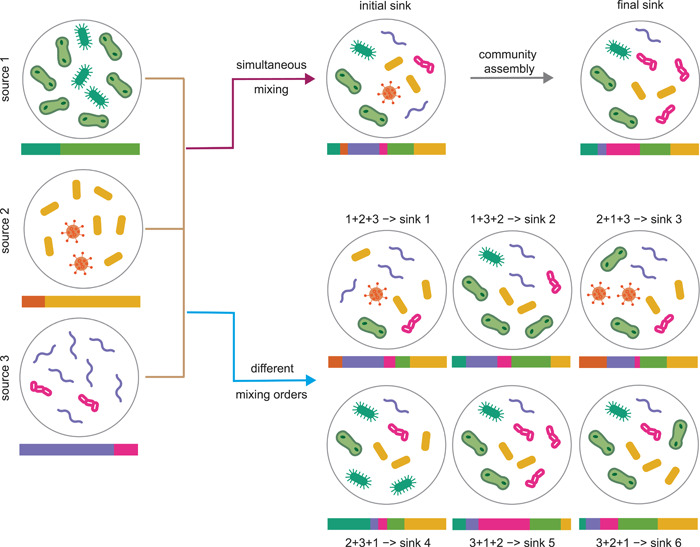
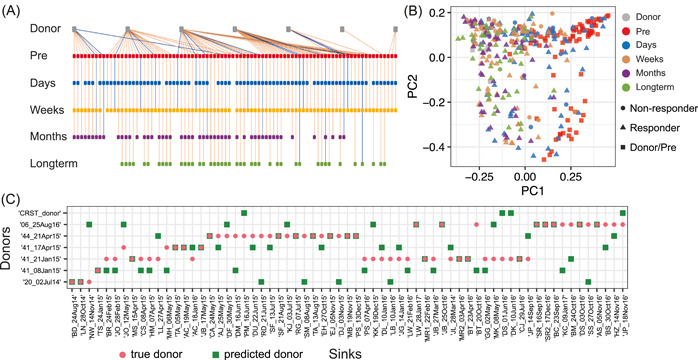
Quantifying the contributions of possible environmental sources ("sources") to a specific microbial community ("sink") is a classical problem in microbiology known as microbial source tracking (MST). Solving the MST problem will not only help us understand how microbial communities were formed, but also have far-reaching applications in pollution control, public health, and forensics. MST methods generally fall into two categories: target-based methods (focusing on the detection of source-specific indicator species or chemicals); and community-based methods (using community structure to measure similarity between sink samples and potential source environments). As next-generation sequencing becomes a standard community-assessment method in microbiology, numerous community-based computational methods, referred to as MST solvers hereafter have been developed and applied to various real datasets to demonstrate their utility across different contexts. Yet, those MST solvers do not consider microbial interactions and priority effects in microbial communities. Here, we revisit the performance of several representative MST solvers. We show compelling evidence that solving the MST problem using existing MST solvers is impractical when ecological dynamics plays a role in community assembly. In particular, we clearly demonstrate that the presence of either microbial interactions or priority effects will render the MST problem mathematically unsolvable for MST solvers. We further analyze data from fecal microbiota transplantation studies, finding that the state-of-the-art MST solvers fail to identify donors for most of the recipients. Finally, we perform community coalescence experiments to demonstrate that the state-of-the-art MST solvers fail to identify the sources for most of the sinks. Our findings suggest that ecological dynamics imposes fundamental challenges in MST. Interpretation of results of existing MST solvers should be done cautiously.
量化可能的环境来源(“源”)对特定微生物群落(“汇”)的贡献是微生物学中的一个经典问题,即微生物源追踪(MST)。解决MST问题不仅有助于我们理解微生物群落是如何形成的,还在污染控制、公共卫生和法医学等方面有深远的应用。MST方法一般分为两类:基于目标的方法(专注于检测源特异性指示物种或化学物质);以及基于群落的方法(利用群落结构来衡量汇样本与潜在源环境之间的相似性)。随着下一代测序成为微生物学中标准的群落评估方法,许多基于群落的计算方法(以下称为MST求解器)已经被开发出来,并应用于各种实际数据集,以证明它们在不同背景下的实用性。然而,那些MST求解器没有考虑微生物群落中的微生物相互作用和优先效应。在这里,我们重新审视了几种有代表性的MST求解器的性能。我们给出了令人信服的证据,表明当生态动力学在群落组装中起作用时,使用现有的MST求解器解决MST问题是不切实际的。特别是,我们清楚地证明,微生物相互作用或优先效应的存在将使MST问题对于MST求解器在数学上无法解决。我们进一步分析了粪便微生物群移植研究的数据,发现最先进的MST求解器未能为大多数受体识别出供体。最后,我们进行了群落合并实验,以证明最先进的MST求解器未能为大多数汇识别出源。我们的研究结果表明,生态动力学在MST中带来了根本性挑战。对现有MST求解器的结果解释应谨慎进行。