Li Yuan-Yuan, Madduri Supradeep S, Rezeli Erika T, Santos Charlene, Freeman Iii Herman, Peng Jing, McRitchie Susan L, Pathmasiri Wimal, Hursting Stephen D, Sumner Susan J, Stewart Delisha A
Metabolomics and Exposome Laboratory, Nutrition Research Institute, Department of Nutrition, University of North Carolina at Chapel Hill, Kannapolis, NC, United States.
Department of Nutrition, University of North Carolina at Chapel Hill, Chapel Hill, NC, United States.
Front Nutr. 2024 May 29;11:1356038. doi: 10.3389/fnut.2024.1356038. eCollection 2024.
Obesity is a multi-factorial disease frequently associated with poor nutritional habits and linked to many detrimental health outcomes. Individuals with obesity are more likely to have increased levels of persistent inflammatory and metabolic dysregulation. The goal of this study was to compare four dietary patterns differentiated by macronutrient content in a postmenopausal model. Dietary patterns were high carbohydrate (HC), high fat (HF), high carbohydrate plus high fat (HCHF), and high protein (HP) with higher fiber.
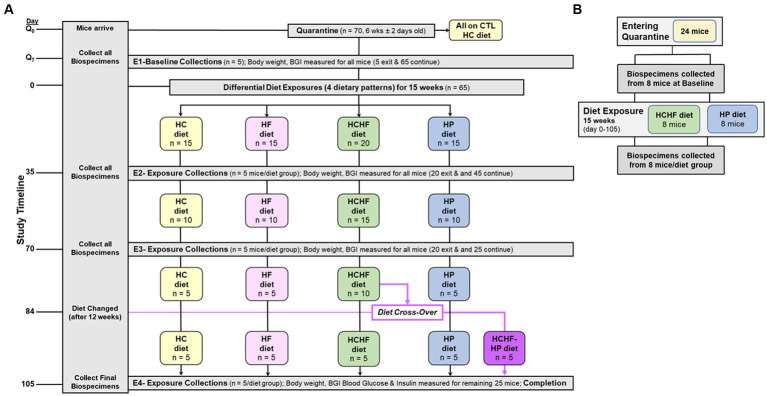
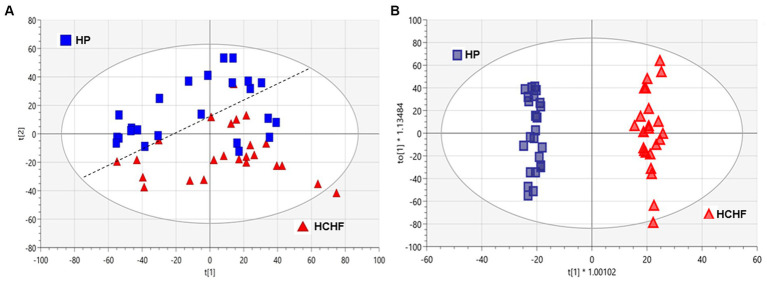
Changes in body weight and glucose levels were measured in female, ovariectomized C57BL/6 mice after 15 weeks of feeding. One group of five mice fed the HCHF diet was crossed over to the HP diet on day 84, modeling a 21-day intervention. In a follow-up study comparing the HCHF versus HP dietary patterns, systemic changes in inflammation, using an 80-cytokine array and metabolism, by untargeted liquid chromatography-mass spectrometry (LCMS)-based metabolomics were evaluated.
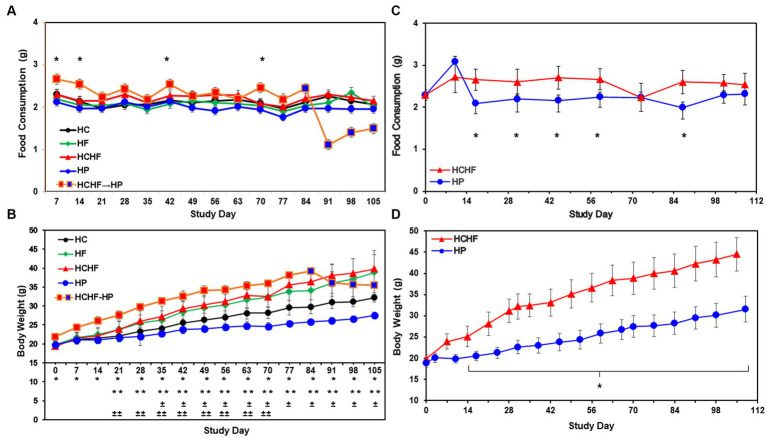
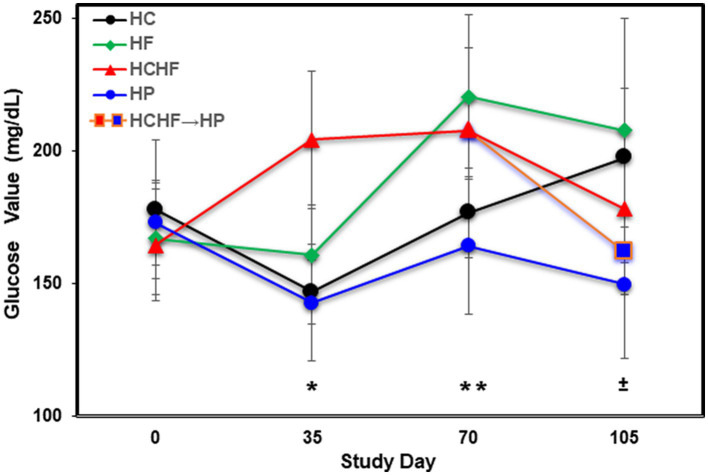
Only the HF and HCHF diets resulted in obesity, shown by significant differences in body weights compared to the HP diet. Body weight gains during the two-diet follow-up study were consistent with the four-diet study. On Day 105 of the 4-diet study, glucose levels were significantly lower for mice fed the HP diet than for those fed the HC and HF diets. Mice switched from the HCHF to the HP diet lost an average of 3.7 grams by the end of the 21-day intervention, but this corresponded with decreased food consumption. The HCHF pattern resulted in dramatic inflammatory dysregulation, as all 80 cytokines were elevated significantly in the livers of these mice after 15 weeks of HCHF diet exposure. Comparatively, only 32 markers changed significantly on the HP diet (24 up, 8 down). Metabolic perturbations in several endogenous biological pathways were also observed based on macronutrient differences and revealed dysfunction in several nutritionally relevant biosynthetic pathways.
Overall, the HCHF diet promoted detrimental impacts and changes linked to several diseases, including arthritis or breast neoplasms. Identification of dietary pattern-specific impacts in this model provides a means to monitor the effects of disease risk and test interventions to prevent poor health outcomes through nutritional modification.
肥胖是一种多因素疾病,常与不良饮食习惯相关,并与许多有害的健康结果有关。肥胖个体更有可能出现持续性炎症水平升高和代谢失调。本研究的目的是在绝经后模型中比较四种以宏量营养素含量区分的饮食模式。饮食模式分别为高碳水化合物(HC)、高脂肪(HF)、高碳水化合物加高脂肪(HCHF)和高纤维高蛋白(HP)。
在喂食15周后,测量雌性去卵巢C57BL/6小鼠的体重和血糖水平变化。一组五只喂食HCHF饮食的小鼠在第84天转喂HP饮食,模拟为期21天的干预。在一项比较HCHF与HP饮食模式的后续研究中,使用80种细胞因子阵列评估炎症的全身变化,并通过基于非靶向液相色谱 - 质谱(LCMS)的代谢组学评估代谢情况。
只有HF和HCHF饮食导致肥胖,与HP饮食相比,体重存在显著差异。两饮食后续研究中的体重增加情况与四饮食研究一致。在四饮食研究的第105天,喂食HP饮食的小鼠血糖水平显著低于喂食HC和HF饮食的小鼠。从HCHF饮食转换为HP饮食的小鼠在21天干预结束时平均体重减轻了3.7克,但这与食物摄入量减少相对应。HCHF模式导致明显的炎症失调,在HCHF饮食暴露15周后,这些小鼠肝脏中的所有80种细胞因子均显著升高。相比之下,HP饮食只有32个标志物发生显著变化(24个上调,8个下调)。基于宏量营养素差异,还观察到几种内源性生物途径的代谢紊乱,并揭示了几种与营养相关的生物合成途径功能障碍。
总体而言,HCHF饮食促进了与多种疾病(包括关节炎或乳腺肿瘤)相关的有害影响和变化。在该模型中确定特定饮食模式的影响为监测疾病风险的影响以及通过营养调整测试预防不良健康结果的干预措施提供了一种方法。