Shintani Shuhei, Inatomi Osamu, Okamoto Takuya, Hiroe Kosuke, Eguchi Takaaki, Tomozawa Yuki, Inoue Akitoshi, Kimura Hidenori, Nishida Atsushi, Tsuji Yoshihisa, Watanabe Yoshiyuki, Andoh Akira
Department of Medicine Division of Gastroenterology Shiga University of Medical Science Shiga Japan.
Department of General Medicine Shiga University of Medical Science Shiga Japan.
DEN Open. 2024 Jun 11;5(1):e387. doi: 10.1002/deo2.387. eCollection 2025 Apr.
Endoscopic ultrasound shear wave elastography (EUS-SWE) can facilitate an objective evaluation of pancreatic fibrosis. Although it is primarily applied in evaluating chronic pancreatitis, its efficacy in assessing early chronic pancreatitis (ECP) remains underinvestigated. This study evaluated the diagnostic accuracy of EUS-SWE for assessing ECP diagnosed using the Japanese diagnostic criteria 2019.
In total, 657 patients underwent EUS-SWE. Propensity score matching was used, and the participants were classified into the ECP and normal groups. ECP was diagnosed using the Japanese diagnostic criteria 2019. Pancreatic stiffness was assessed based on velocity (Vs) on EUS-SWE, and the optimal Vs cutoff value for ECP diagnosis was determined. A practical shear wave Vs value of ≥50% was considered significant.
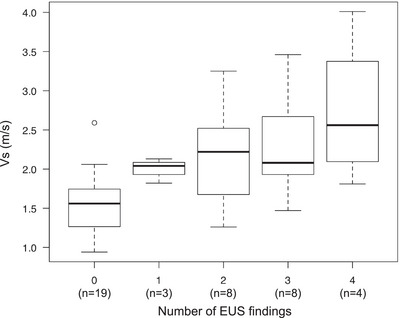
Each group included 22 patients. The ECP group had higher pancreatic stiffness than the normal group (2.31 ± 0.67 m/s vs. 1.59 ± 0.40 m/s, < 0.001). The Vs cutoff value for the diagnostic accuracy of ECP, as determined using the receiver operating characteristic curve, was 2.24m/s, with an area under the curve of 0.82 (95% confidence interval: 0.69-0.94). A high Vs was strongly correlated with the number of EUS findings (rs = 0.626, < 0.001). Multiple regression analysis revealed that a history of acute pancreatitis and ≥2 EUS findings were independent predictors of a high Vs.
There is a strong correlation between EUS-SWE findings and the Japanese diagnostic criteria 2019 for ECP. Hence, EUS-SWE can be an objective and invaluable diagnostic tool for ECP diagnosis.
内镜超声剪切波弹性成像(EUS-SWE)有助于对胰腺纤维化进行客观评估。尽管它主要用于评估慢性胰腺炎,但其在评估早期慢性胰腺炎(ECP)方面的疗效仍研究不足。本研究评估了EUS-SWE对使用2019年日本诊断标准诊断的ECP的诊断准确性。
共有657例患者接受了EUS-SWE检查。采用倾向评分匹配法,将参与者分为ECP组和正常组。ECP采用2019年日本诊断标准进行诊断。基于EUS-SWE上的速度(Vs)评估胰腺硬度,并确定ECP诊断的最佳Vs临界值。实际剪切波Vs值≥50%被认为具有显著性。
每组包括22例患者。ECP组的胰腺硬度高于正常组(2.31±0.67 m/s对1.59±0.40 m/s,<0.001)。使用受试者工作特征曲线确定的ECP诊断准确性的Vs临界值为2.24m/s,曲线下面积为0.82(95%置信区间:0.69-0.94)。高Vs与EUS检查结果数量密切相关(rs = 0.626,<0.001)。多元回归分析显示,急性胰腺炎病史和≥2项EUS检查结果是高Vs的独立预测因素。
EUS-SWE检查结果与2019年日本ECP诊断标准之间存在密切相关性。因此,EUS-SWE可以成为ECP诊断的一种客观且有价值的诊断工具。