Kao Szu-Yu Zoe, Nycz Elise, Benoit Tina J, Clarke Kristie E N, Jones Jefferson M
CDC COVID-19 Response, Centers for Disease Control and Prevention, Atlanta, Georgia, USA.
Microbiol Spectr. 2024 Aug 6;12(8):e0012324. doi: 10.1128/spectrum.00123-24. Epub 2024 Jun 13.
We estimated monthly cross-sectional seroprevalence rates of anti-nucleocapsid (anti-N) and anti-spike (anti-S) antibodies to severe acute respiratory syndrome coronavirus 2 in two U.S. nationwide studies. The nationwide blood donor seroprevalence (NBDS) study included specimens from blood donors, while the nationwide commercial laboratory seroprevalence (NCLS) study included residual serum specimens tested in commercial laboratories for reasons unrelated to the assessment of coronavirus disease 2019 infection. In September-December 2021, specimens collected from both nationwide studies were tested for anti-N antibodies. In September-October 2021, specimens from both studies within a five-state area were tested for anti-S antibodies. We used raking methods to adjust all seroprevalence estimates by the population distribution of key demographics in included states. Seroprevalence estimates of each antibody type were compared across the two studies for specimens drawn in the same U.S. states during the same time period. Our analysis revealed that over a 4-month period, national NCLS monthly anti-N estimates were 0.5-1.9 percentage points higher than NBDS estimates. In contrast, across five states during a 2-month period, NBDS anti-S estimates were 7.6 and 8.2 percentage points higher than NCLS estimates. The observed differences in seroprevalence estimates between the NBDS and NCLS studies may be attributed to variations in the characteristics of the study sample populations, particularly with respect to health status, health behaviors, and vaccination status. These differences should be considered in the interpretation of seroprevalence study results based on blood donors or commercial lab residual specimens.
This study was the first systematic comparison between two nationwide severe acute respiratory syndrome coronavirus 2 (SARS-CoV-2) studies which estimated seroprevalence, or the proportion of the population with antibodies to the virus, using differing convenience sample populations. One study tested blood donor specimens; the other study tested specimens left over from clinical blood tests. The seroprevalence of anti-nucleocapsid and anti-spike antibodies was compared in the same states during the same months with statistical adjustments based on state demographics. Similar anti-nucleocapsid antibody seroprevalence estimates produced by two independent studies using differing convenience samples build confidence in the generalizability of their anti-nucleocapsid findings. Due to high blood donor vaccine rates, blood donor SARS-CoV-2 anti-spike antibody estimates might overestimate general population seroprevalence, an important consideration for interpreting national seroprevalence study results. Furthermore, because laboratory residuals and blood donations are two common sources of specimens for seroprevalence studies, study findings may be informative for other respiratory virus seroepidemiology studies.
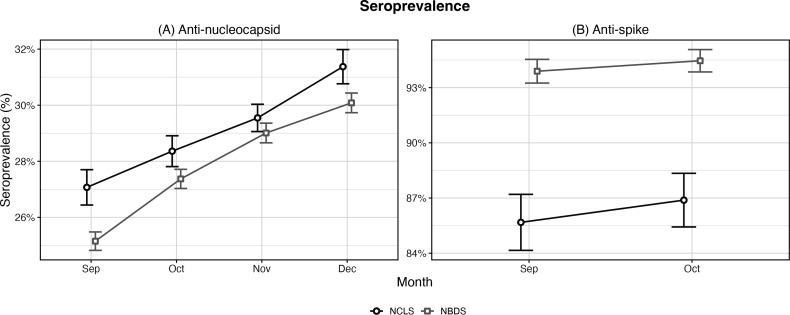
在两项美国全国性研究中,我们估计了针对严重急性呼吸综合征冠状病毒2的抗核衣壳(抗N)和抗刺突(抗S)抗体的月度横断面血清阳性率。全国献血者血清阳性率(NBDS)研究纳入了献血者的样本,而全国商业实验室血清阳性率(NCLS)研究纳入了因与评估2019冠状病毒病感染无关的原因在商业实验室检测的剩余血清样本。在2021年9月至12月期间,对两项全国性研究收集的样本检测抗N抗体。在2021年9月至10月期间,对五个州地区两项研究的样本检测抗S抗体。我们使用加权方法,根据纳入州关键人口统计学特征的人群分布,对所有血清阳性率估计值进行调整。对同一时间段内在美国同一州采集的样本,比较两项研究中每种抗体类型的血清阳性率估计值。我们的分析显示,在4个月的时间里,全国NCLS月度抗N估计值比NBDS估计值高0.5 - 1.9个百分点。相比之下,在2个月的时间里,五个州的NBDS抗S估计值比NCLS估计值高7.6和8.2个百分点。NBDS和NCLS研究中观察到的血清阳性率估计值差异,可能归因于研究样本人群特征的差异,特别是在健康状况、健康行为和疫苗接种状况方面。在解释基于献血者或商业实验室剩余样本的血清阳性率研究结果时,应考虑这些差异。
本研究首次对两项全国性严重急性呼吸综合征冠状病毒2(SARS-CoV-2)研究进行了系统比较,这两项研究使用不同的便利样本群体估计血清阳性率,即人群中病毒抗体的比例。一项研究检测献血者样本;另一项研究检测临床血液检测剩余的样本。在同一月份的相同州,比较抗核衣壳和抗刺突抗体的血清阳性率,并根据州人口统计学进行统计调整。两项独立研究使用不同的便利样本得出的类似抗核衣壳抗体血清阳性率估计值,增强了其抗核衣壳研究结果可推广性的可信度。由于献血者疫苗接种率高,献血者SARS-CoV-2抗刺突抗体估计值可能高估了一般人群的血清阳性率,这是解释全国血清阳性率研究结果时的一个重要考虑因素。此外,由于实验室剩余样本和献血是血清阳性率研究的两个常见样本来源,研究结果可能对其他呼吸道病毒血清流行病学研究具有参考价值。
